INDEX
Ballagan
Blane Valley Burns Club
Blane Valley Railway
Blanefield Printworks
Blanefield Smithy
Britons: Strathblane and the Britons, AD 400 to 1100
Children’s Home Hospital (1903-1994)
Dumbrock Mills and Bleachfields
Duntreath and the Edmonstones
Edenkill/Edenkiln
Edmonstone Hall
Farming
Free Church
Jenny Brash
Mugdock
Netherton/Blanefield
Romans and Picts Around Strathblane
School (1716 – 1966)
Shops
Slavery
Slavery and the Abolitionists
St Kessog’s Roman Catholic Church
Village Activities
Water
Whisky
World War One
World War Two – Strathblane Seven
World War Two – The Home Front
Ballagan
Strathblane Valley has a long history and Ballagan has been part of it since early times. When a cairn on the estate was opened, a cist containing ashes and a piece of a Late Bronze Age sword were found. The exact site of the cairn is not known, but the sword fragment was donated to…
Blane Valley Burns Club
Picture the scene: a snowy January evening at the Edmonstone Hall in Blanefield. An expectant audience of 130 at the village’s annual Burns Supper awaits the traditional piping-in of The Haggis. The chef and piper make their way through the snow from the kitchen at the rear, around the outside of the building to the…
Blane Valley Railway
RAILWAY MANIA By 8.30 on the morning of Monday 1 July 1867 an excited crowd had gathered in Blanefield near the bottom of the Cuilt Brae to greet the community’s first passenger train. Britain was in the grip of railway mania. The 1861 Blane Valley Railway Act provided for land purchases, engineering work, construction and…
Blanefield Printworks
Block printing is the printing of patterns on fabrics using a carved block, usually made from wood. It originated in India around the 5th century BC but did not arrive in Scotland until the late 17th century. It later developed into a technique using rollers or cylinders, opening the possibility of printing several colours simultaneously.…
Blanefield Smithy
Blanefield smithy is thought to be around 300 years old, though its exact age is unknown. It is certainly one of the very oldest surviving buildings in the parish of Strathblane. It appears on John Grassom’s map of the area published in 1817. It also features on local historian John Guthrie Smith’s attempt to show…
Britons: Strathblane and the Britons, AD 400 to 1100
by Dr Tim Clarkson [adapted from a talk presented to Strathblane Heritage on 16 September 2024] This essay takes a look at what was happening in the area around Strathblane in the early medieval period, a span of some 700 years from the beginning of the fifth century to the end of the eleventh. The…
Children’s Home Hospital (1903-1994)
“Often a child made a dramatic recovery on the back of good food, fresh air & loving care” – Margaret McIntyre, who worked at Strathblane Children’s Home Hospital for two periods between 1958 and its closure in 1994. The rapid industrialisation of Glasgow during the 19th century and chronic overcrowding in slum housing left children…
Dumbrock Mills and Bleachfields
The abundance of water meant that bleaching and water-driven industries were commonplace in the parish in the 18th century and lasted well into the 19th century. By 1870 most of them had closed down but their legacy endures in the landscape and village memory. At Dumbrock, in the area commonly known as the Glen, near…
Duntreath and the Edmonstones
Originally thought to have been of Flemish stock, the Edmonstone family are said to have come to Scotland in the train of Princess Margaret who became the Queen of Malcolm Canmore III (1031-1093) and first settled in Midlothian. The line of ‘Edmonstone of Duntreath’ descends from a cadet (younger) son of the Edmonstones of Culloden…
Edenkill/Edenkiln
Edenkill (now Edenkiln) occupied the heart of the community we now call Strathblane and was one of the three villages that comprised the parish, along with Netherton (Blanefield) and Mugdock. Edenkill dates back to the 13th century and the name means “a place sloping towards the church”. There was a market every Friday and two…
Edmonstone Hall
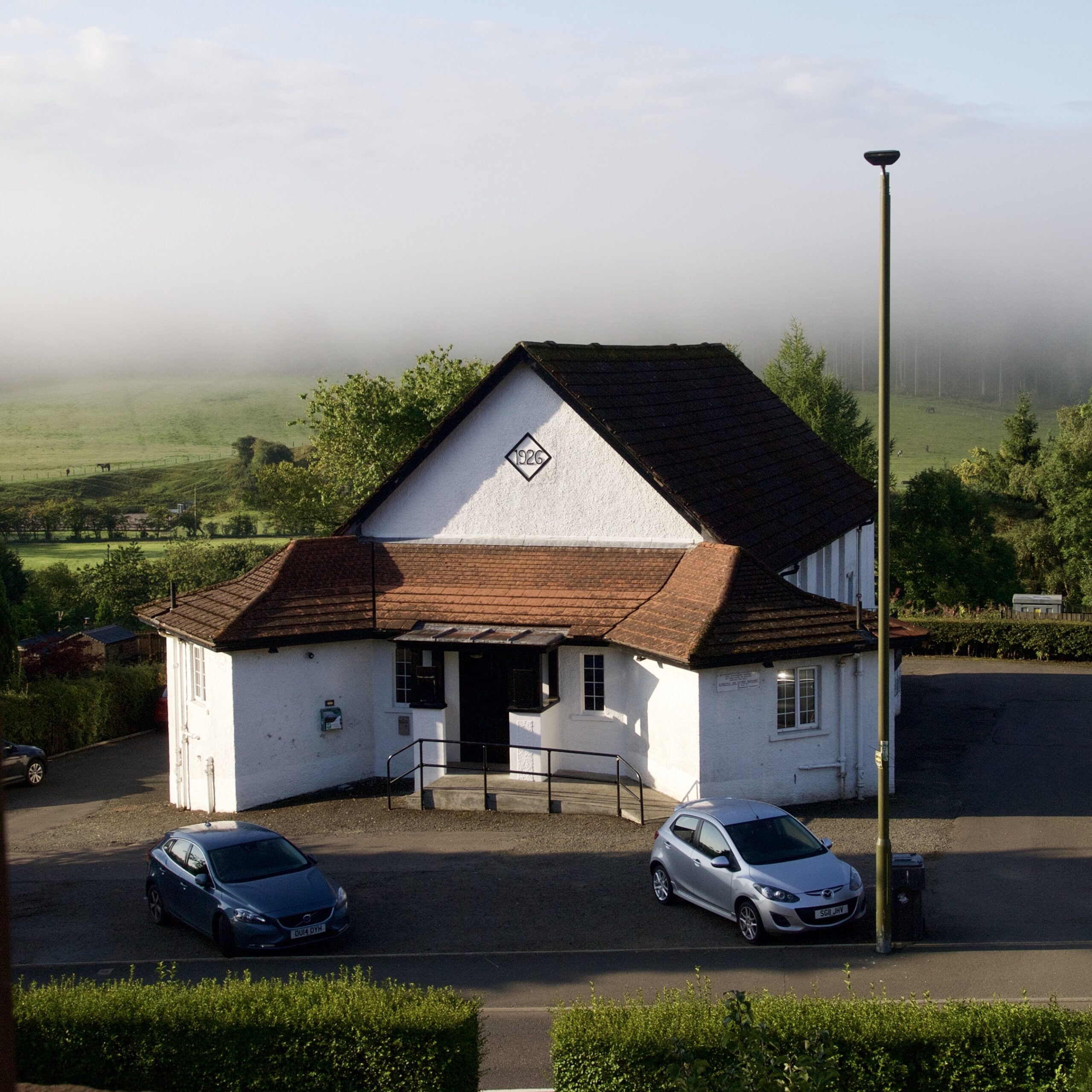
THE DONOR Our Edmonstone Hall is 100 years old! Nobody alive here today was present when it opened on 29 October 1926. Yet it is not hard to reconstruct the circumstances that produced it. It was a very different world. The Hall was the brainchild of Gwendolyn Mary Field, the granddaughter of the famous Chicago…
Farming
Until the mid-20th century farming was very much an integral part of the life of the parish of Strathblane. The school log contains frequent references to children skipping school to help with the harvest. The Blanefield printworks acknowledged that they had difficulty in recruiting children to work in the factory, probably because there was alternative…
Free Church
John Guthrie Smith records that the neat little church and manse belonging to the Free Church stands on the site of the old village of Netherton and the first ordained minister was the Rev George Rennie. Early records indicate that by 1864 there was a sufficient number of members and adherents to merit discussion of…
Jenny Brash
WHO WAS JENNY BRASH? Jenny’s Glen, Jenny’s Burn, Jenny’s Lum: Blanefield locals are well familiar with these names. But who was Jenny? It took a bit of digging but an evening’s research produced a surprising amount of information about her. In his history The Parish of Strathblane, published in 1886, John Guthrie Smith refers to…
Mugdock
Mugdock Village Mugdock was at one time the most important place in the Parish of Strathblane. It was “The Towne and Burgh of Mugdock” and the “head Burgh of the Regalitie of Montrose” with a “weekly mercat ilk fryday and two free faires yearlie”, granted by a 1661 Act of Parliament, following the restoration of…
Netherton/Blanefield
“Nothing is now left of Old Netherton save the smithy and the school-house, and its very name seems likely to perish, for the factory originally called Blane Printfield has expanded to such ample proportions, and covered its environs with so many workers’ houses that the whole of Netherton and neighbourhood with its post-office and railway…
Romans and Picts Around Strathblane
By Dr Murray Cook As every patriotic Scot knows, the Romans tried and failed to conquer Scotland…the only nation in Europe to resist the might of the Eagles. Unfortunately, this is not really true. The Romans didn’t really try. They just gave up: the cost of controlling our wee bit hill and glen was just…
School (1716 – 1966)
Though the first Strathblane parish schoolmaster was appointed in 1716, it was many years before the school was housed in a permanent schoolhouse. This was finally built in 1781 at Thorn of Cuilt, at Netherton, which is the area now known as Blanefield. This first building was so inadequate that it was demolished and rebuilt…
Shops
Local Shops Over the years a surprising number of people have run shops in the community. Some have lasted longer than others, but all have been memorable in their own way. The fortunes of retailers have waxed and waned with the general fortunes of the community. There were three key factors at play here, most…
Slavery
Introduction How is Strathblane linked to Black slavery? More than we might think. First some context. Two key dates: 1807, the abolition of the transatlantic trade in enslaved people and 1833, the abolition of slavery itself throughout the British Empire. In the past 25 years or so, academics such as Dr Stephen Mullen of Glasgow…
Slavery and the Abolitionists
Introduction How do we remember our past? A common response to the stories of Strathblane’s links to the institution of Black slavery is that our ancestors saw the world differently, a world in which racial stereotypes were deeply embedded, and it is not for us to judge them. The perspectives presented on this website on…
St Kessog’s Roman Catholic Church
The opening of St Kessog’s Roman Catholic Church in Blanefield on 28 May 1893 was the culmination of much enterprise in the parish. The number of Roman Catholics had increased through many coming to work in the printworks as well as the construction of the water tunnels. The navvies working on the construction of the…
Water
The Glasgow Water Supply The Blane Valley is the final stage of what justifiably can be called one of the greatest civil engineering achievements of the 19th Century. In an effort to eradicate cholera from the City of Glasgow, the Lord Provost, Robert Stewart, appointed a Committee of Enquiry to find an adequate and reliable…
Whisky
A Distillation of Whisky-Making in the Blane Valley As long as there have been humans, there has been alcohol. Production of wine and beer has been dated back 7,000-odd years in Central Asia, according to archaeologists. But the origins of whisky distilling, at least as we know it today, are more recent. Some historians have…
World War One
Boer War Of 1899-1902 One of the famous battles of this war was the Relief of Mafeking, which was marked by a bonfire in a field near Napier Lodge. The school children were also given a half-day’s holiday to commemorate the Peace of Pretoria and an exceptional holiday on the 2nd June 1902 to celebrate…
World War Two – Strathblane Seven
Stories of the Fallen Six men from the parish of Strathblane who died in the Second World War are recorded on Strathblane War Memorial. James Callander is incorrectly spelled Callender on the memorial. Richard R N Pedder is incorrectly recorded as Richard N R Pedder. A seventh man, Daniel Davidson, who died in 1946 aged…
World War Two – The Home Front
Introduction During the Second World War Strathblane, in common with many other villages, was organised into areas to respond in case of enemy attack. Villagers were encouraged to attend the various Auxiliary Fire Service demonstrations and to “man the pumps”! With many of the men away fighting, women were quite often involved in these activities…