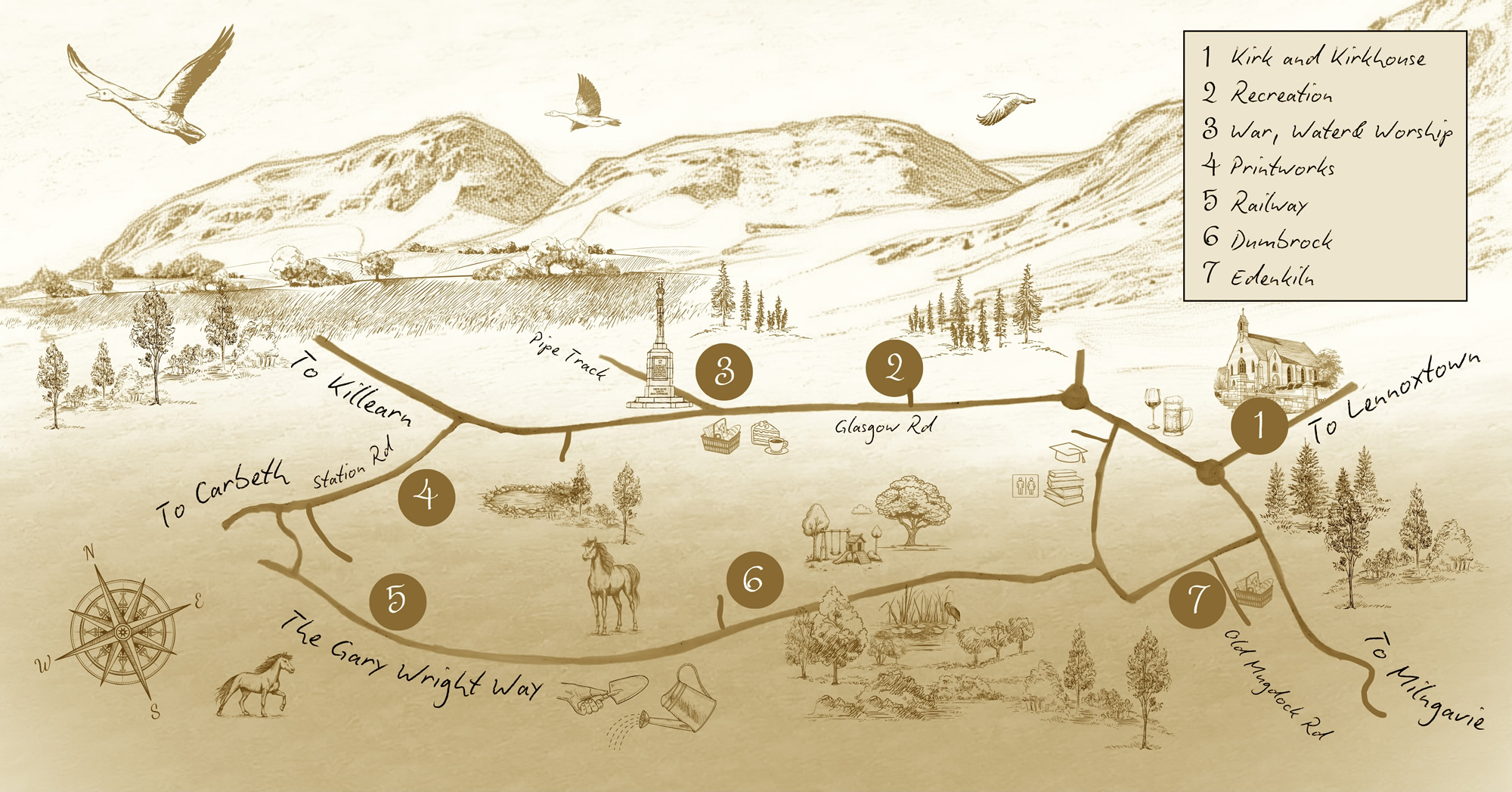
DISPLAY BOARD ⑦ EDENKILN
(This is a copy of the information on the Heritage Trail display board.)

Edenkiln (formerly Edenkill) occupied the heart of Strathblane. The name, meaning “a place sloping towards the church”, dates from the 13th century. There was a market every Friday and two fairs a year. In 1886 local antiquarian John Guthrie Smith, complained that compared with 1800 Edenkiln was “hardly so picturesque, many of its thatched cottages having given way to commonplace two-storeyed slated tenements.”
LIVING CONDITIONS
The 1881 Census of Edenkiln found families living with up to a dozen people in a couple of rooms. Even large households often included a lodger. Many of the inhabitants were employed at the Blanefield Printworks. Inevitably, this degree of overcrowding created problems with water and sanitation. The original water supply came from the Blane Burn into which undiluted sewage was also discharged, resulting in complaints about smell and concern about disease. Few homes boasted water closets.
Paradoxically, pipes carrying millions of gallons of pure water from Loch Katrine to the citizens of Glasgow passed in huge tunnels under the village while those living in Edenkiln were still using pillar wells on the street, supplied by the (far from pure) Blane Burn.
After the closure of the printworks in 1898, holidaymakers from Glasgow were quick to take advantage of the resulting profusion of empty rented accommodation. A room and kitchen could be had for 2/6d a week.
OLD EDENKILN

This house, known as Old Edenkiln, was built around 1769, probably as the factor’s house on the Leddriegreen Estate. It was the home and surgery of Dr William Rankin, who served as village doctor from 1876 until 1909. His successor, Dr George MacMillan, then lived in the house and served the community until 1950. He kept a skeleton named “Mr Horrocks” suspended in his consulting room! The extension on the left was the surgery.
DUMBROCK ROAD
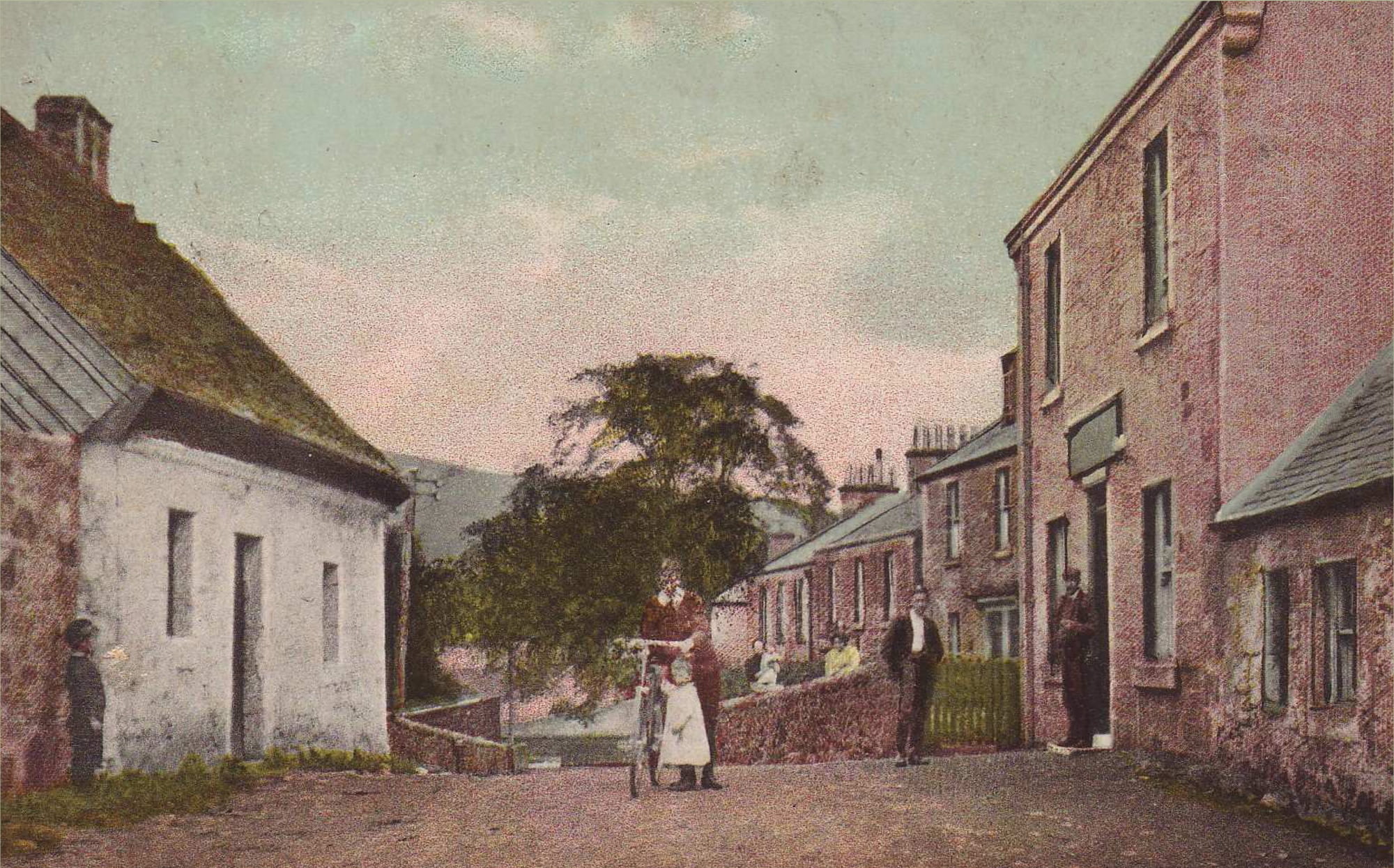
The whitewashed building on the left (below), known simply as “The Cottage”, was the last to have a thatched roof. Between 1890 and 1911, it was leased by John Guthrie Smith who fitted it out as a village club with carpet bowling, billiards and even a shooting gallery! The building opposite is the former Post Office.
OLD MUGDOCK ROAD
This early 20th century postcard (below) is the view down Old Mugdock Road looking towards Dumbrock Road. The first two buildings on the right were demolished before the First World War but the third, recognisable by its dormer windows, is now part of the local supermarket. Note the small dog trotting towards the camera. Shoppers chat outside the village store. Some things don’t change.

PREFABS
In 1948 Stirling County Council attempted to tackle the post-WW2 housing shortage in Edenkiln by erecting 24 prefabricated homes. The Prefabs, as they were affectionately known, were fondly remembered by those who lived in them. Emily Brown, who was born in one of them, recalls: “It was a very happy community. All the children played together. I remember the boys playing ‘Knock Door Run’. But the homes weren’t well insulated and so they were boiling hot in summer and freezing cold in winter.”
The Prefabs were cleared to make way for social housing in what are now Dumbrock Crescent and Dumbrock Road. A gang of men arrived one Sunday to dismantle and remove one of the by-then empty structures. When the official demolition squad arrived, they found they were a prefab short. What became of it is not known!

HERITAGE TRAIL MAP