Introduction
How do we remember our past? A common response to the stories of Strathblane's links to the institution of Black slavery is that our ancestors saw the world differently, a world in which racial stereotypes were deeply embedded, and it is not for us to judge them. The perspectives presented on this website on some of our local families may be dismissed by some as a clumsy attempt to “rewrite our history”.
However, the 1807 act banning the transatlantic slave trade and the 1833 act ending plantation slavery in the British Empire did not come out of nowhere. They were the culmination of more than half a century of a rising tide of unease and ultimately revulsion at the idea of what was described as “the horrible traffick in humans”. In that time hundreds of petitions flooded into parliament from all over Britain, demanding an end to it: a particularly interesting one came from the people of Strathblane.
The focus of this piece is the contributions of three people connected with Strathblane, who played important roles in ending slavery: a minister, an MP and an admiral.
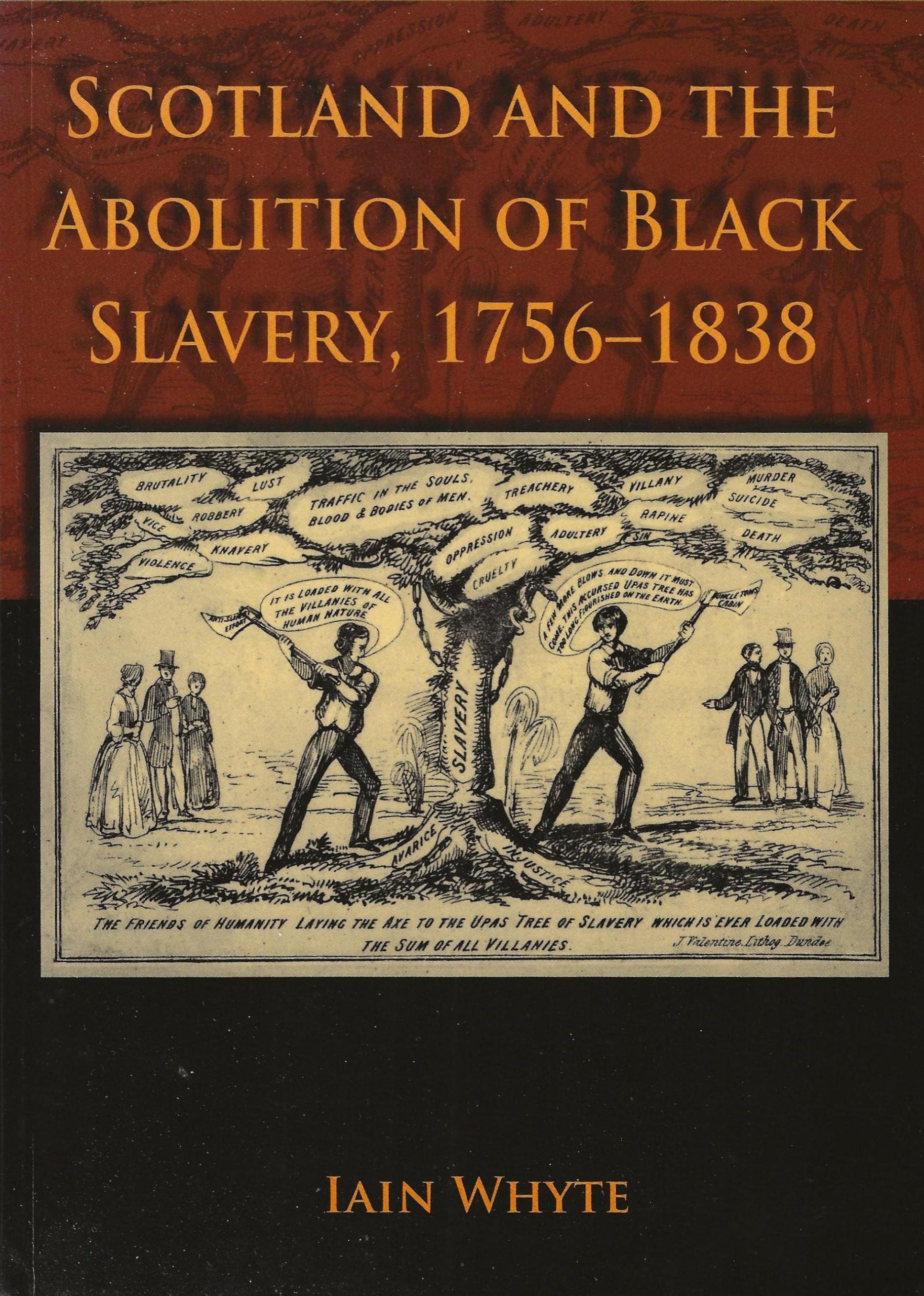
Scots were pivotal in the anti-slavery movement. That is the conclusion of Scotland and the Abolition of Black Slavery, 1756-1838 by Iain Whyte (Edinburgh University Press 2006), the key reference work on this topic.
The movement's roots are to be found in the presence of slaves in Scotland in the 18th century. The cause célèbre was the Court of Session judgment in 1778 that resulted in the liberation of runaway slave Joseph Knight, effectively outlawing chattel slavery in Scotland. James Boswell and Samuel Johnson helped prepare Knight's case, arguing: "No man is by nature the property of another".
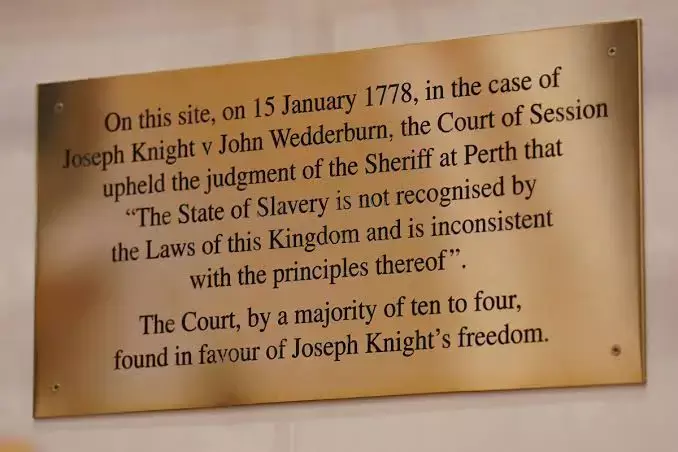
The case precipitated a period of moral re-examination and slowly criticism of the institution of slavery began to gain ground.
Initially, it was led by ministers of the Church of Scotland and rooted in the idea that all are equal before God. It also owes something to the Scottish Enlightenment and a philosophical distaste for slavery among educated and enlightened Scots, based on logic and reason. In 1788 the Universities of Glasgow and Aberdeen and synods and presbyteries from Dumfries to Kirkwall all petitioned parliament on the matter.
The Scottish anti-slavery writer William Dickinson embarked on a huge tour of Scotland in early 1792. He took with him cameos produced by Josiah Wedgwood of a kneeling slave in chains with the legend "Am I not a man and a brother."
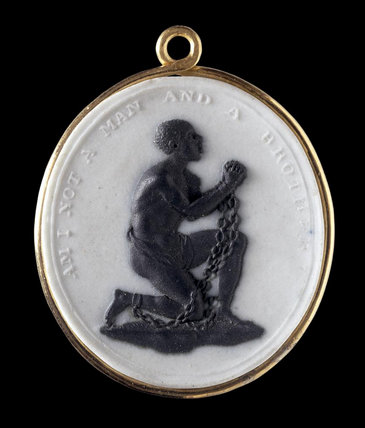
The tour resulted in 185 petitions in 1792 alone from Scotland demanding the abolition of slavery. Some campaigners boycotted sugar and rum.
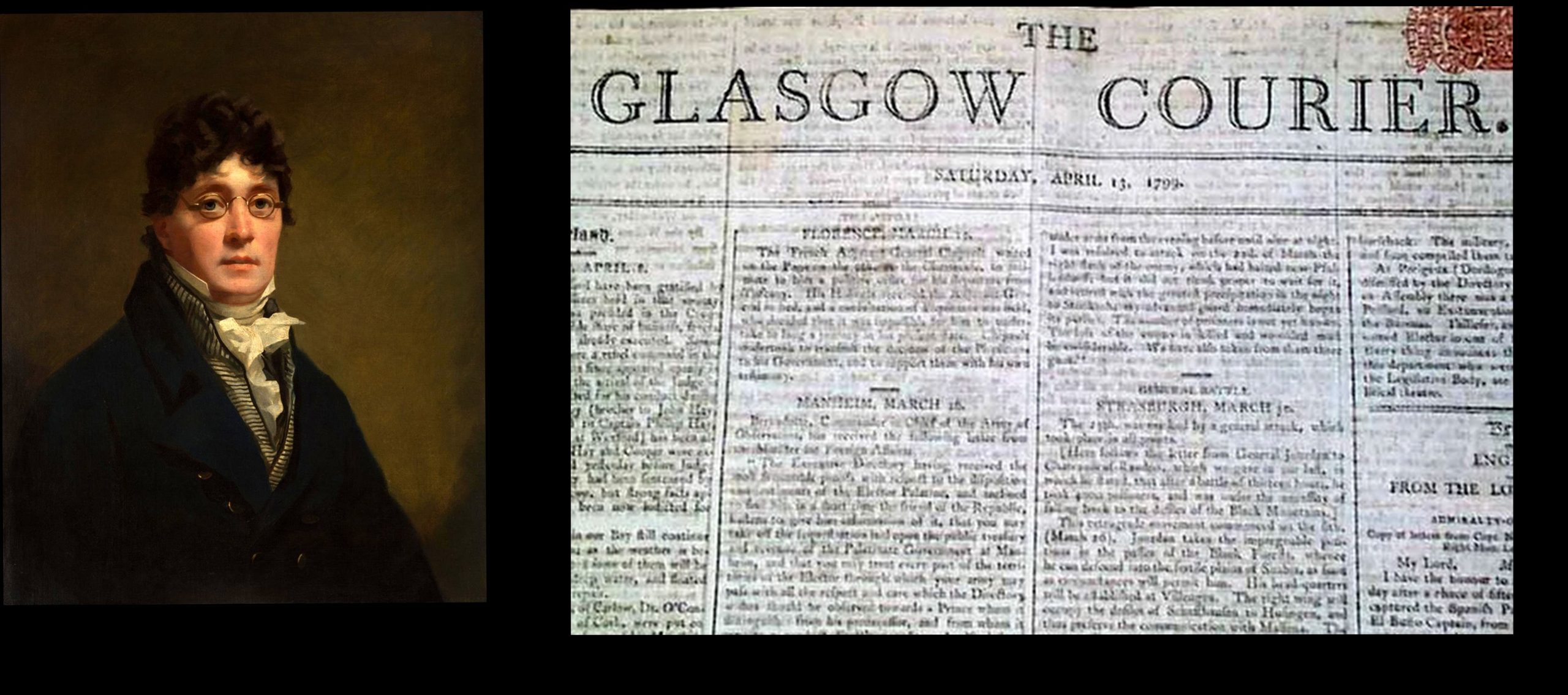
In Glasgow there was a vigorous press war. The Glasgow Advertiser (forerunner of The Glasgow Herald) backed the abolitionists. The Glasgow Courier, edited by a former plantation owner, led the campaign against abolition and represented the views of the Glasgow West India Association, whose founder members included Archibald Smith from Craigend and John Guthrie of Carbeth Guthrie. When it was clear that their cause would be lost, The Courier switched to campaigning for large compensation payments for those who owned slaves or held mortgages or annuities on plantations.
The Parish Minister: the Reverend Dr William Hamilton
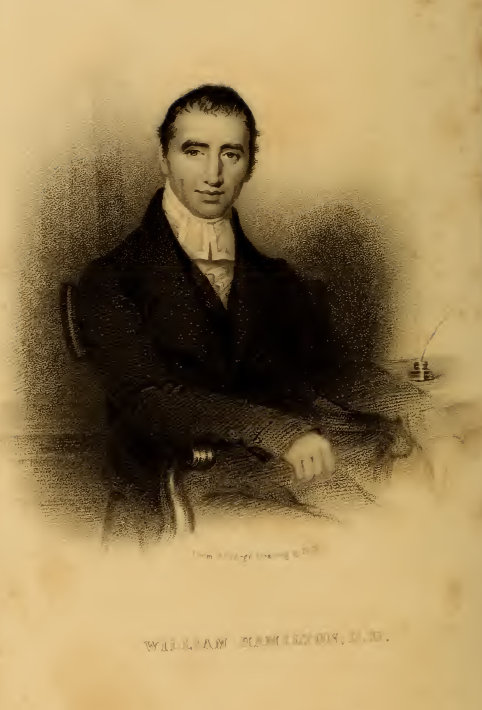
William Hamilton was appointed as Strathblane's parish minister in 1809 and held the post until his death in 1835. He was a remarkable man by any standards. He created the first public library in the parish and launched a local savings bank. He was a vociferous opponent of the employment of small children at Blanefield printworks and a passionate opponent of patronage in the appointment of parish ministers, arguing that heads of households should have that power. He was also a passionate abolitionist. These views did not endear him to the church heritors such as John Guthrie. [Heritors were local landowners whose responsibilities included maintaining church property.]
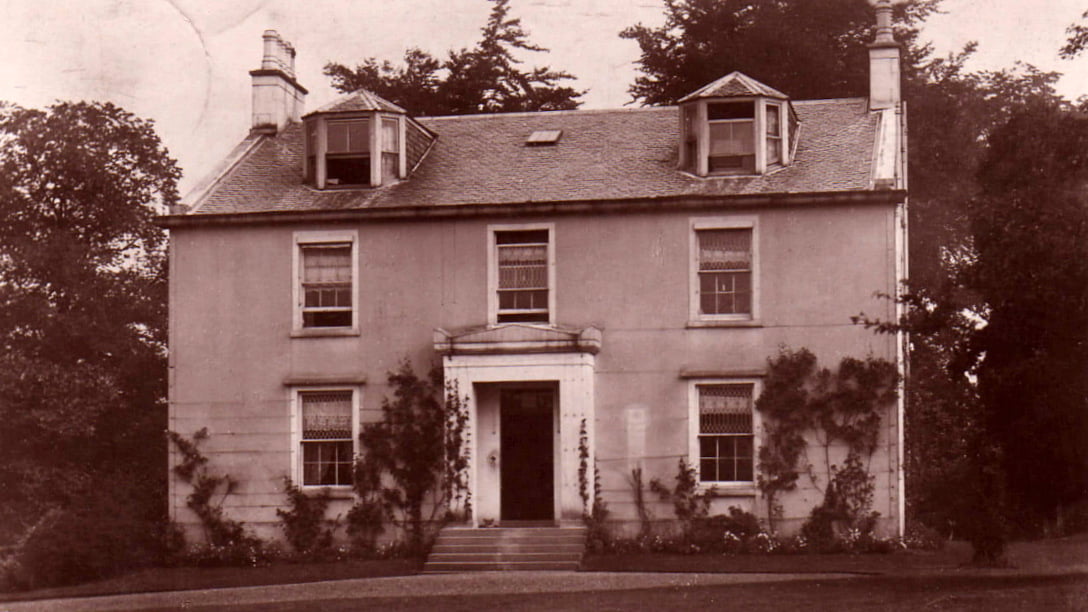
They took it out on their minister by refusing to replace the cramped, damp, semi-derelict manse. Dr Hamilton took them to court and won. The new manse [confusingly now known as the Old Manse!] was not finally completed until 1828. Later his son referred to "that ill-treatment which he incurred by his noble and disinterested conduct in reference to West India slavery".
Following the 1807 Abolition of the Slave Trade Act, many campaigners believed the ending of plantation slavery was in sight. They underestimated the strength of commercial vested interests. In a final push to get legislation over the line, communities from throughout Scotland flooded both houses of parliament with petitions. They included one from the people of Strathblane that stood out from the rest in its uncompromising tone. It not only opposed compensation to slave owners but also demanded compensation for the slaves themselves. No prizes for guessing its author.
The Patriot newspaper recorded that on 18 February 1833 at a meeting of “the inhabitants of Strathblane”, petitions were unanimously adopted calling for “the immediate and total abolition of slavery and compensation to the slaves for the cruelties which they have sustained from their masters.” The newspaper added: “The Christian and generous spirit of these worthy people cannot be too speedily or too widely diffused, and it is to be hoped that they will be supported and animated in their patriotic and seasonable [sic] exertions by every parish in Scotland early applying to Parliament for the same just and necessary objects”.
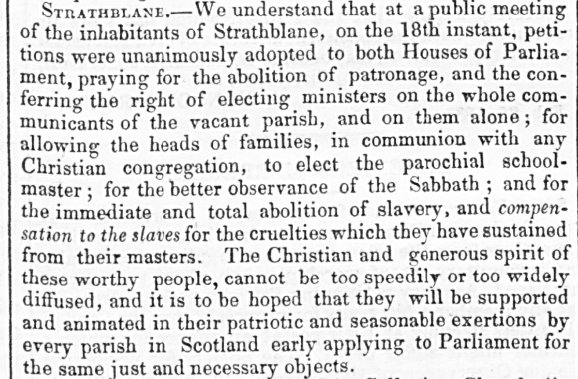
Sadly, the petitions to the Commons were destroyed in a fire in 1834 and the House of Lords archives have been unable to find their copy. However, a summary of some of the petitions of that year records that Strathblane wanted to see compensation paid to enslaved people “for the floggings, oppressions and mutilations which they have sustained from their masters”. Interestingly, the same petition called for the abolition of patronage in the appointment of church ministers, which gave the principal landowner (in Strathblane’s case the Duke of Montrose) the exclusive right to make that appointment. They argued that the choice should be open to all (male!) communicants. For many Christians, the two causes – abolition of patronage and abolition of slavery – were based on the same argument: the idea that all were equal before God.
Dr Hamilton also supported the passing of the 1832 Great Reform Act which resulted in the reduction of West Indian planters represented in the House of Commons to 35. Despite the disapproval of the heritors, he invited local supporters of reform to bring their marching band to the manse and entertained them to tea following the successful passage of the bill.
The Member of Parliament: Charles Fleeming
The subsequent poll resulted in the election of more than 100 members pledged to immediate abolition. They included Charles Elphinstone Fleeming as MP for Stirlingshire. Fleeming called slavery “this beastly and inhuman traffic”.
He was well qualified to make the argument for abolition as he had been the Royal Navy’s commander in the West Indies from 1827 to 1829.
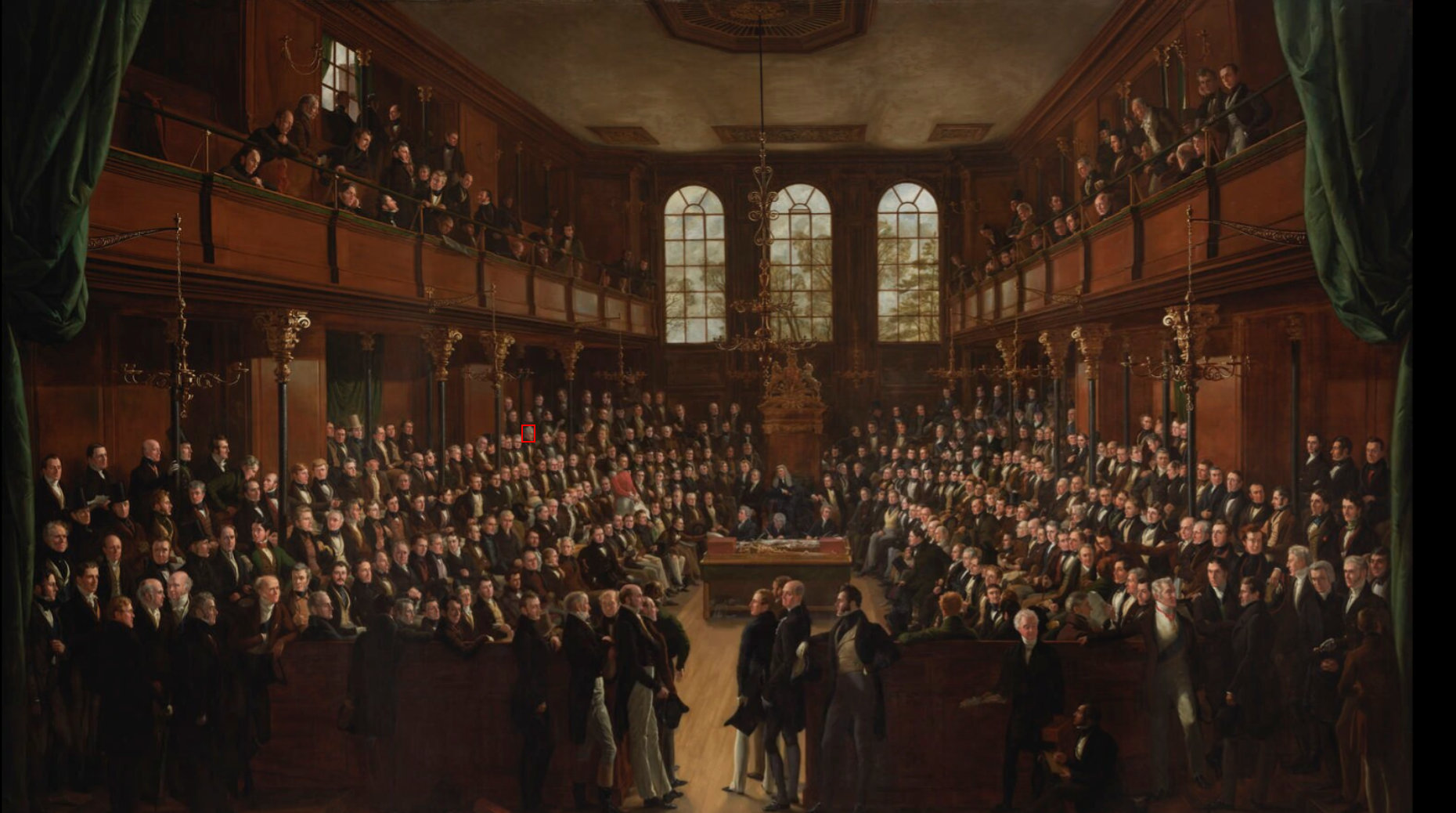
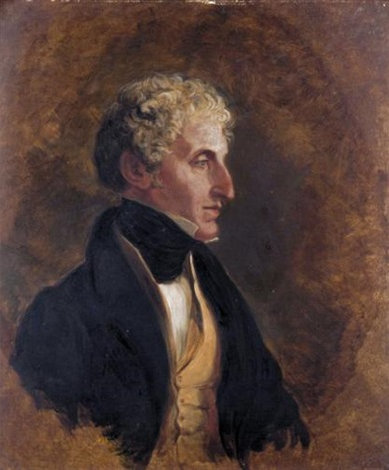
Fleeming was from a prominent Scottish landowning family. Having fought in the Royal Navy in the French Revolutionary and Napoleonic Wars, he rose through the ranks to become a vice-admiral. When he was 42 he fell in love with a 16-year-old Spanish girl and married her. They went on to have five children and she sailed on his ships. (One of their daughters was born on a sailing ship off the coast of Venezuela!)
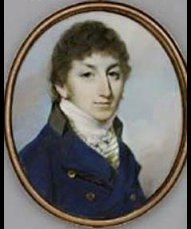
On 3 June 1832 Fleeming made a passionate speech in the slavery debate in the Commons. In it he said: “I very early in life became convinced of the necessity of abolishing negro slavery, not only as an act of justice, but one of true policy and for the best interests of the colonists.”
On the basis of 35 years of visiting the West Indies, Fleeming stated: “From the first time I visited those countries in 1796 until I last left them in 1830, no material amelioration in the treatment of negro slaves had taken place.” (Opponents of abolition, including apologists like John Guthrie, argued that the conditions of enslaved people had improved dramatically.)
In Jamaica Fleeming declared that he found: “Councils of Protection and all their boasted laws in favour of the slave were an utter mockery and…there was not only no real protection for the negro, but that the same excess of forced labour, the same scarcity of food, scantiness of clothing and inattention to healthy lodging produced the same melancholy waste of human life.” (John Guthrie of Carbeth Guthrie had been appointed “Guardian of Slaves” in Grenada.)
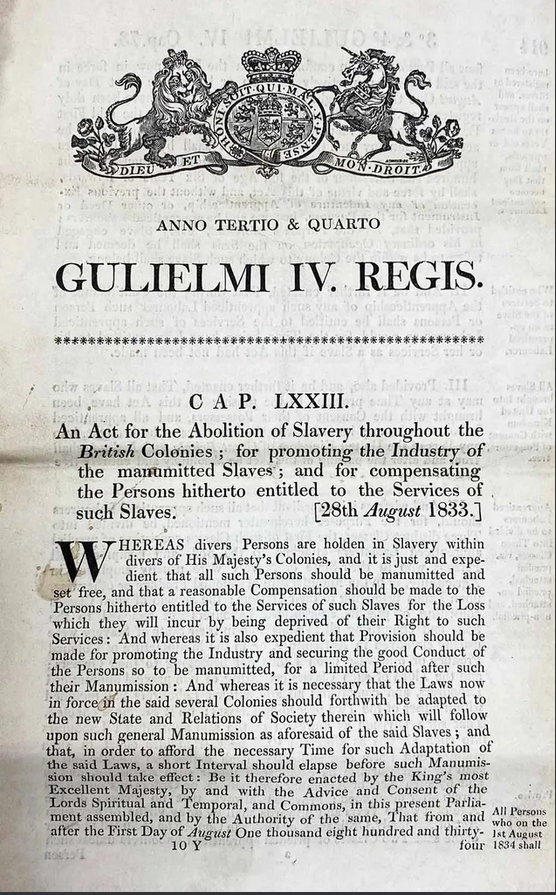
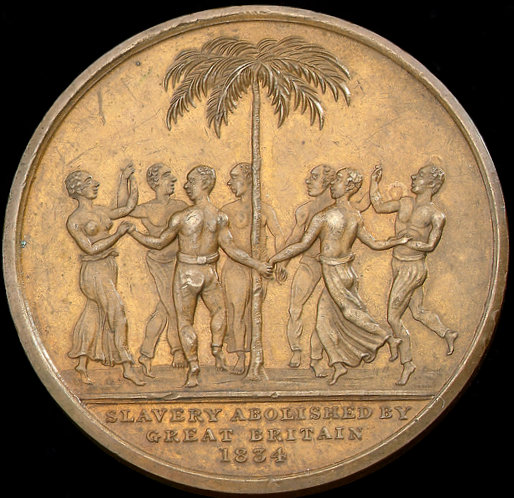
A medallion marking the act, showing a group of jubilant slaves dancing around a palm tree, was somewhat premature. Under the act’s terms not only did slave owners receive a total of £20m between them in compensation but enslaved people were expected to work for a further four years. These “apprenticeships” were unpaid. (It is claimed that the British government finished paying the interest on the £20m in 2014. In 1833 it represented 40% of the annual government budget.)
What can we take from all this? The profits from industries that relied on slave labour generated huge profits for some individuals, families and companies. Some of that wealth was then invested in Scottish industry, agriculture, railways and philanthropy (libraries, schools, churches, for example). It seems right to challenge some of the assumptions about where this money came from and in doing so rebalance history by learning the truth of what happened.
Derwyn Crozier-Smith, a descendant of the Smiths of Craigend, put it like this: “We can’t change the past but nor should we try to hide from it.”
The Admiral: William Edmonstone
The 1807 Slave Trade Act abolished the trade in the British Empire and created fines of up to £100 per enslaved person found on the ship. That year marked a dramatic shift in Britain's global naval policy. A nation that once had been an enthusiastic participant in slave trading switched to using the global dominance of the Royal Navy to suppress the transatlantic trade in African enslaved people. Nevertheless, it would take 60 years to put an end to the illegal trade
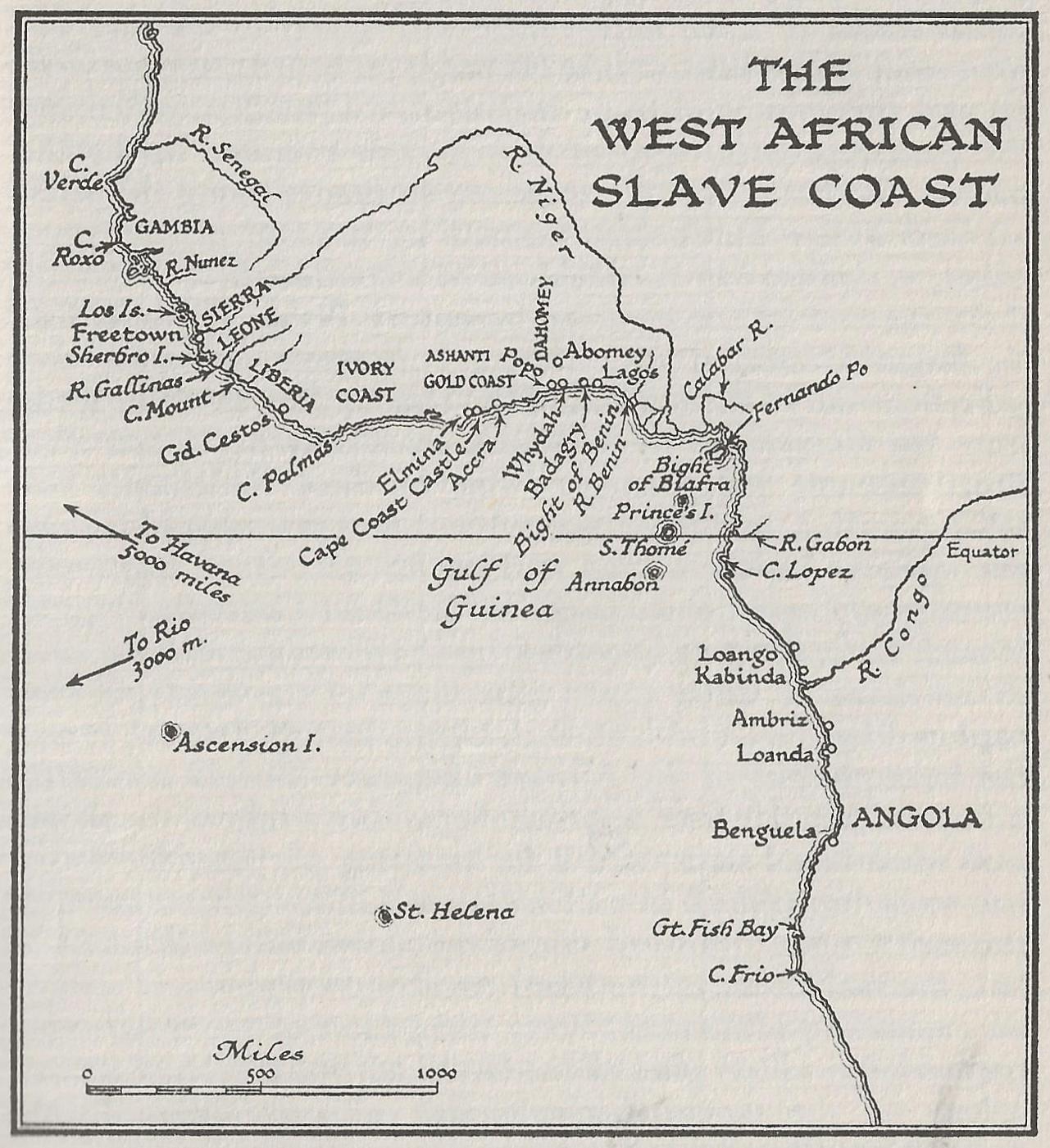
The West African Squadron was formed to capture and destroy slave ships and liberate enslaved men, women and children. BUT:
*Initially the squadron had a 3000-mile coastline to patrol, stretching from modern-day Senegal to Namibia from bases in Ascension and St Helena.
*At first, the slave ships, which were mostly built in the United States, were faster.
*The illegal trade was extremely lucrative. In 1810 a man sold in West Africa for £20 could fetch £90 in Havana.
*The US banned the transatlantic slave trade but merely switched to bringing in enslaved Africans through Cuba.
*Many slavers used the American flag. The West African Squadron was not permitted to search them.
*In the early years, the squadron could not touch ships set up for carrying slaves but with no slaves on board.
Even so, there were some successes, such as the capture of the Portuguese slave ship Diligente captured in 1838.
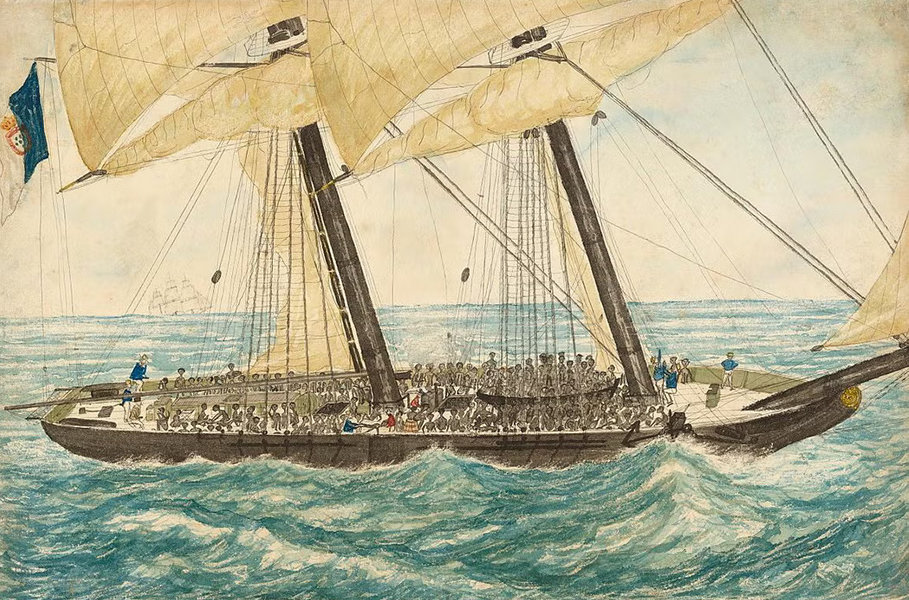
In fact, an estimated 200,000 people were released by the Royal Navy between 1808 and 1863 but an estimated 3.2m were taken from West Africa as slaves during the same period.
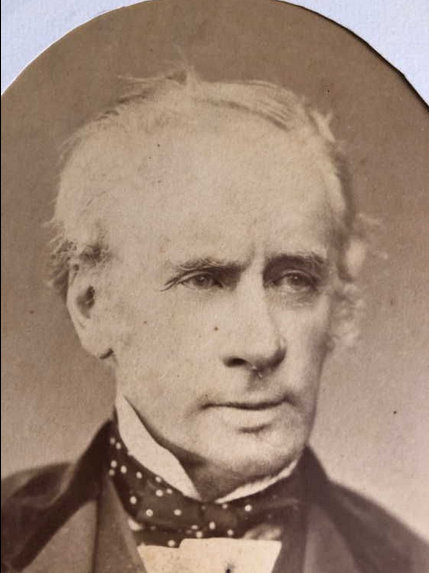
What has this to do with our local history? In 1859 William Edmonstone, the brother of Sir Archibald Edmonstone of Duntreath, the 3rd baronet, was made Commodore of the West African Squadron. His ship was HMS Arrogant, a 46-gun frigate with an auxiliary screw-propeller, driven by 330-horse power engines.
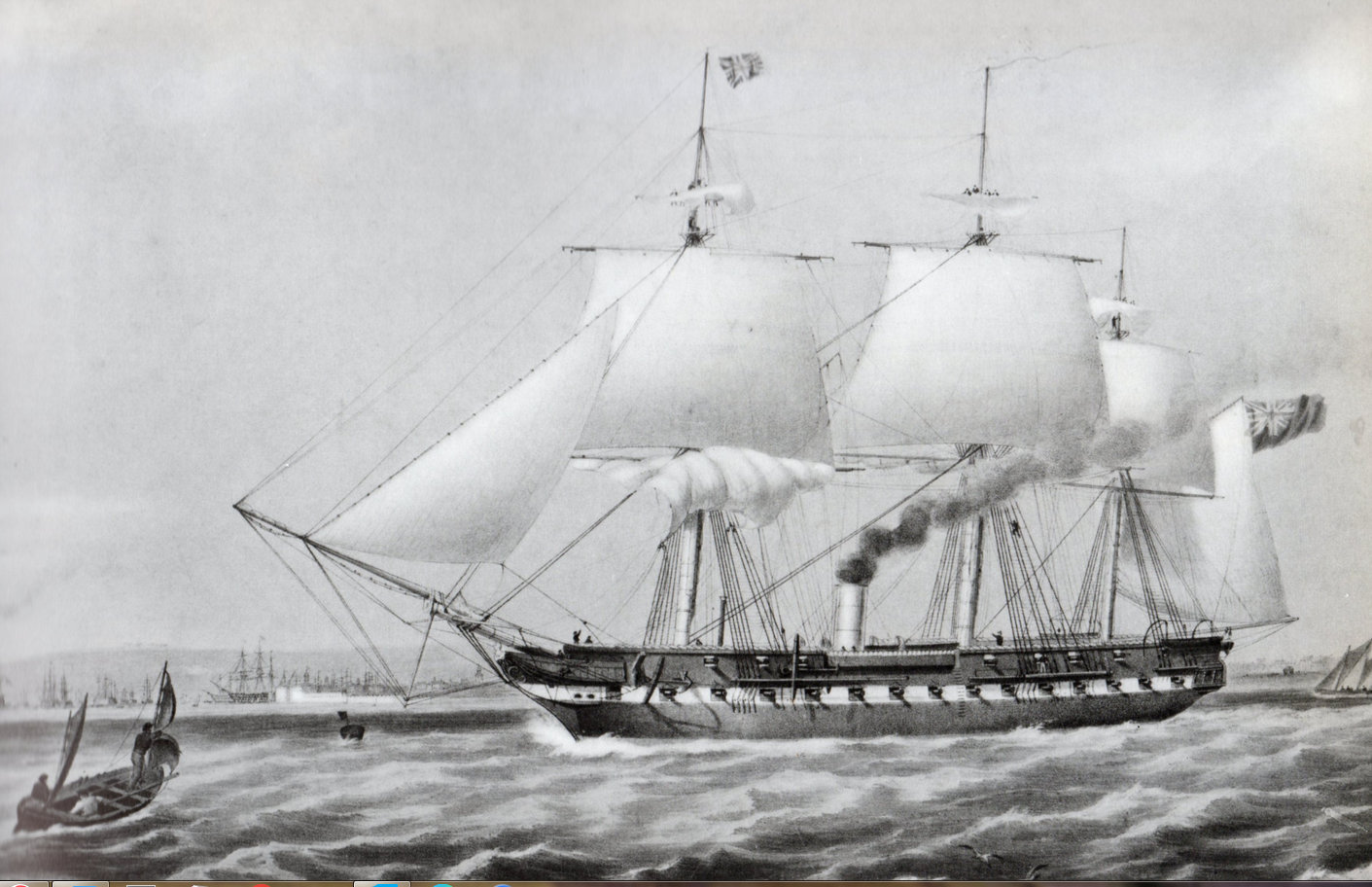
By now the tide was starting to turn in the Navy's favour:
*The coastline from which enslaved people were being shipped had shrunk to the area around Whydah (in modern-day Benin) and on either side of the River Congo as a result of diplomatic and military pressure on local chiefs. (In 1861 Edmonstone led an attack on Porto Novo (west of Lagos) after the local leader refused to desist from the slave trade. Two weeks later the leader agreed to stop trading slaves, as well as desisting from the practice of human sacrifice and allowing in European traders. Morality and commercial self-interest were clearly intertwined in such agreements.)
*By now the squadron was empowered to confiscate ships fitted out for the slave trade, even if there were no captives on board.
*Edmonstone had faster ships than his predecessors. His squadron of 14 were all steamers or steam auxiliary ships. And he had 1800 men at his disposal.
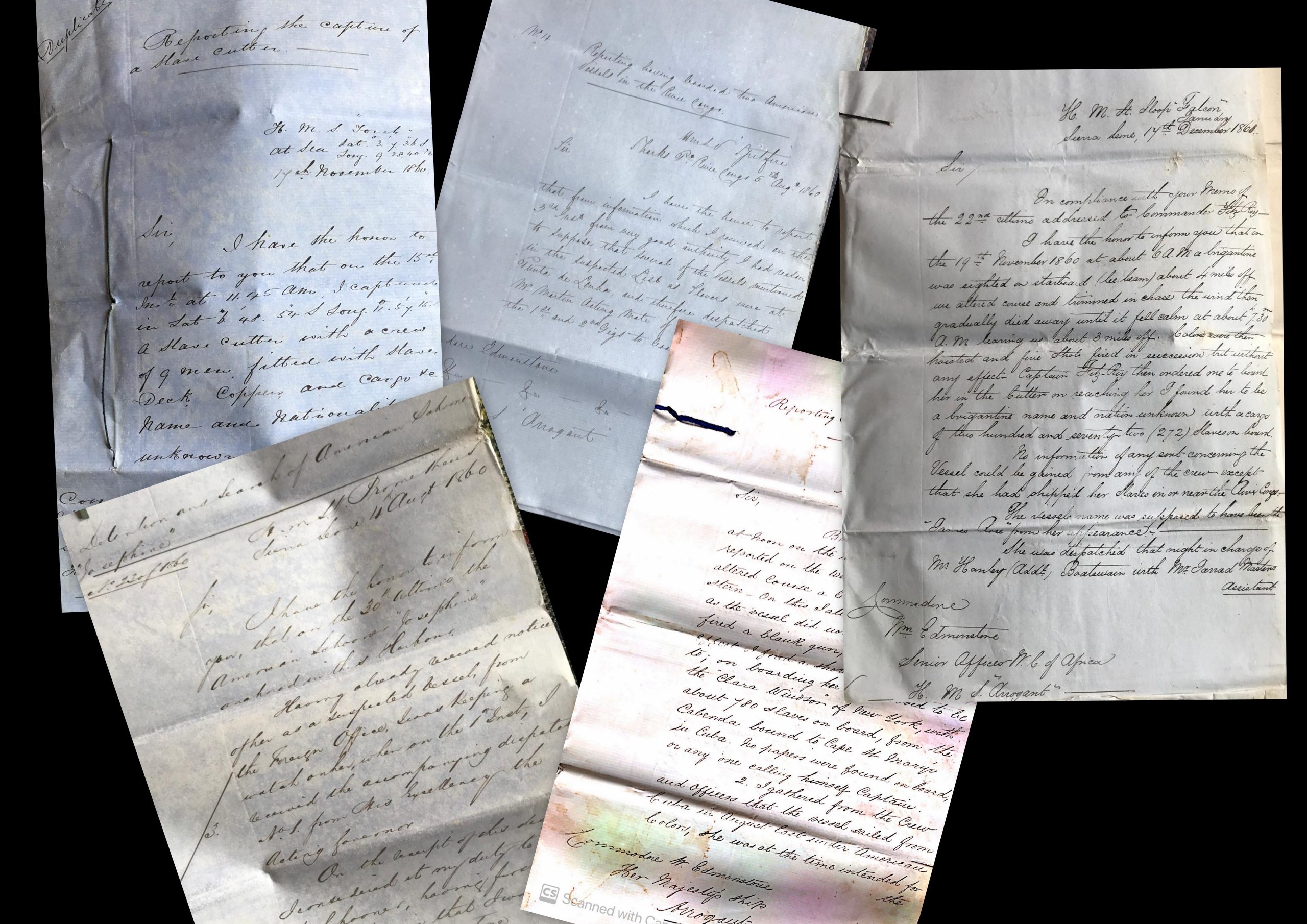
Thanks to copies of letters he sent to the Admiralty, especially a bundle dating from the second half of 1860, kept in a wooden box at Duntreath, we have a vivid idea of this crucial period in the fight against the illegal slave trade.
For example, on 17 November 1860 Edmonstone reported the capture of a slave cutter: “I have the honour to report to you that on the 15th inst. at 4.45am, I captured in Lat. 6 48 54, Long. 4 5 15 a slave cutter with a crew of nine men, fitted for slaves, deck coppers and cargo, the name and nationality unknown.” The letter is sent from Ascension Island which had been a supply base for the squadron. He believed the ship was Spanish and had been fitted out in Havana with the intention of shipping a cargo and 300 slaves the following morning. No documents of any kind were found on board. The ship was burned.
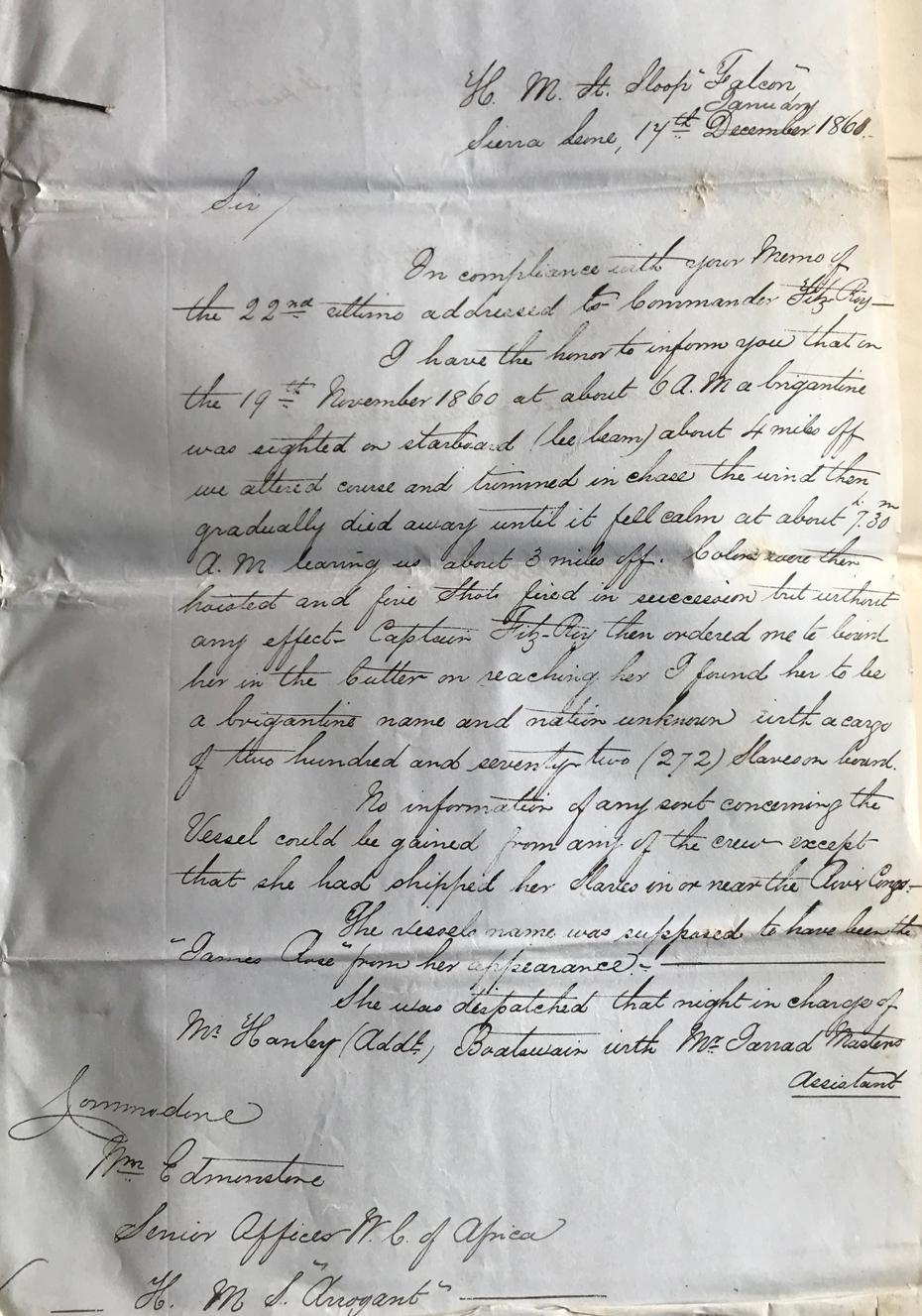
Just two days later, another ship is captured, this time with 272 slaves on board. Edmonstone passes on the report from the HM Auxiliary Sloop Falcon: "I have the honour to inform you that on the 19th November at about 6am a brigantine was sighted on the starboard (lee bow) about 4 miles off. We altered course and trimmed in chase. The wind then gradually died away until it fell calm at about 7.30am. Colours were then hoisted and five shots fired in succession but without any effect. Captain Fitzroy then ordered me to board her in the cutter. On reaching her I found her to be a brigantine name and nation unknown with a cargo of 272 slaves on board. No information of any sort concerning the vessel could be gained from any of the crew except that she had shipped her slaves in or near the River Congo." The ship was sent to St Helena so that her fate could be decided in the Admiralty Court there.
As Mary Wills observes in her book Envoys of Abolition, British Naval Officers and the Campaign against the Slave Trade in West Africa: "A snapshot of the human interactions at the heart of slave trade suppression is the "prize voyage", where intercepted slave vessels were transported to Admiralty Courts, usually in the British colony of Sierra Leone. The terrible conditions for those captives aboard slave vessels on the infamous Middle Passage across the Atlantic meant dysentery, fever, small pox and eye diseases were common, compounded by over-crowding and poor ventilation below deck. These conditions were not easily alleviated if the ships were taken under the control of the Royal Navy."
There is a tragic illustration of this in the case of the Clara Windsor. On 14 December, HM Steam Vessel Espoir, another ship in the West African Squadron under Edmonstone’s overall command, captured an American-built barque called the Clara Windsor with 840 slaves (including 430 children) on board, heading for Cuba from the Cabinda River (in the Portuguese Congo, now Angola). [Cuba remained active in the slave trade right up to 1867.] The slave ship was sent first to Ascension Island and then Sierra Leone, so that the Vice-Admiralty Court there could decide its fate.
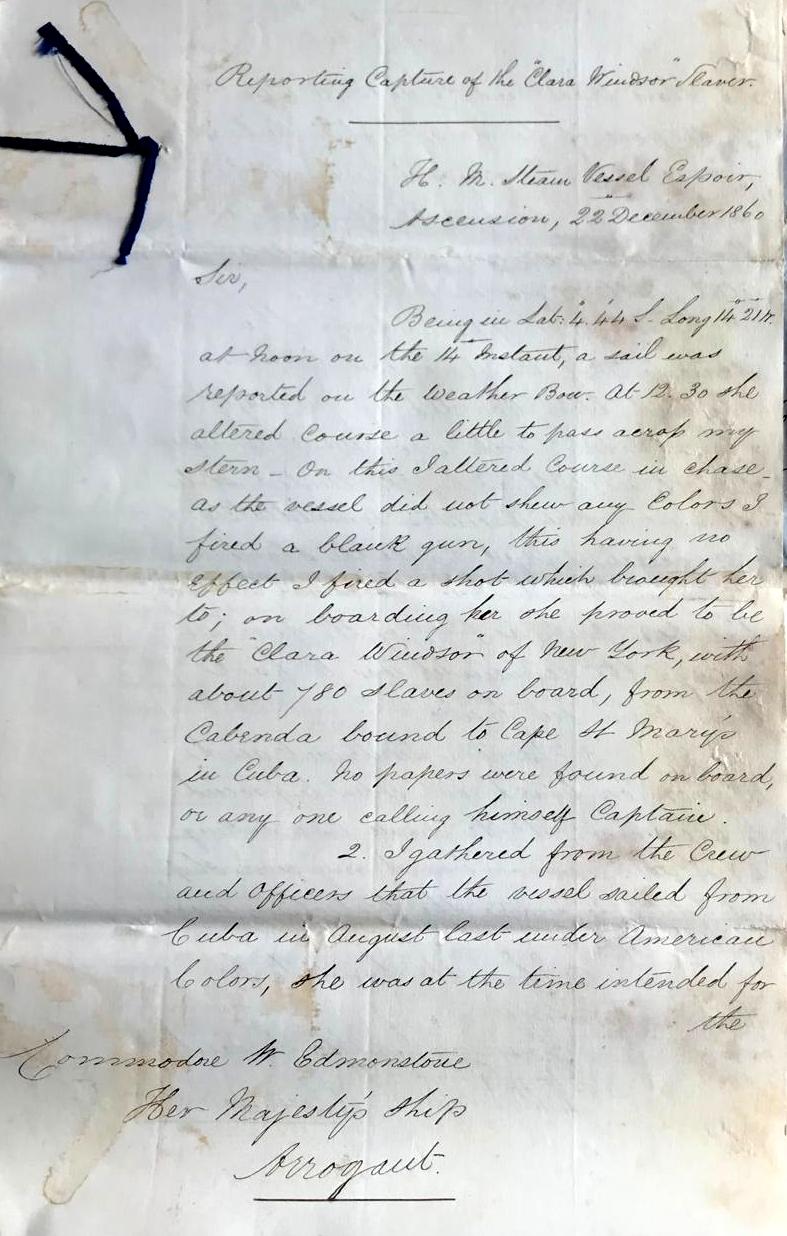
Edmonstone puts the number of slaves at 780 but the figures in the accompanying document suggest the figure was more like 840, of whom only 616 landed back in Africa. Again, this material was found among papers held by the Edmonstone family at Duntreath Castle.
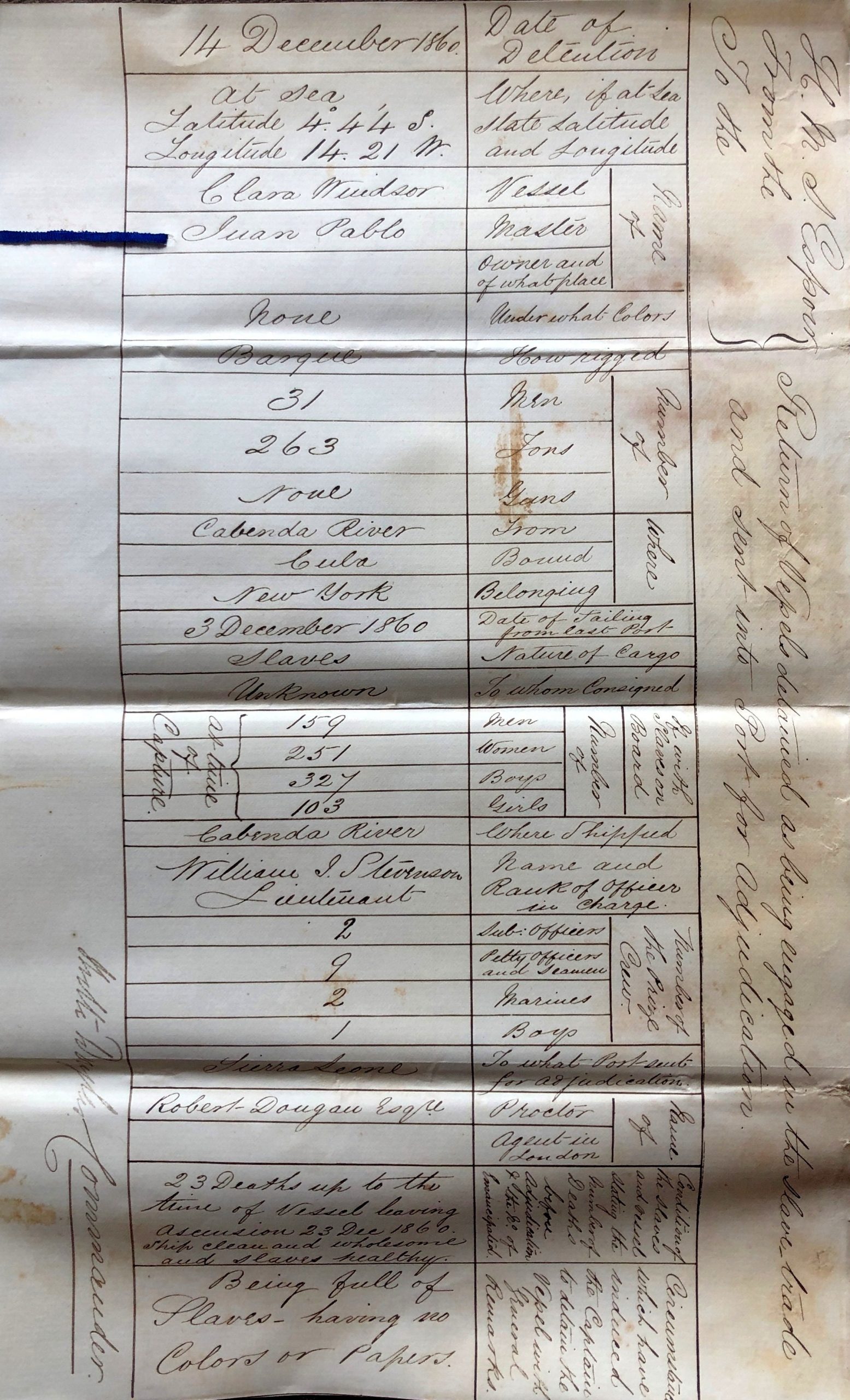
On 7 January 1861 RN surgeon Richard Carr McClement visited the ship in Sierra Leone and described the horrific conditions on board. The slave deck was only 40 inches high and emitted a foul stench. Here he found “men, women and children, huddled together; some emaciated to skeletons; some lying sick and heedless of all around; and some on the point of passing into another world.....all were naked and had their skins besmeared with the filth in which they lay.”
Note that the slaves included 327 boys and 103 girls. Some were new-born infants and many were aged between five and ten. Even by the time the ship reached left Ascension Island, 23 of the slaves had died. According to Carr McClement, only 616 landed in Sierra Leone, suggesting more than 200 of the original 840 had died, following a deadly outbreak of dysentery.
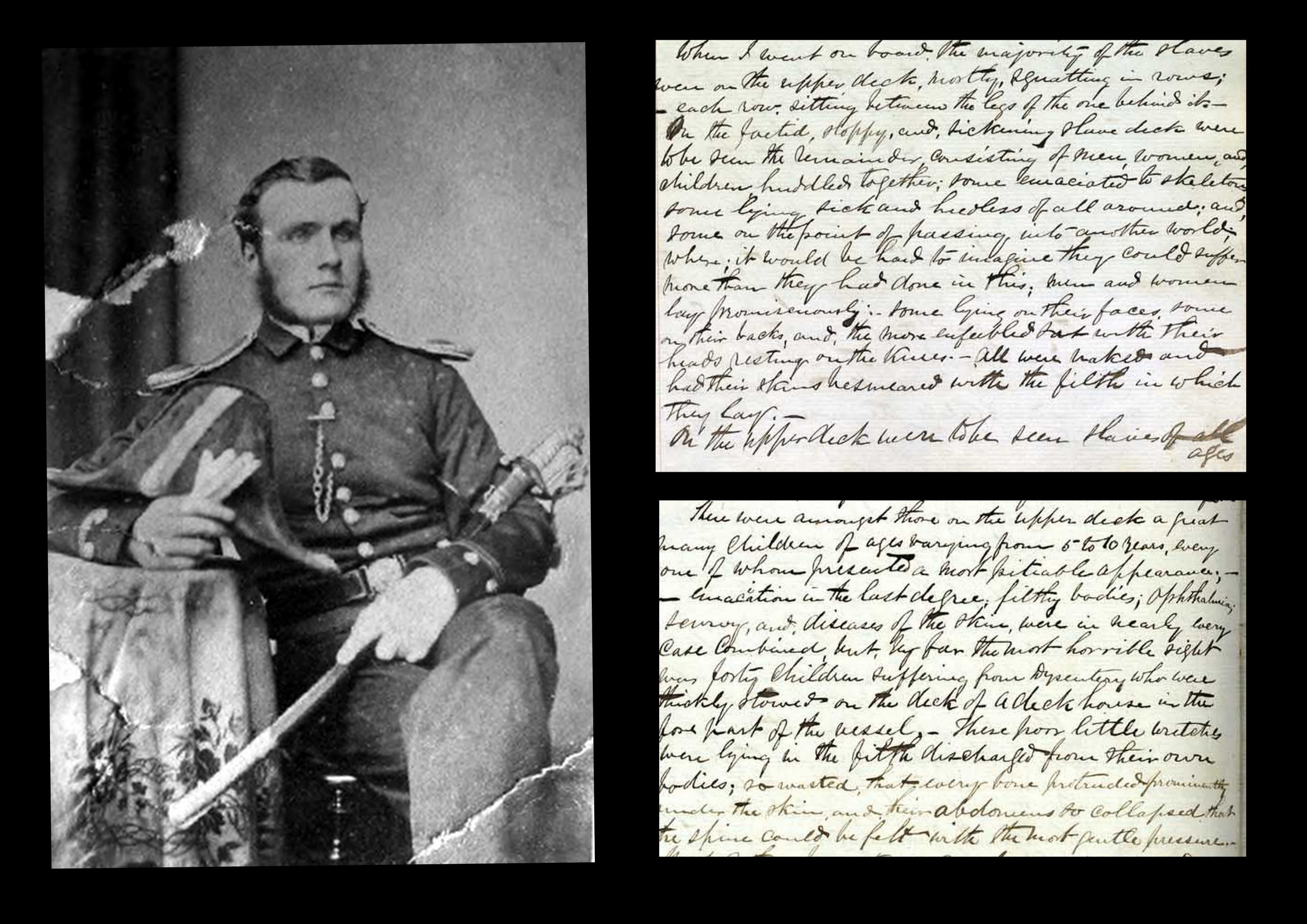
African people liberated by the West Africa Squadron did not necessarily return whence they came. In fact, this was avoided because of the likelihood that they would be re-enslaved. It is estimated that 40,000 of them were shipped to the Caribbean as indentured servants, working in conditions barely better than the enslaved. Those that were landed in Sierra Leone were more likely to be distributed to local settlements created for what were known as “Liberated Africans”. Many of the men ended up being enlisted as soldiers in the Royal African Corps. Some children received basic education from Protestant missionaries. The liberated Africans from the Clara Windsor were discharged at Kissy (a suburb of Freetown), a settlement founded in 1820 to accommodate those freed by the Royal Navy. A Colonial Hospital had been opened there in 1844 to care for physically disabled and mentally disturbed patients.
Despite improvements in the West African Squadron's operating effectiveness, William Edmonstone vents his frustration when he writes from his station off the Congo in August 1860: "As vessels engaged in the slave trade almost invariably fly the American flag and other cruisers are forbidden from in any way interfering with them, of course, we are to a very serious extent powerless in putting a check on the trade."
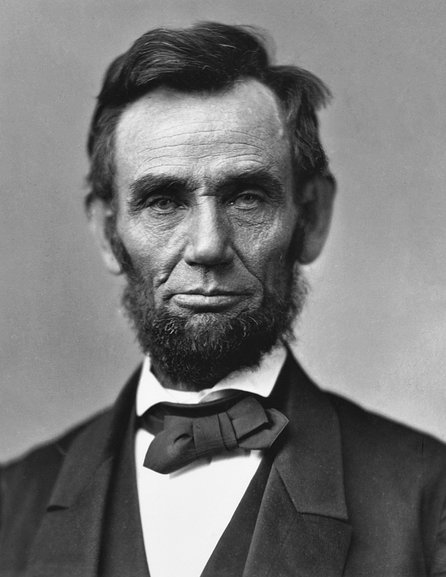
But change is coming. Abolitionist Abraham Lincoln was nominated American President in the autumn of 1860 and took office in March 1861. By June Commodore Edmonstone is able to report to the Admiralty: "I have great pleasure in bringing to your notice the efforts made by the American Squadron to put a check on the slave trade being carried on under the protection of their flag."
In February 1862 for the first time since the US declared slave trading to be a capital offence back in 1820, an American slave trader, Nathaniel Gordon, was hanged. He had been caught with 890 slaves, including 600 boys under 14, off Cuba.
In April 1862 the Treaty of Washington gave RN ships the authority to search American ships carrying slaves or equipped for slave trading. In 1863 Lincoln signed the Emancipation Proclamation that became the basis of the 13th Amendment to the American Constitution, eight months after his assassination in 1865. By the end of the year the transatlantic slave trade was at a standstill.
Two years later the West African Squadron was withdrawn from service. William Edmonstone had commanded it at a pivotal moment, though it is unlikely that he relished the job. A summary of his correspondence from the year 1862 held at Duntreath is peppered with requests for various officers and crew to be invalided out of service. The squadron suffered far higher mortality and disease rates than other branches of the navy because of the harsh climate and chance of encountering violence. It was also notoriously boring, with little chance of shore leave beyond a few days in Ascension Island or St Helena. A popular saying of the time complained:
"From the Bight of Biafra to the Bight of Benin, Few come out and many go in."
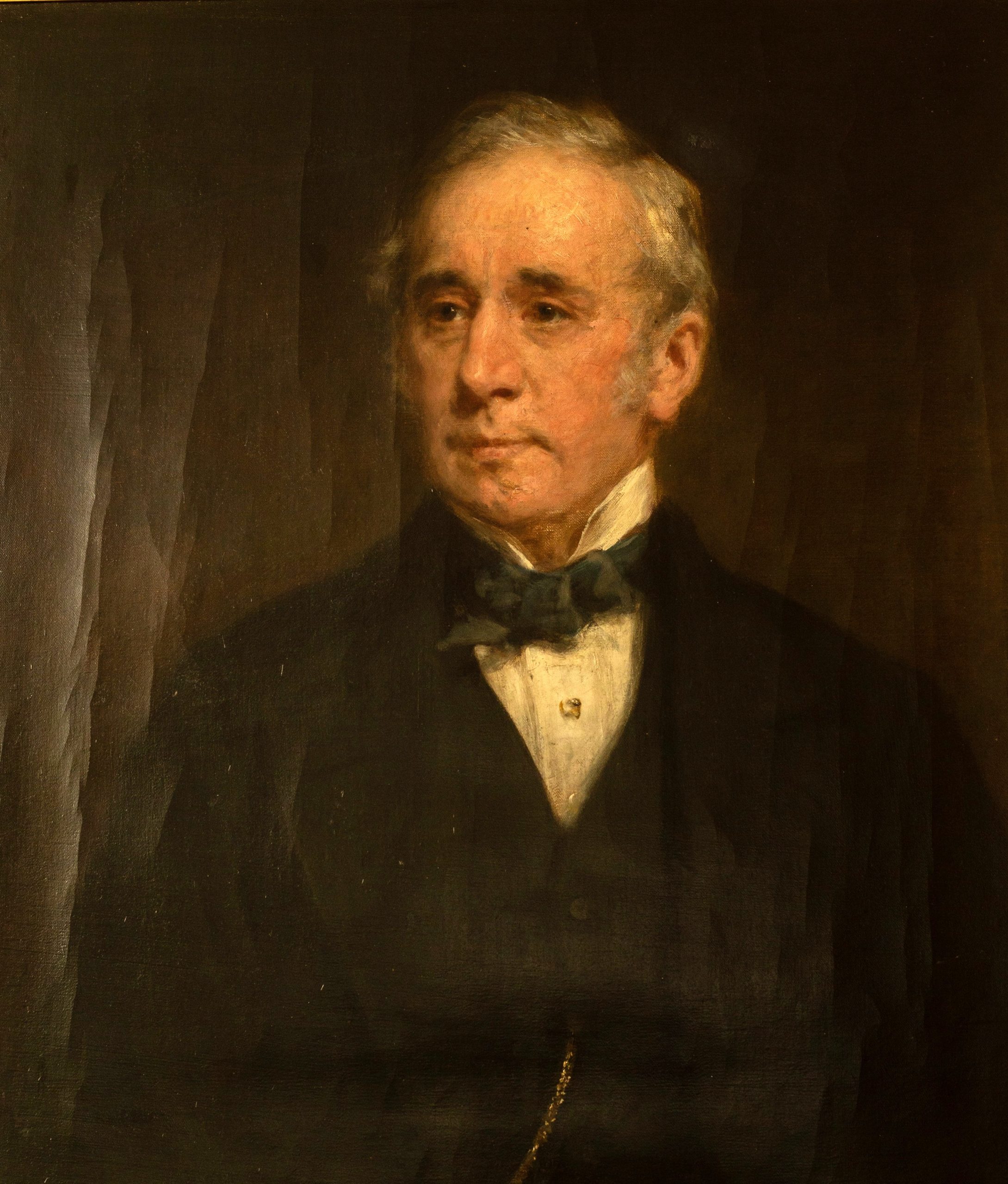
By the time he retired in 1870, William Edmonstone was a rear admiral. He inherited Duntreath on the death of his half brother in 1871. With his wife Mary (nee Parsons) he had nine surviving children, one son and eight daughters, including Alice (the Hon Mrs Keppel), who became the mistress and confidante of King Edward VII. Sir William Edmonstone became MP for Stirlingshire and an aide-de-Camp to Queen Victoria. He died in Edinburgh in 1888. He is buried in the family mausoleum in Strathblane Churchyard. (Queen Camilla is Admiral Edmonstone’s great great granddaughter.)
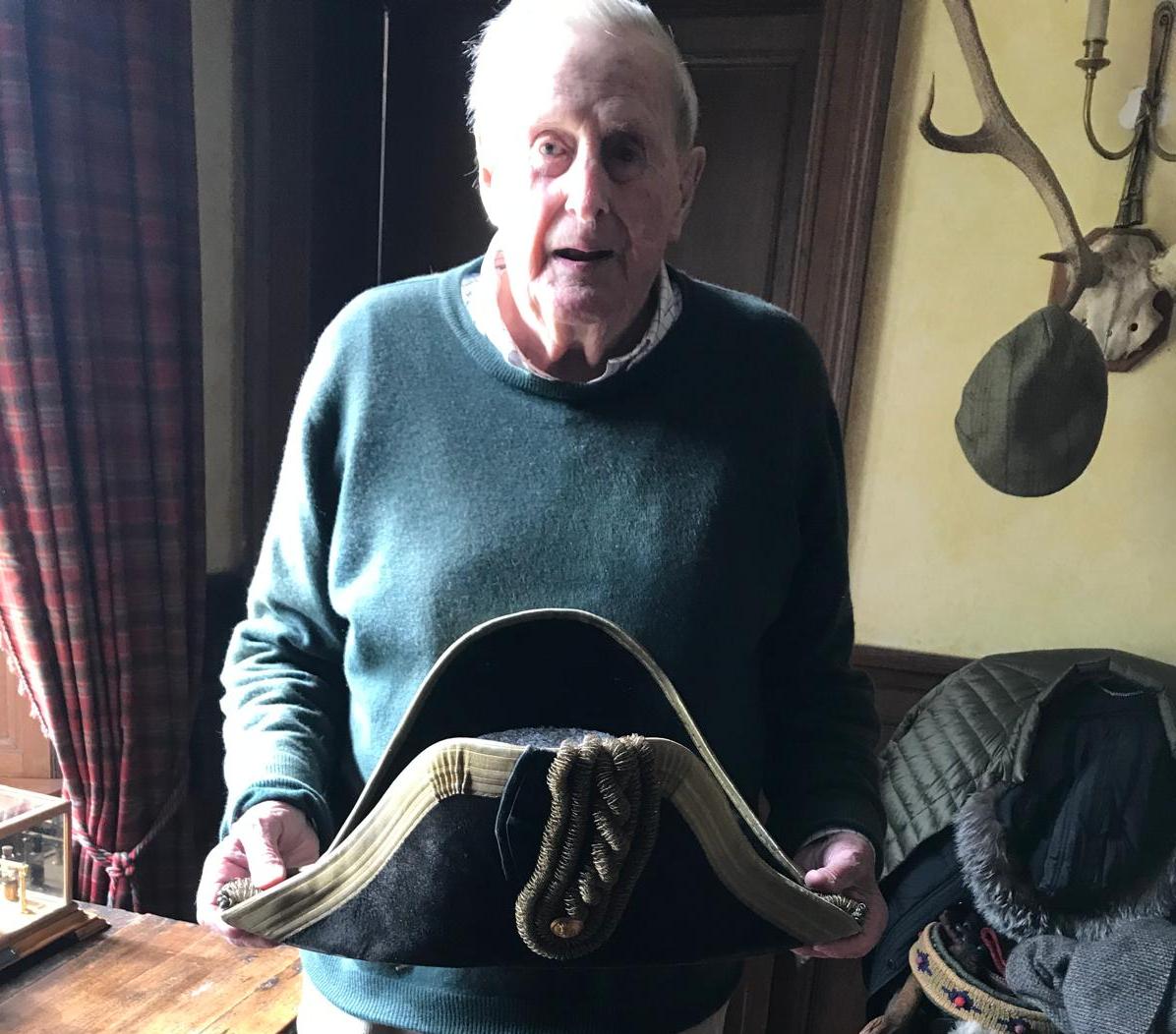
As well as his letters, the Edmonstones still treasure the Admiral's hat.
.
Further reading:
Scotland and the Abolition of Black Slavery, 1756-1838 by Iain Whyte (Edinburgh University Press 2006)
The Navy and the Slave Trade: The Suppression of the African Slave Trade in the 19th Century by Christopher Lloyd (Longman 1949)
Envoys of Abolition British Naval Officers and the Campaign Against the Slave Trade in West Africa by Mary Wills (Liverpool University Press 2019)