Stories of the Fallen
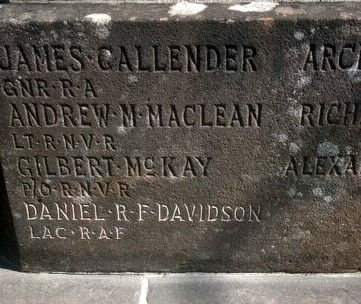
- James Callander GNR Royal Artillery
- Daniel Davidson LAC Royal Air Force
- Andrew M Maclean Lt Royal Naval Volunteer Reserve
- Archibald MacNicol SPR Royal Engineers
- Gilbert McKay P/O Royal Naval Volunteer Reserve
- Richard RN Pedder Lieut Col Highland Light Infantry
- Alexander Turnbull CH P/O Royal Naval Volunteer Reserve

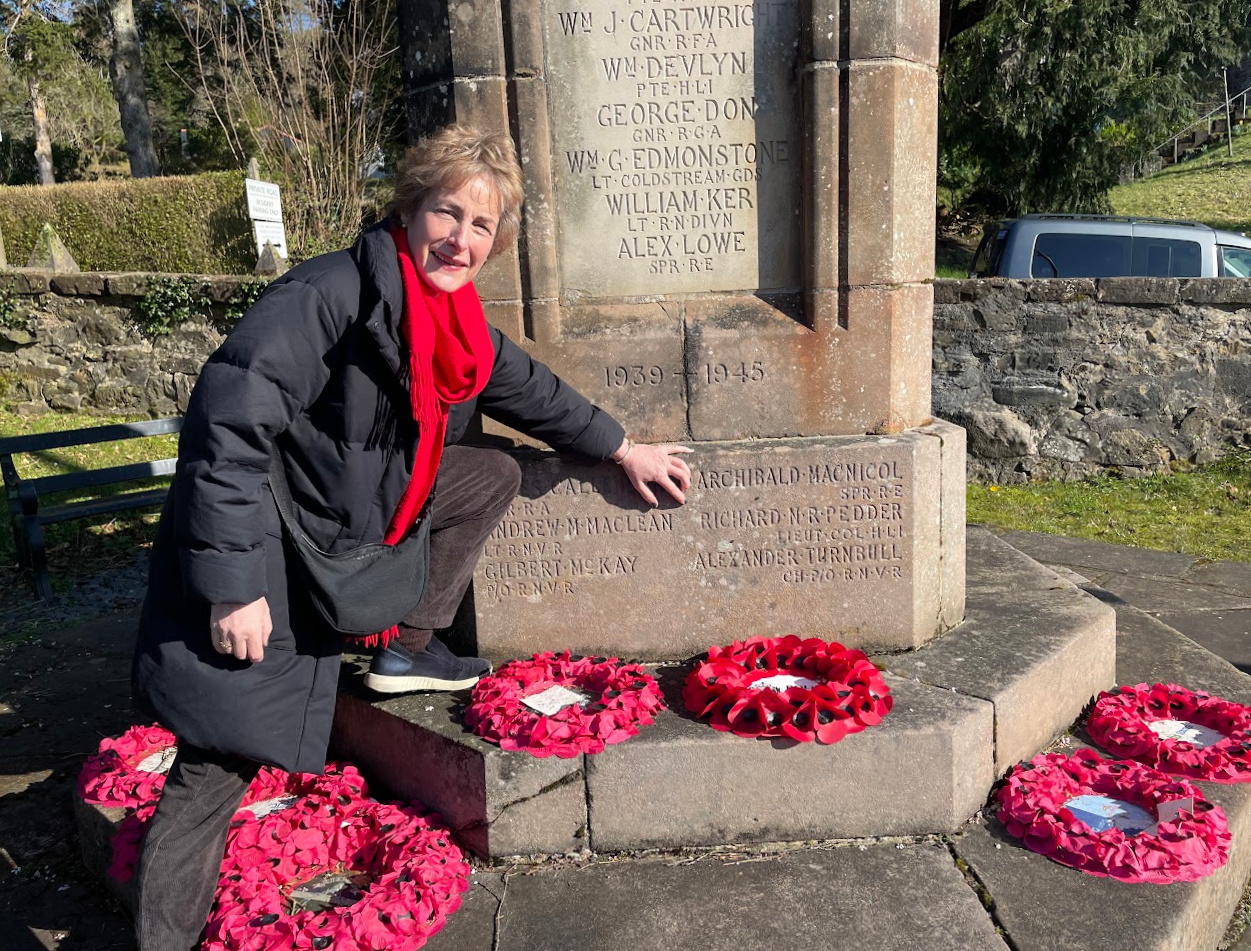
Six men from the parish of Strathblane who died in the Second World War are recorded on Strathblane War Memorial.
James Callander is incorrectly spelled Callender on the memorial. Richard R N Pedder is incorrectly recorded as Richard N R Pedder.
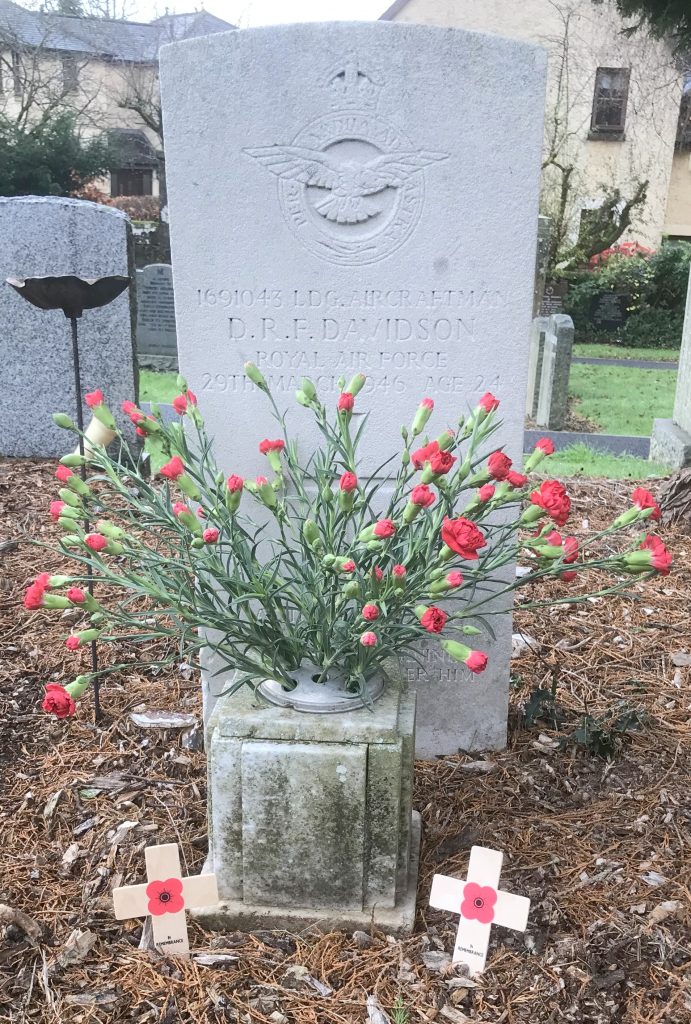
A seventh man, Daniel Davidson, who died in 1946 aged 24, does not have his name on the war memorial but he has a Commonwealth War Grave in Strathblane Cemetery. Efforts are underway to add this seventh name to the war memorial.
The graves of Andrew Maclean and Gilbert McKay are also in Strathblane Parish Cemetery and are maintained by the Commonwealth War Graves Commission.
These life and war stories were produced by members of Strathblane Heritage in the run-up to the 80th anniversary of VE Day on 8 May 2025. No attempt has been made to standardise the stories, which is why their forms and style vary as much as the authors, and indeed the men themselves.
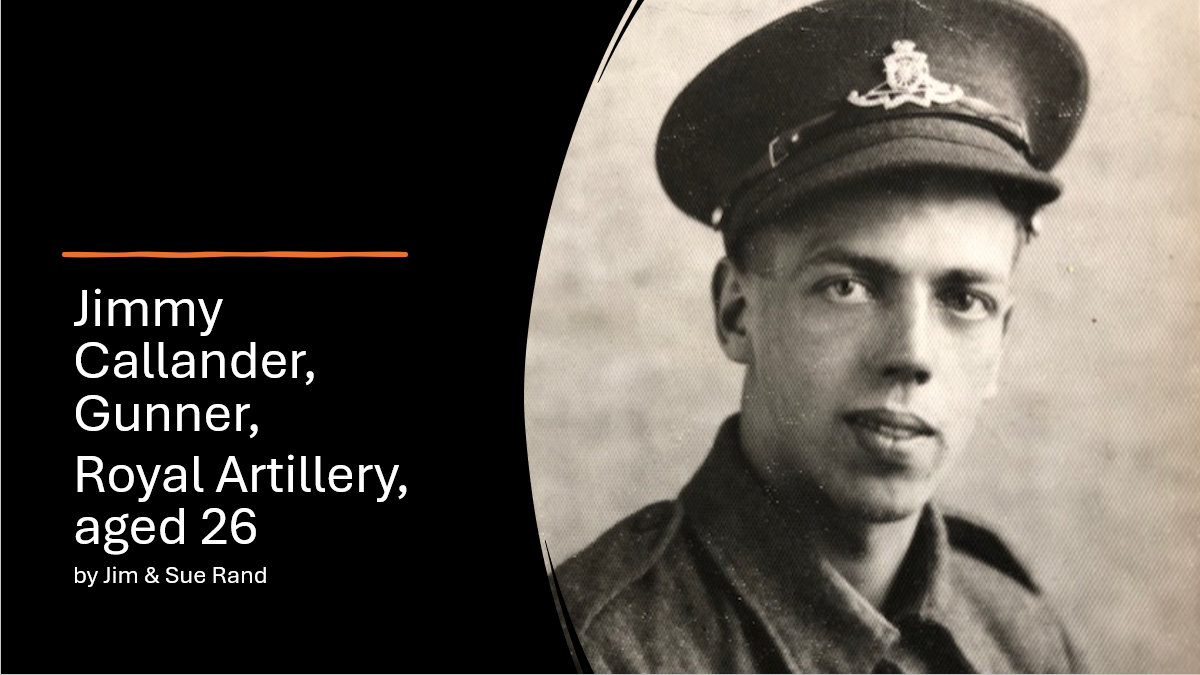
James Callander
.
Early Years
Jimmy was born on 26 March 1918 at Mid-Ballewan, which was then part of the Duntreath Estate. His grandparents had moved there from Kilsyth in the 1860s. In the 1911 Census, Jimmy's father William is recorded as an electrician, an unusual occupation in the days before many houses had electricity. It seems likely that he was installing electricity at Duntreath Castle, which had previously relied on a water-powered system.
Jimmy's parents married in 1914 in Glasgow. His mother, Margaret Clark, aged 32, was 18 years younger than her husband. They would have five children: two girls who were older than Jimmy and two boys who were younger. They all attended the local school. After William's death in 1936, the family relocated to 8 Park Terrace in the Edenkiln area of Strathblane.
When Jimmy volunteered in 1939, aged 21, he was working as a grocer's assistant.

Training
On 15 December 1939 Jimmy enlisted as a Gunner at the 6th Field Training Regiment of the Royal Artillery, at Longniddry, East Lothian. Training would have lasted between eight and 12 weeks and he was then drafted to the 90th (City of London) Field Regiment. His Army Pay Book records that he was less than 5ft 8ins tall, with an expanded chest measurement of about 34ins.
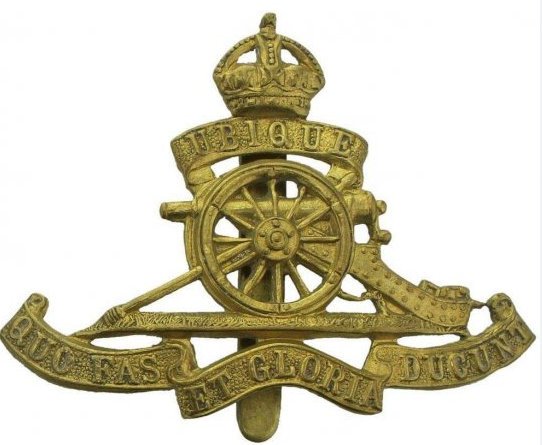
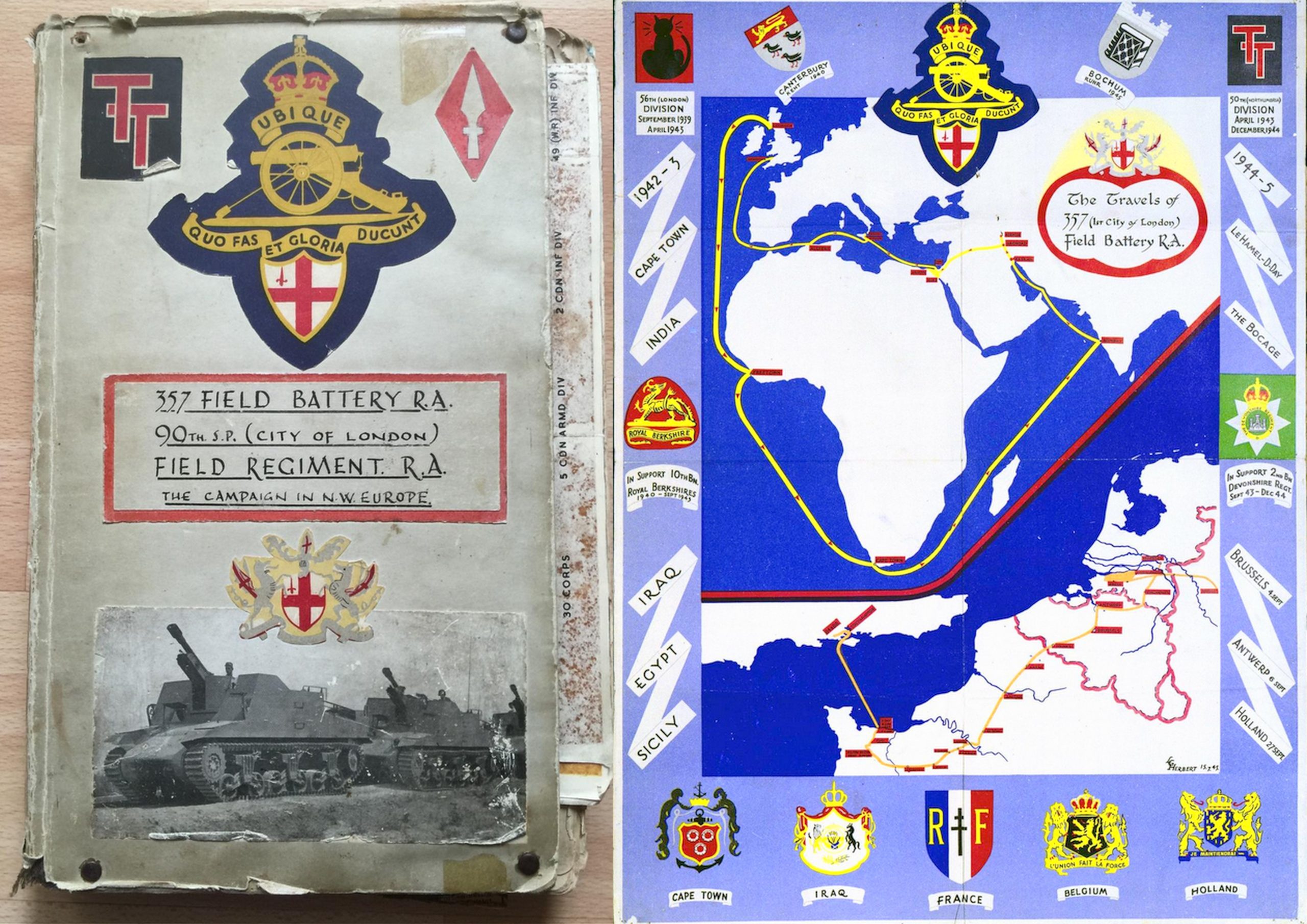
Once Jimmy joined his regiment he was then assigned to 357 Field Battery, which was then based in Sussex. We know a lot about Jimmy Callander’s war because it happens that some men from 357 Field Battery took photographs and kept detailed diaries of their experiences and their exploits. And, long after the War, they used the internet to share all of this with their families and their former comrades. After the deaths of many of the veterans, their families continued to share this valuable record.
A Very Busy War
Jimmy was probably too new to his regiment to have been deployed to Dunkirk, as some of the City of London men were. In the aftermath, with the threat of invasion hanging over the UK, the regiment was deployed at home. But in summer 1942, the 90th City of London Field Regiment took the long (and at that time extremely hazardous) sea journey to Iraq, sailing via South Africa and India.

There are photographs of Jimmy's comrades celebrating Christmas near Kirkuk in Iraq. (Also from https://ww2talk.com Chris Woffenden's father, Bill, who served alongside Jimmy Callander in A Troop throughout the war is in the back row, second from right.)
At the same time in North Africa the allied armies were having a very hard time, losing men and equipment to Rommel and the German Africa Corp.
As a consequence, the 90th City of London Regiment was detached from the 56th Infantry Division and was sent to drive overland from Iraq to Egypt to reinforce the 50th Northumbrian Division, which had suffered heavy losses.
In Spring 1943, the whole 50th Division was then withdrawn from the desert fighting in order to prepare for Operation Husky, the Allied invasion of Sicily.
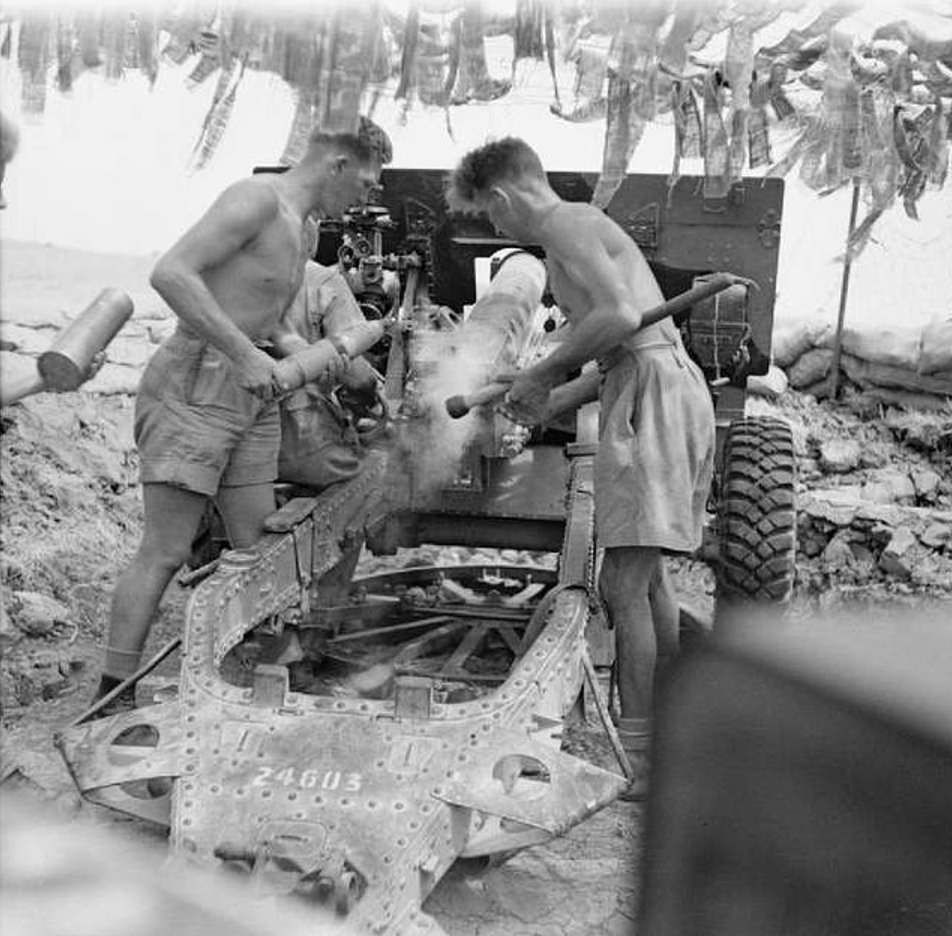
In the event, the 90th City of London Field Regiment played an important role in the operation, staging an amphibious landing at Syracuse on 13 July and it was subsequently involved in actions around Mount Etna.
In October 1943, the 50th Northumbrian Division – including the 90th City of London Field Regiment - was returned to the UK to prepare for further challenging amphibious landings which were to come on D Day. Once again it would have a key role in spearheading the amphibious assaults.
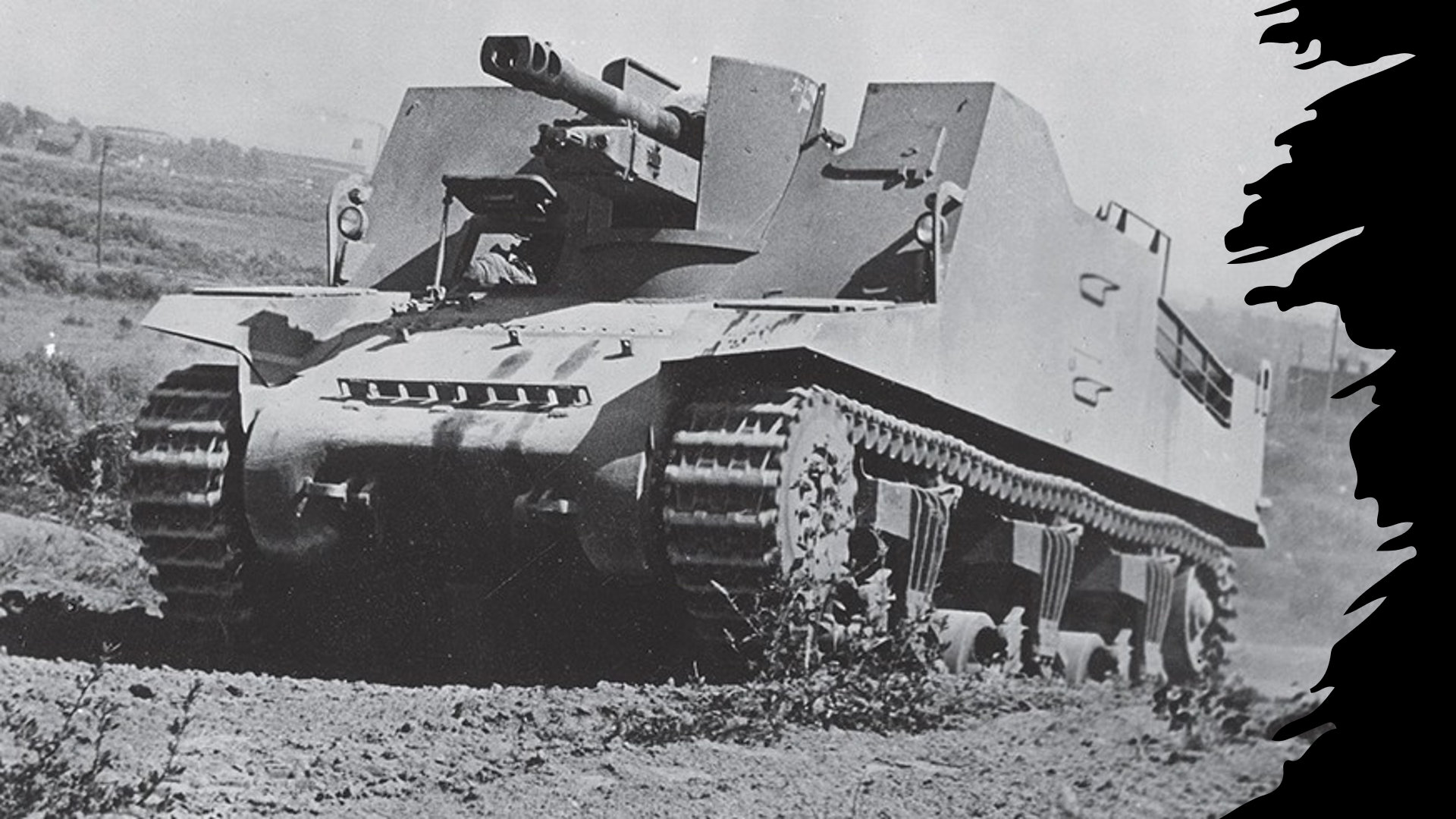
During the time the 90th City of London Regiment was preparing for D-day there was a radical change in their equipment. They changed from towing their field guns to new ‘self-propelled’ field guns known as Sexton Mark 11s.
D-Day
On D-Day itself the 90th Field Regiment was assigned to support the assault of the 231 Infantry Brigade Group on the most westerly sector of Gold Beach on the Normandy coast.
The Regimental War Diary for 6 June 1944 reports that at 06:50 hrs the ‘Sextons’ began their ‘shoot’ from their landing craft. That is whilst they were still in transit towards the beach. The War Diary also confirms that by 08:25, A, C and E Troops of the 357 Field Battery had landed on Gold Beach. (Jimmy was in A Troop.)
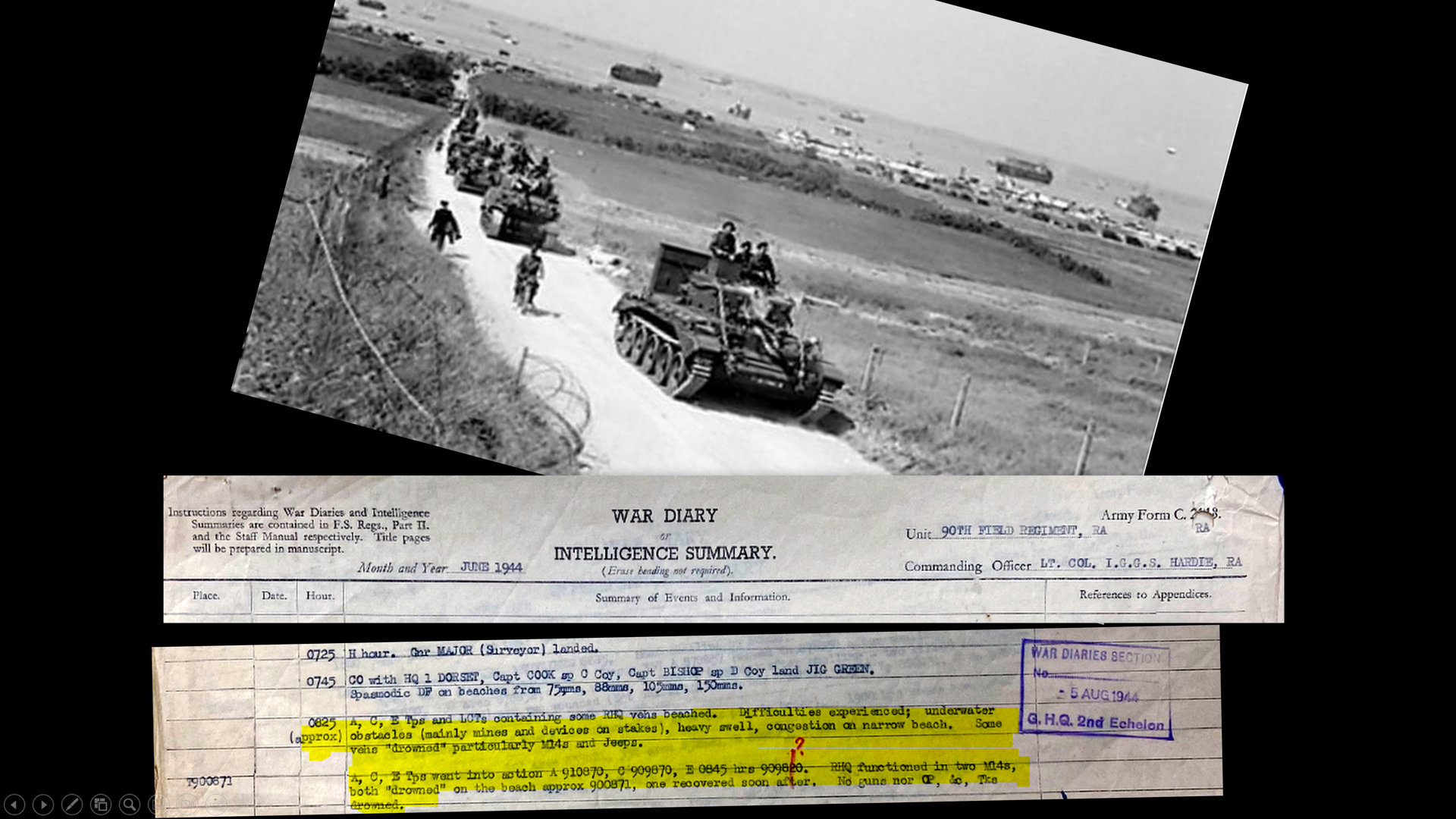
So, we know that Jimmy Callander and his fellow gunners were absolutely central to the very first assault on the Normandy beaches on D-Day. It is recorded elsewhere, that the Sextons of the 90th City of London Regiment were the first artillery to land on the ‘Jig’ (western) sector of Gold Beach.
The Liberation of Brussels
After the D-Day landings the 357 Field Battery fought their way through northern France with the objective of reaching the Rhine crossings around Arnhem in the hope of cutting off a German retreat. We know from the Regimental War Diaries that on their way to Holland, they fought with some elite German units, who were retreating from the launch sites in Northern France of the V2 missiles that had been causing enormous fear and considerable destruction in England. The Regimental War diaries record that after a high-speed advance following fighting around Arras, the Field Battery played an important role in the liberation of Brussels on 3rd September 1944. Photographs from the time capture some of the ecstatic welcome the British troops received from the local people.
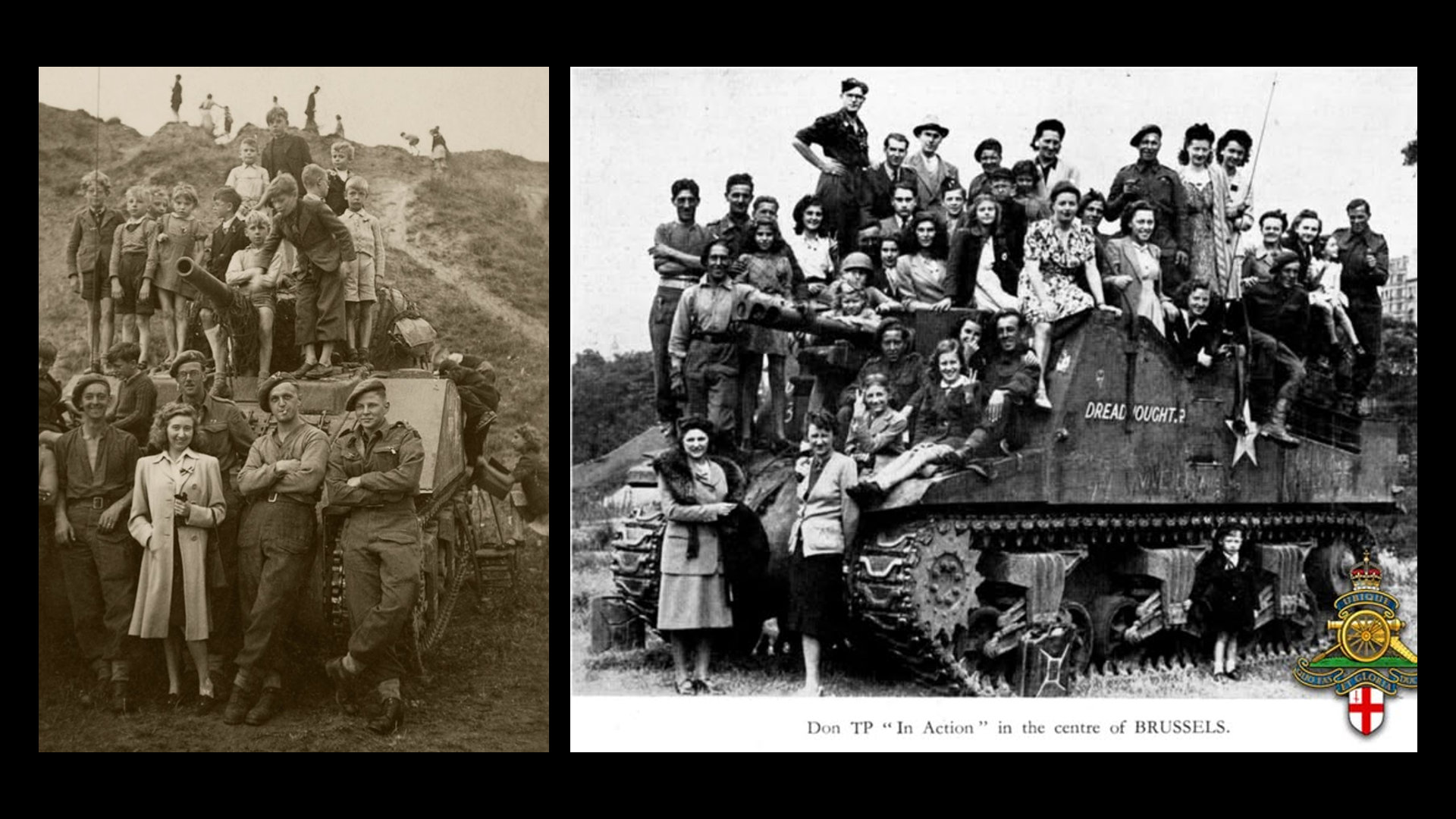
For Jimmy Callander and his gunner colleagues these scenes must have been such a stark contrast to the terror and degradation they had witnessed in the previous four years. Of the horror of desert warfare in North Africa, of the visceral fear and terror of the amphibious landings on Sicily and the close quarters fighting that followed; and a few months later the terrifying experience of seeing hundreds of your fellow soldiers being blown to pieces on the Normandy beaches and of witnessing men who had become close friends meeting their deaths whilst standing next to you.
From the perspective and comfort of today, it is difficult to fully appreciate how the young men – like Jimmy Callander, who only a short time before had been serving and delivering groceries in Strathblane – were able to process the brutality and the traumas they had experienced over the preceding four years and then to be faced – quite suddenly - with the sheer joy of the liberated citizens of Brussels.
Operation Market Garden
September 1944 witnessed the start of Operation Market Garden, one of the best known Allied operations of the war (immortalised in the 1977 film A Bridge Too Far).
The ‘Market’ element in the name referred to an ambitious and highly risky attempt to land airborne troops and equipment into German-occupied Netherlands. The objective was to capture bridges in order to cut off the German retreat and to provide an invasion route into northern Germany for the Allied forces advancing from Normandy.
The ‘Garden’ element of the operation was for Allied land forces advancing from Normandy to cross the bridges and hopefully secure the gains achieved by the airborne operation.
Thanks to the film, it is now well known that the ambitious plan turned out to be, as suggested by the title of the film, ‘a bridge too far’. It resulted in a huge loss of life and equipment. It was also significant in shaping the events that resulted in Jimmy Callander’s death.
Jimmy's Death
Following the liberation of Brussels and Antwerp, three weeks later, the 90th City of London Field Regiment found itself engaged in attempting to repel German counter attacks after Operation Market Garden in what became known as the battle of the ‘Nijmegen Salient’.
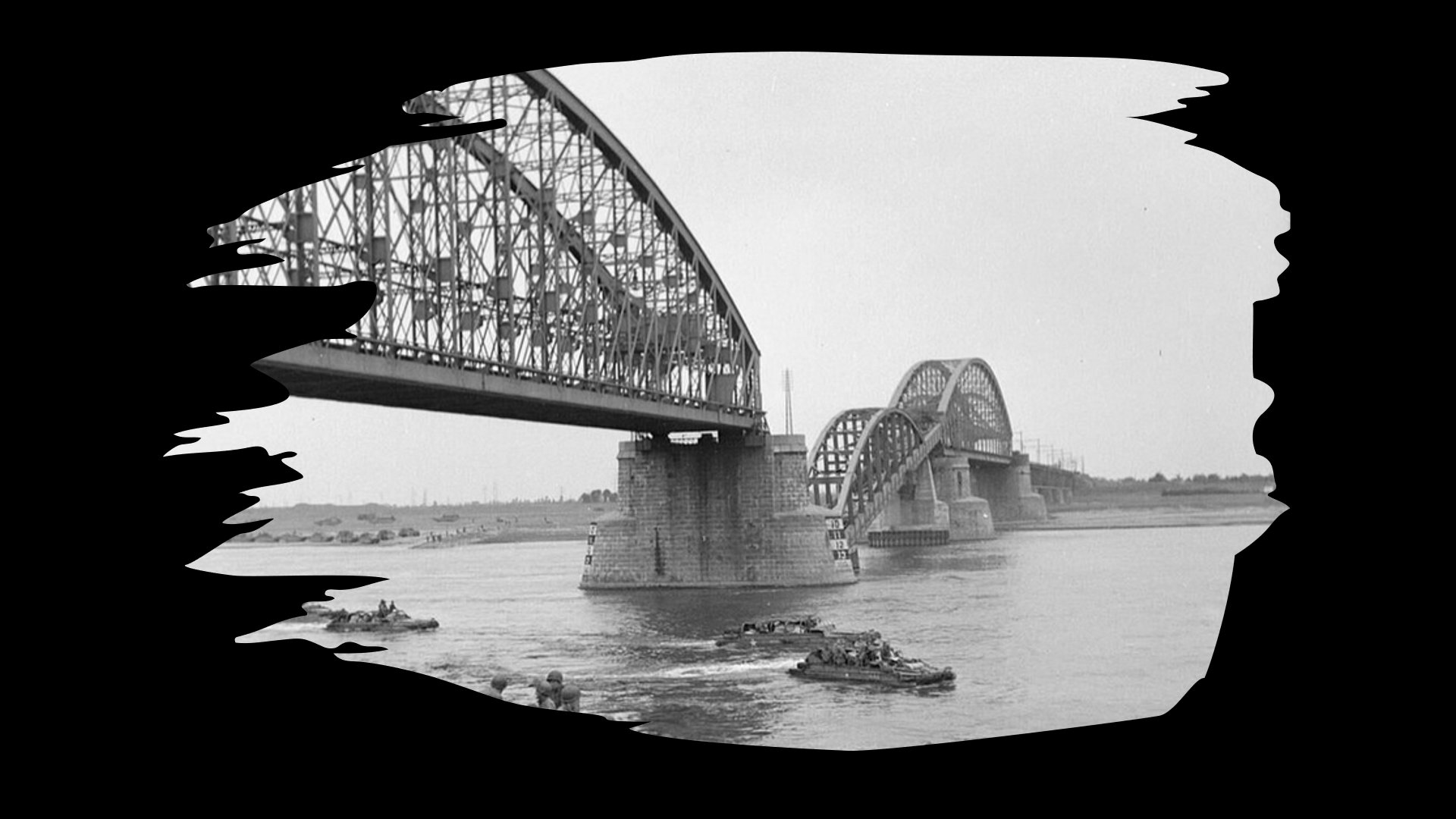
On 2 October Jimmy Callander and A Troop were located close to a bridge crossing of the lower Rhine near Bemmel. Seemingly out of nowhere, a single German anti-personnel bomb fell on their position. Jimmy Callander was killed.
Gunner Bill Woffenden, who was beside him, later told his son, Chris: "It was very sudden, very unexpected and Jimmy was struck in the chest by a piece of shrapnel. This fragment that killed him was no bigger than a thruppenny bit." He died instantly.
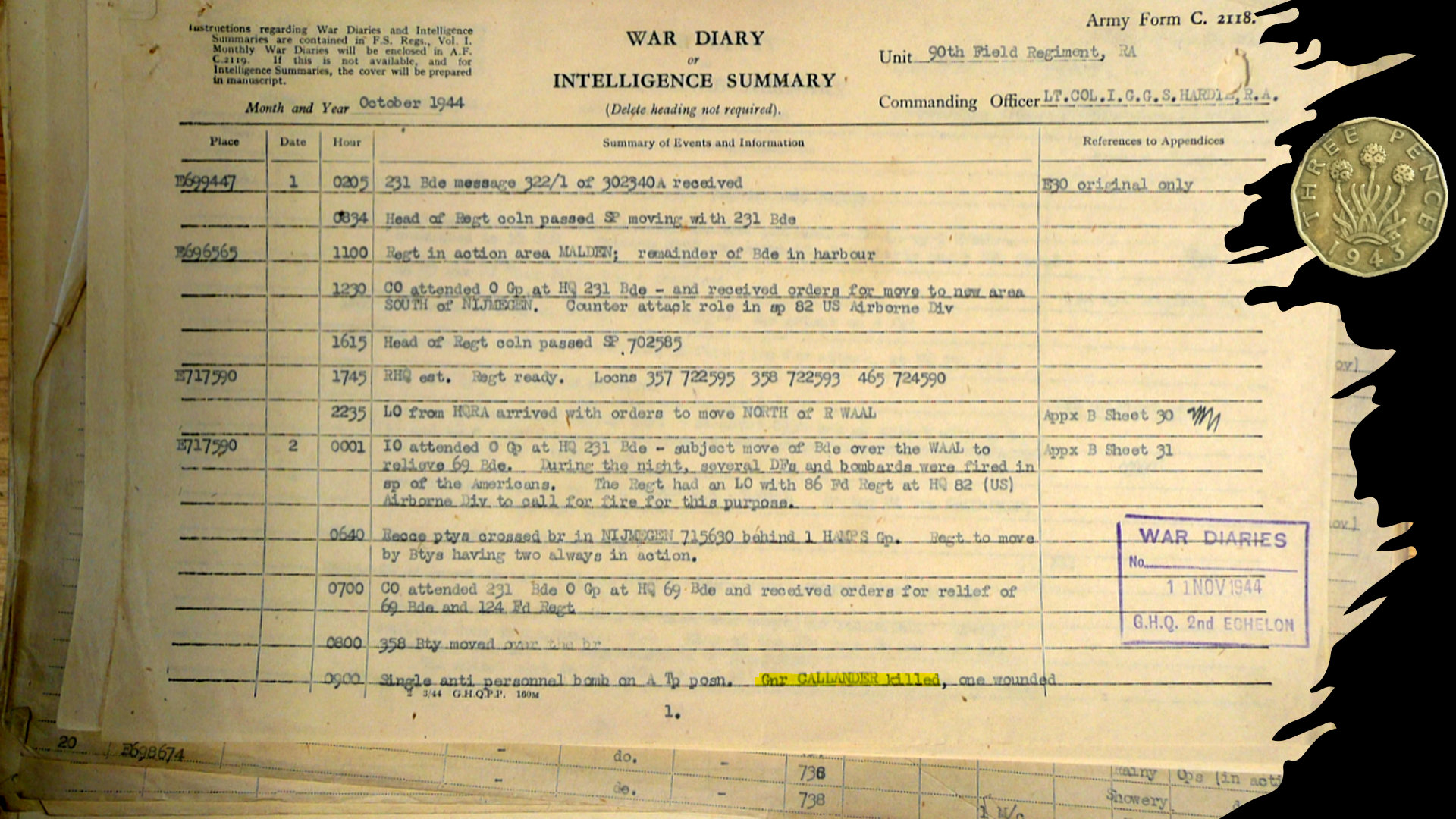
The Regimental War diary for 2 October 1944 records: "09.00 hours Single anti-personnel bomb on A Tp posn. Gnr Callander killed. One wounded."
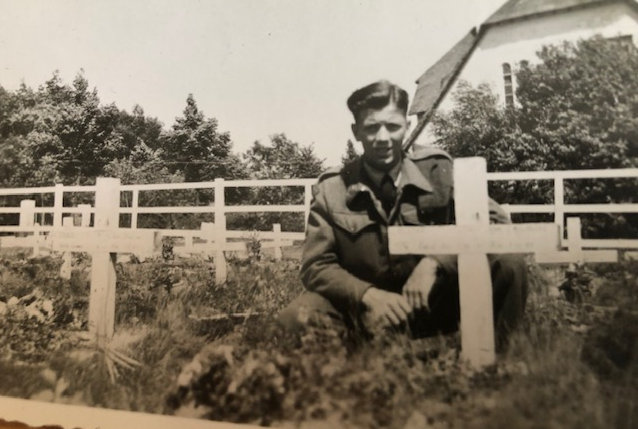
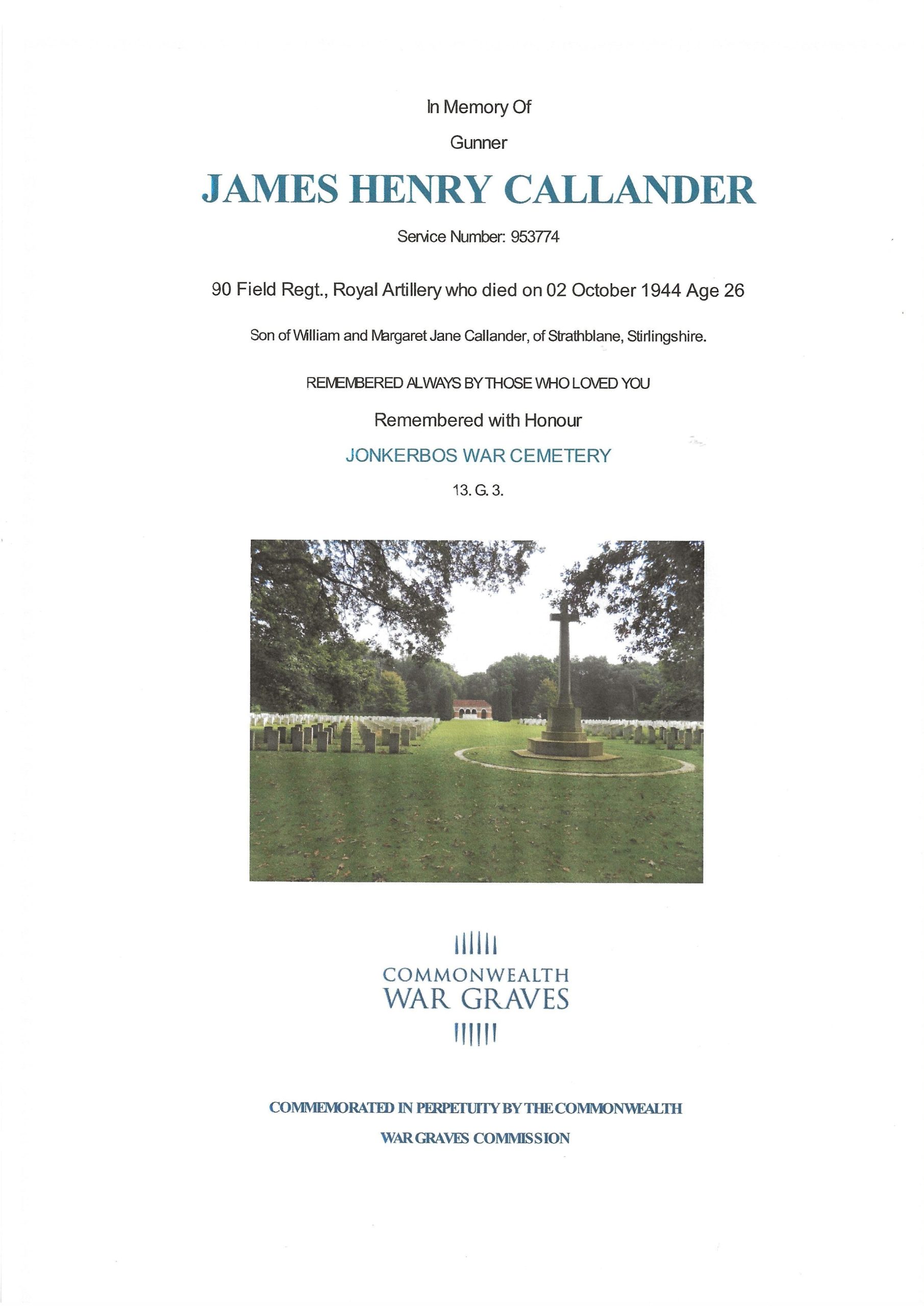
Jimmy’s family have photographs of his brothers – Clemy and Bill, both in military uniforms, at his temporary grave close to Bemmel. We believe these photos must have been taken in late 1945. His body was subsequently reburied at the Jonkerbos War Cemetery, Nijmegan, which is now maintained by the Commonwealth War Graves Commission.
In January 1949 Jimmy’s mother received a letter from the Director of Personal Services at the War Office, enclosing two photographs of Jimmy’s grave and the temporary cross that had been erected.
It cannot have helped his grieving mother to believe that Jimmy’s sacrifice had been valued when the family name was miss-spelled in the letter as Callender rather than Callander.
Sometime after the end of the War, Mrs Callander received a small brown cardboard box through the post. It contained the six medals and their ribbons which Jimmy’s war service had earned him.
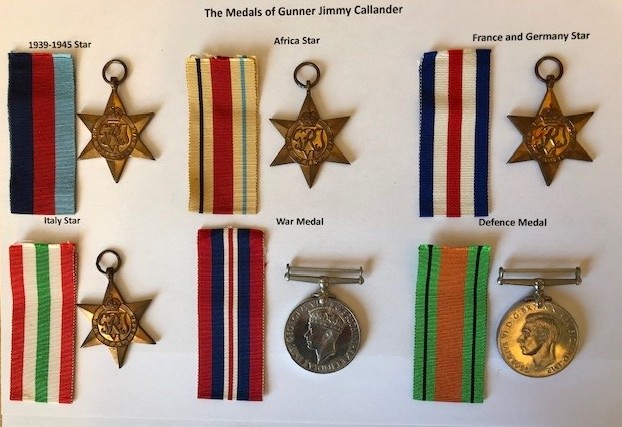
Many thanks to all on www.facebook.com/people/90th-Field-Regiment-RA-in-World-War-II and in particular Chris Woffenden, son of Gunner Hedley (Bill) Woffenden. See also https://ww2talk.com/index.php?threads/90th-city-of-london-field-regiment-ra.31996/page-2 . Thanks also to Jimmy's nieces Shona Railton and Heather Murray for all her help.
Daniel Davidson
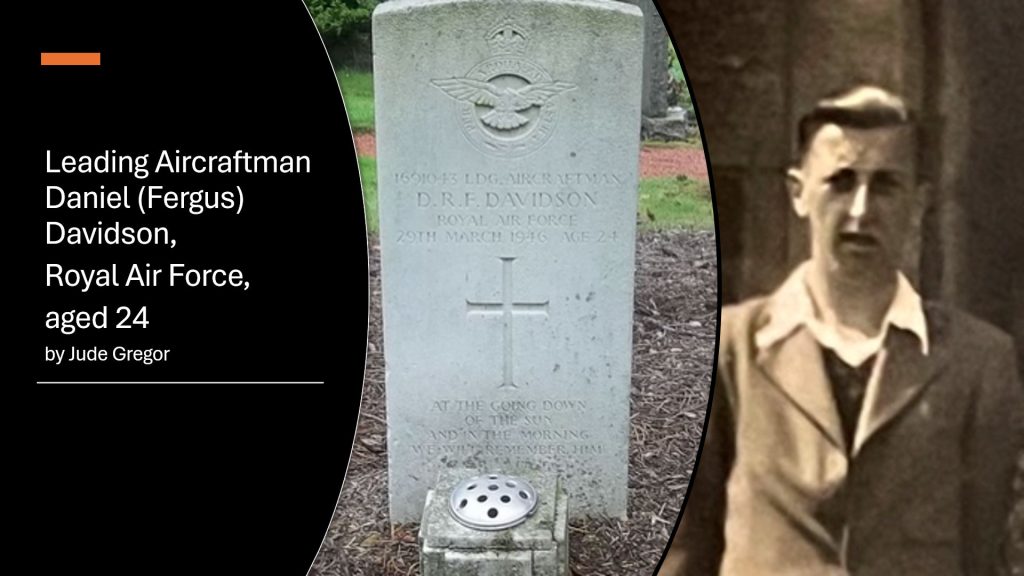
At the going down of the sun and in the morning we will remember him
These well-known words adorn the somewhat forlorn-looking grave of Daniel Roy Ferguson Davidson in Strathblane cemetery - but who was he? He was quite an enigma: born in Glasgow in 1922 and died in Hairmyres Hospital in East Kilbride in 1946. How come his name was not on the war memorial but he has a Commonwealth War Grave? Where does this tall willowy man fit into the story of Strathblane's World War Two heroes?
Campbell Davidson and Williamina Peterson married in Glasgow in 1921 and were still living there when their first child, Daniel Roy Ferguson Davidson, was born in 1922. He was always known as Fergus to his family. They had strong family links to Stirlingshire dating back to 1883 when Fergus’s grandfather, also called Daniel Roy Ferguson Davidson, married Annie Martin from Fintry. This man, described as a master iron founder on his wedding certificate, went on to become superintendent at the well-known Carron Ironworks in Falkirk.
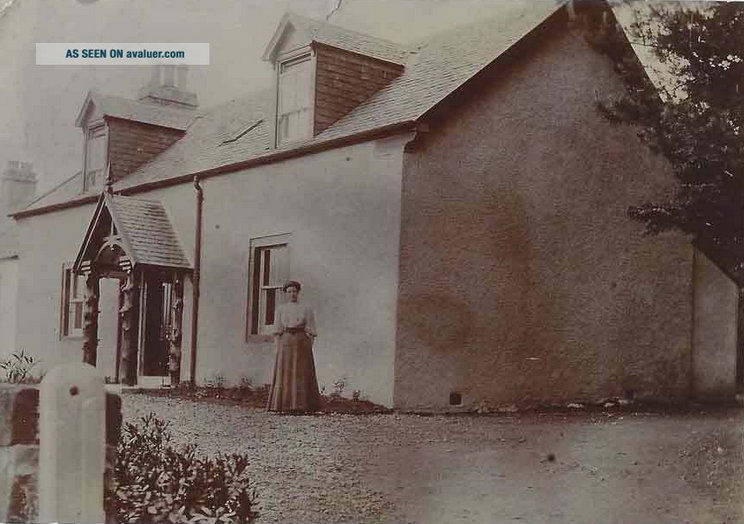
The Davidson family were living in Blanefield by the time Fergus’s siblings were born: Alfred William Davidson (known as William) in Burnside on Station Road in 1924, followed by Annie Martin Davidson in 1927, Margaret Smith Davidson in 1929 and Campbell Davidson in 1931. By this time the family were living at Blairquhosh Cottage, near Glengoyne Distillery, on the Duntreath estate, where Campbell Senior was working as a joiner. The older children almost certainly attended Strathblane School.
Tragedy struck the family in 1932. Campbell Snr died of influenza in March. As a result, the family had to leave their tied house on the Duntreath Estate and moved to Fintry to be near extended family. Even more sadly, Williamina, the mother, died of influenza in December the same year. That left the five children orphans and they were split up. Seemingly Fergus and William went to live with his father’s spinster sister, Aunt Annie, in Fintry and the girls were taken in by another aunt in Bearsden. Baby Campbell was very fortunate. He was adopted by his father‘s oldest brother David, 13 years his elder, and his wife Rose who lived near Rotherham in Yorkshire. David had moved there to work as a huntsman. Their son Cyril had died in his teens and so it was a very serendipitous adoption and Campbell‘s daughter Fiona and her family are the family’s sole descendants.
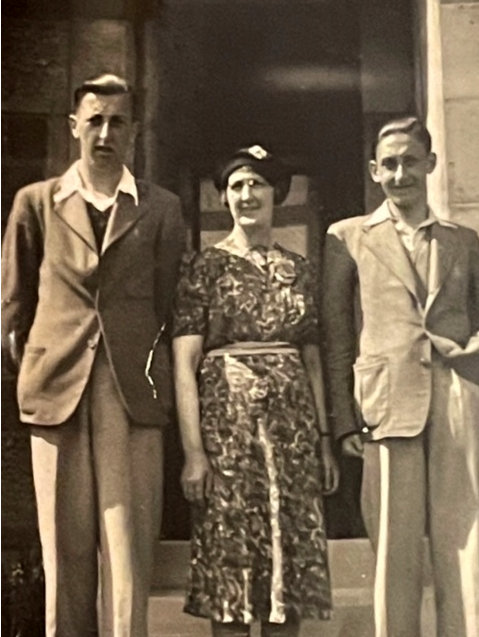
Fergus was tall and lanky. He was over 6 foot but only had a 34-inch chest. This is the only photo I have of him, seen here on the left with his Aunt Annie, his dad’s sister, and his brother William. The boys were ten and eight respectively when their parents died.
In 1942 Fergus enlisted in the RAF and was posted to RAF Innsworth in Gloucestershire. He had hoped to become a pilot but unfortunately his six- foot frame was a major disadvantage as squeezing into the narrow spaces on a WWII plane was too difficult.
He became a member of the Royal Air Force Volunteer Reserve. Service life and training obviously suited Fergus. (By this time Innsworth was also used as a training camp for young women who had volunteered for the WAAFs and I can't help wondering if this tall nice-looking chap ever caught the eye of one of them!) At any rate Fergus flourished, and by May 1943 he had been promoted to Leading Aircraftman. These men were skilled technicians and craftsmen who played a vital role in ensuring the operational readiness of an aircraft.
On the 29th of December 1944 Fergus set sail from Liverpool to West Africa, then often dubbed "The White Man’s Grave", due to the hot and humid conditions and tropical diseases. It was said that those posted there were told their time there would count double for overseas service because of this. As a Leading Aircraftman and mechanic Fergus’s destination was probably the port of Takoradi on the Gold Coast (now Ghana). This little-known venture has been officially recorded as the "West African Reinforcement Route". Planes were shipped out from the UK in sections and assembled in the West African port by trained mechanics.
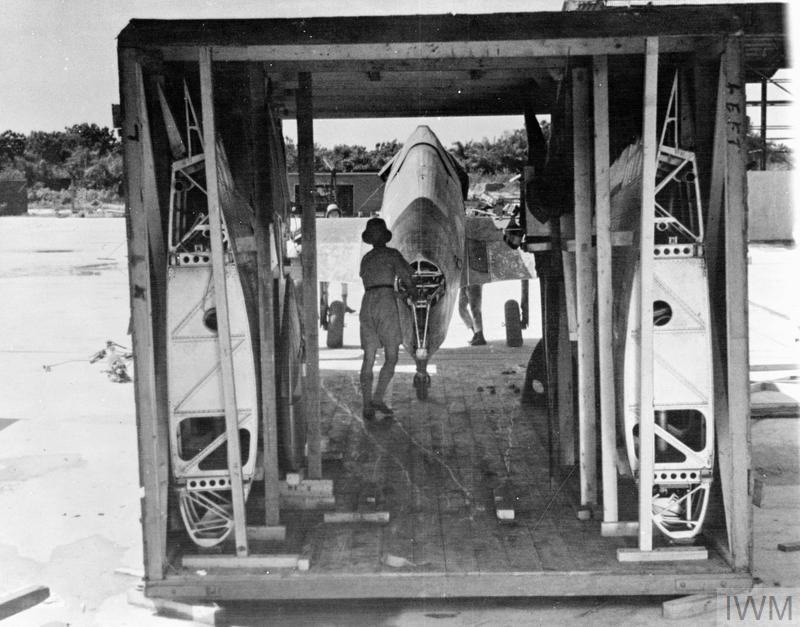
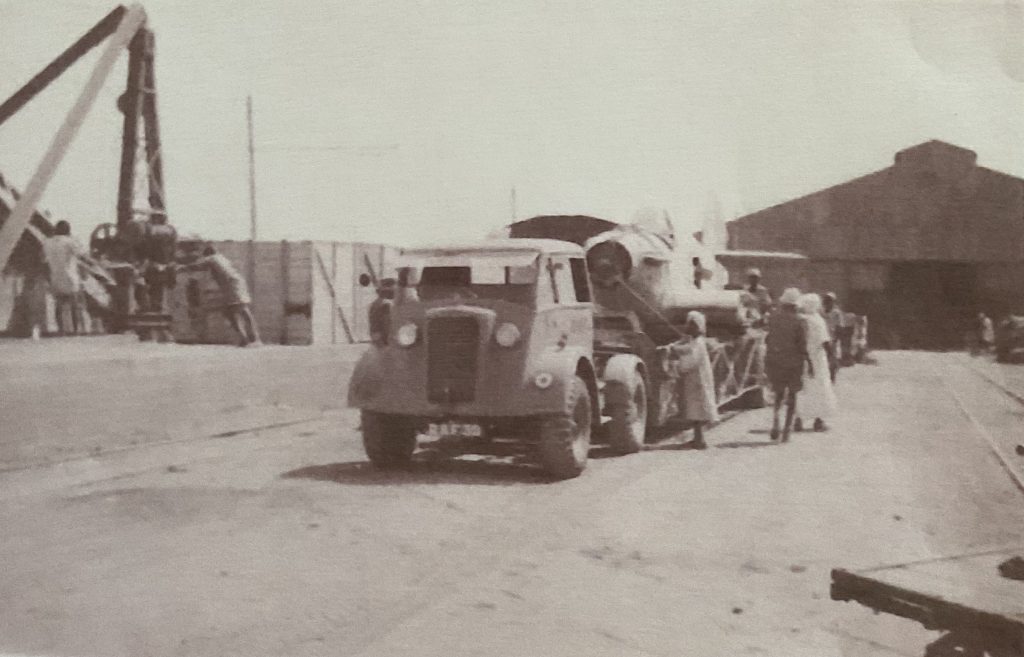
You can see from the first photograph that a section of one RAF aircraft is being uncrated at Takoradi. The second shows that a truck has been loaded with a Hurricane and is arriving at the base where maintenance mechanics will rebuild the plane.
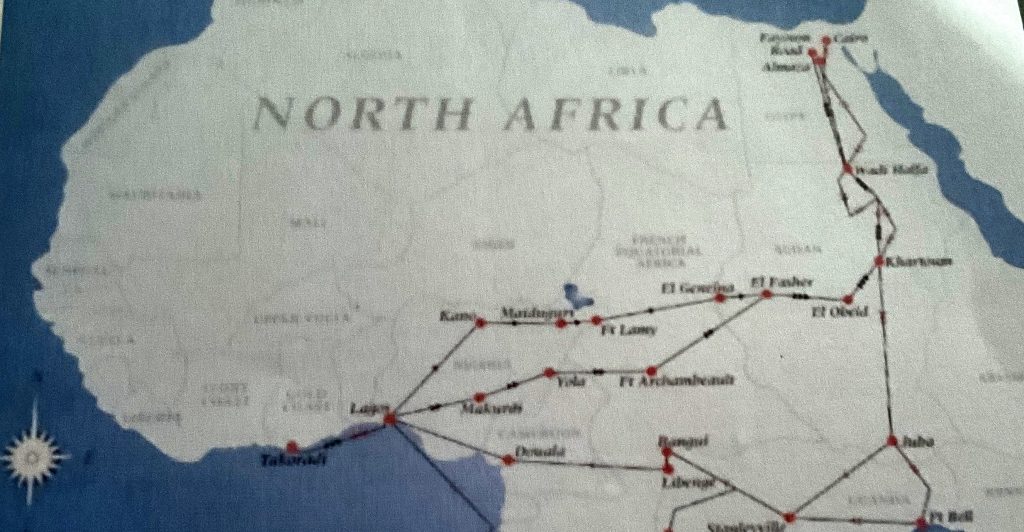
As you can see from this map, a series of secret landing strips had been built across Africa south of the Sahara. The newly assembled or repaired aircraft used these strips as bases to fly across Africa in a series of hops due to their limited fuel. Very ingenious! Fortunately for Fergus, by the time he arrived in Africa the Battle of El Alamein had ensured a pivotal victory for the Allies so life was less dangerous.
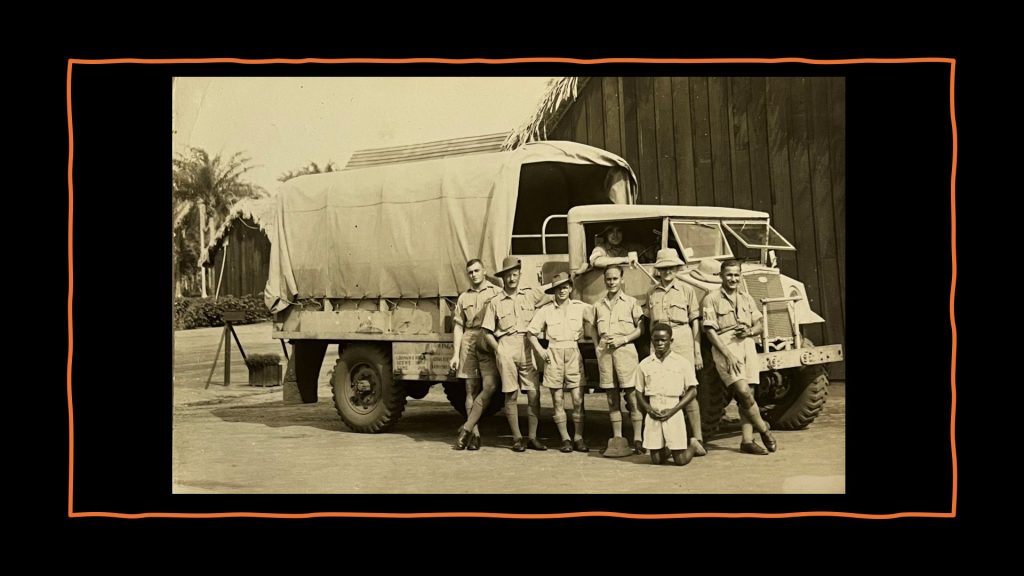
This photo is of air mechanics in West Africa. It’s personal and slightly emotional for me as in the group photo the man on the far right hand side is my uncle, also a Leading Aircraftman. I can but wonder if he and Fergus crossed paths at some point?
World War Two ended in September 1945. Fergus was never actually demobbed. He returned to Scotland to live with his Aunt Annie, who by now was living in Glasgow. Doubtless, she was proud of her nephew returning with his War Medals - the 1939-45 Star and the War Medal. Unfortunately, however his health had deteriorated and he was admitted to Hairmyres Sanatorium near the then village of East Kilbride. The hospital concentrated on treating patients with TB and chest diseases. Despite all the specialised treatments, Fergus failed to recover and died on 29 March 1946. Causes of death were listed as pulmonary tuberculosis, a collapsed lung and cardiac failure. His death was witnessed by his Aunt Annie and, as he had never been discharged, he was described as having "died on active service”. Consequently, the Commonwealth War Graves Commission erected a war grave for him in Strathblane Cemetery.
And what of the remaining Davidson family?
Quite a few of Fergus’s relations are buried in Fintry kirkyard. His Aunt Eliza born in 1898, never married and lived in Glasgow but is buried in Fintry.
His Uncle James Martin Davidson was born in 1888 and also had a son called Daniel Roy Ferguson Davidson. This child was born in Glasgow in 1922 a couple of months after "our" Daniel Roy Ferguson Davidson. Not such a coincidence, perhaps, as both babies were named after their paternal grandfather, the man who ruled the roost at the Carron Ironworks. Such is the lottery of life that this cousin survived his namesake and exact contemporary by 70 years! (He died in Banchory in 2016, aged 94.) His father James, or Jimmy as he was known, worked in Fintry as a joiner, and is still remembered there.
His Aunt Annie, who took in Daniel (Fergus) and brother William after the boys' parents died, had been born in Fintry in 1885 but lived latterly in Glasgow. She registered Fergus’s death. She died in 1972 in Killearn and is also buried in Fintry.
What became of Fergus’s siblings? Neither William nor the two girls, Annie and Margaret, ever married. The girls were apparently evacuated to Australia during the war. They both had good jobs and together they bought a house in Cedar Road in Killearn in the early 70s. I was told that they were neighbours who "kept to themselves" and were frequently visited by their brother William, who died in Glasgow in 1984. Annie survived until 2005 and Margaret until 2013.
Fergus's youngest brother, Campbell, who was brought up in Yorkshire, died in Nottinghamshire in 2020, where his house was called Blanefield! We're delighted to have managed to contact his daughter Fiona. And finally, in May 2026, a monumental sculptor commissioned by Strathblane Heritage added Fergus's name, Daniel R F Davidson, to Strathblane War Memorial. Now we can truly say: "At the going down of the sun and in the morning, we WILL remember him."
Andrew Maclean
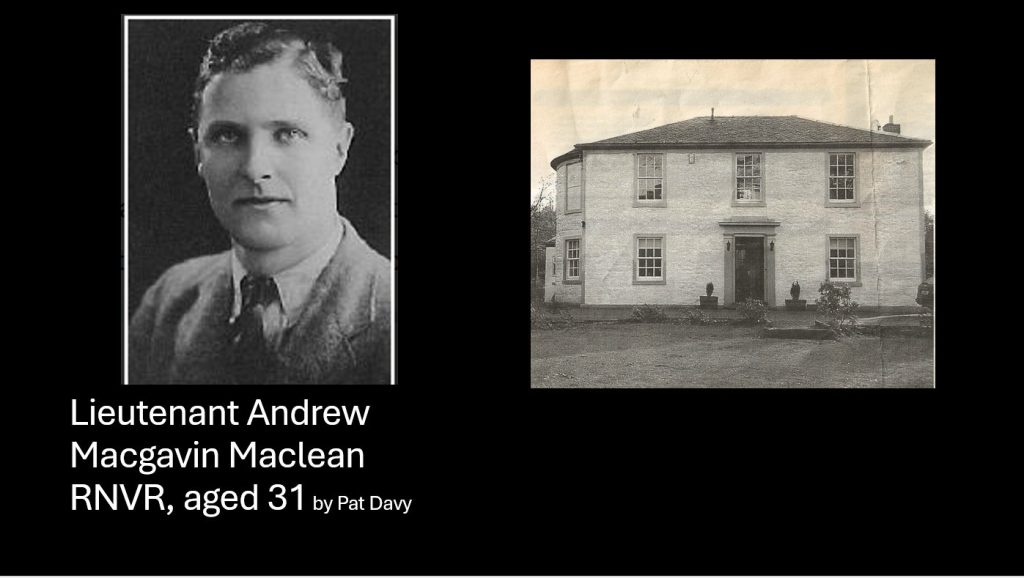
This is Andrew Macgavin Maclean whose family home was Milndavie House, Strathblane. Many of you will know it as I certainly do. His sister Jean (or Miss Maclean as I knew her) lived there until 1982 & my husband and I bought a piece of her lovely garden in 1975 to build our home. I knew the inside of Milndavie House well and believe it had barely changed since Andrew had lived there, but I knew nothing of his life or untimely death until now. This is his story.
Andrew died aged 31 on 18th February 1940 and is remembered on a gravestone with his family in Strathblane Cemetery.
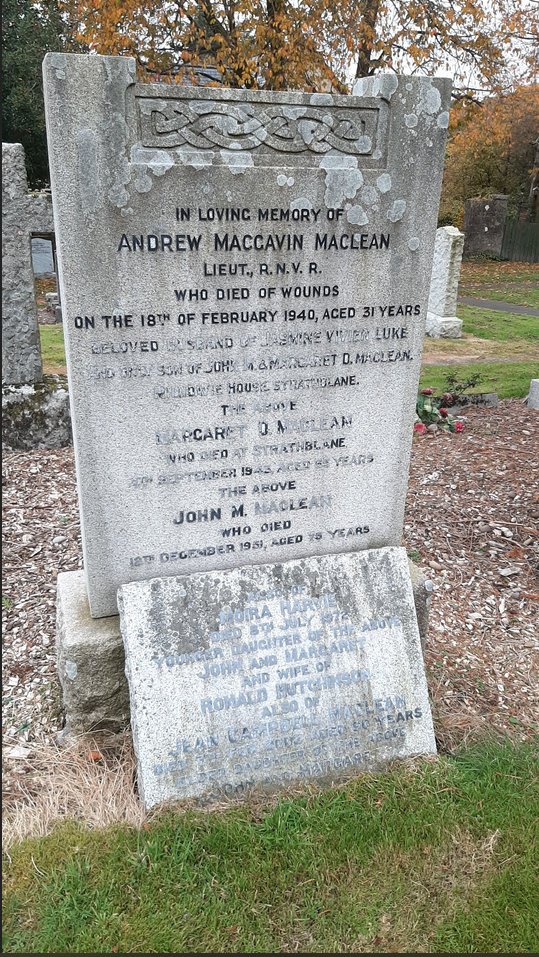
As the minister observed at his funeral on 21 February: “When Andrew Macgavin Maclean was taken from us, he stood on the threshold of life”.
Andrew’s character is described here by the minister during his eulogy: "He had the greatest of all gifts in these days of hurry and bustle – the ability to prolong a conversation into the small hours of the morning, and season it with a ready wit.”
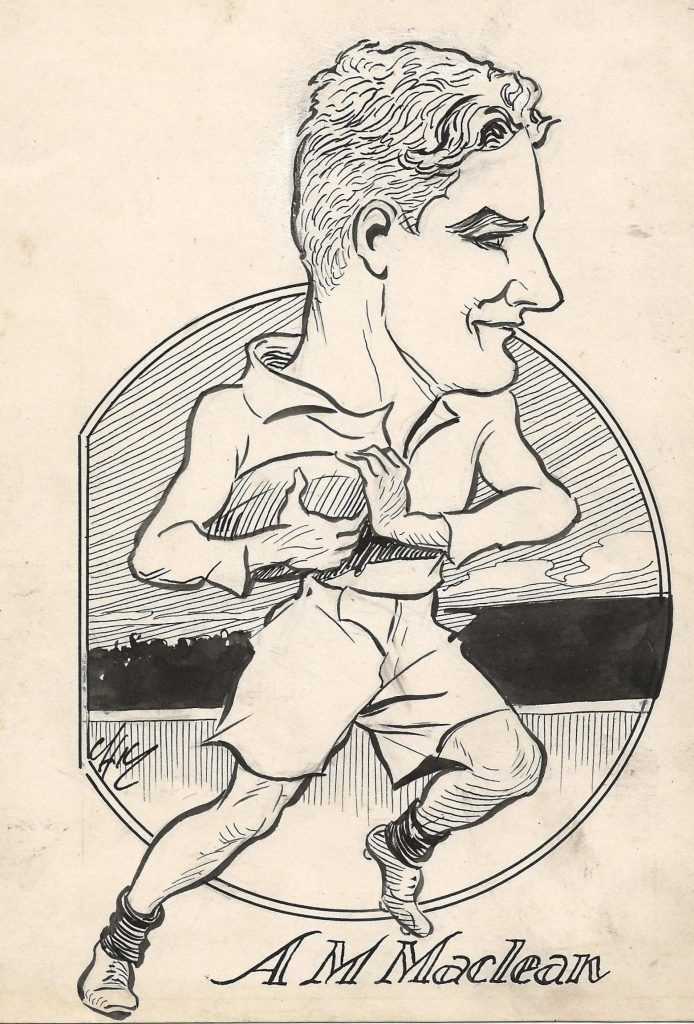
Andrew was born in 1908 in Long Ashton, Somerset to John and Margaret Maclean but the family soon came back up north to join John’s widowed mother in Kirklee Gardens in the west end of Glasgow. He spent some of his young days at nearby Kelvinside Academy, which his uncles had also attended. He was later to become Captain of Kelvinside Academicals XV Rugby Team and he also trialled for the Scottish International Rugby Team when only 18 years old.
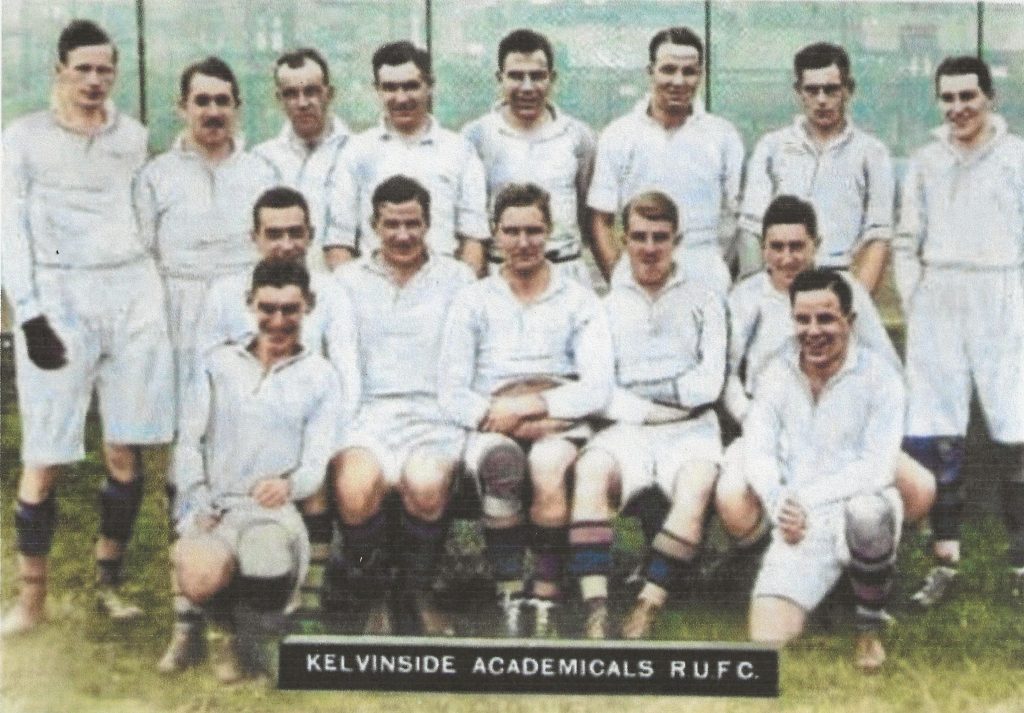
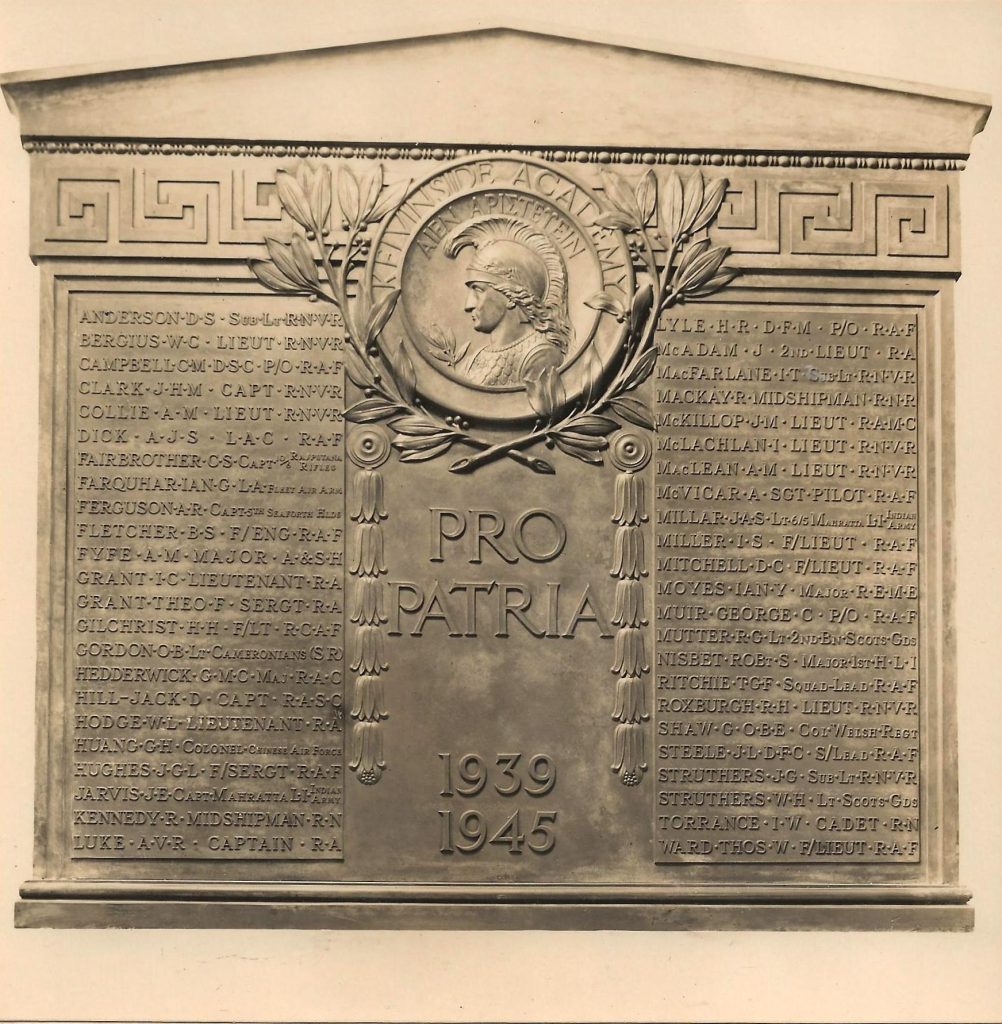
Andrew is in the centre front of the photo and displays a bandage from a knee injury, which finally ended his playing days. His name is also on the Kelvinside Academical Memorial plaque in the school.
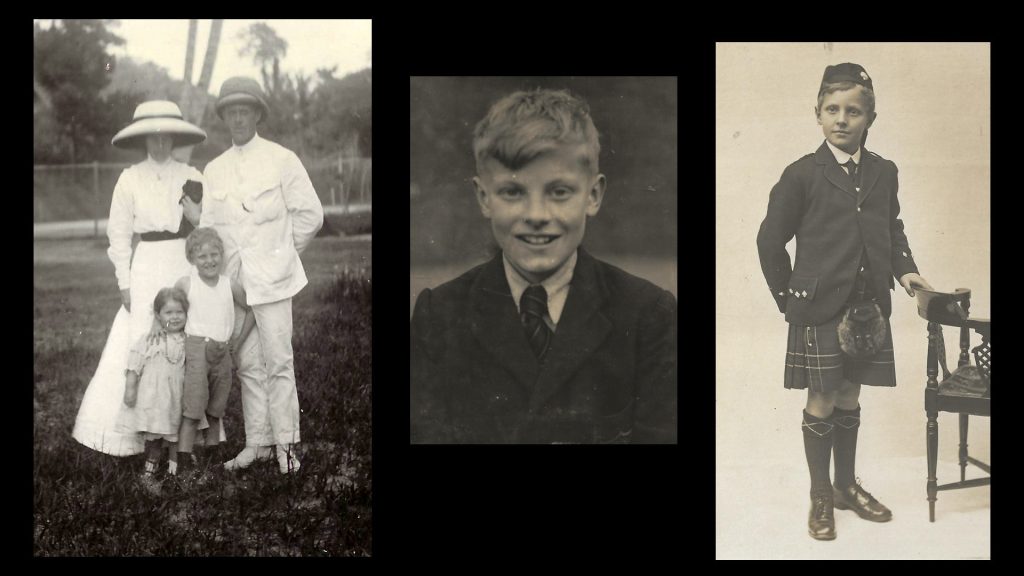
His father’s occupation as a civil engineer took the family to many different locations not just in Britain. By the age of 6, Andrew was with the family in Singapore where his sister Moira was born. In this photo Andrew is with his sister Jean. By 1921 the family were back in Durham where Andrew attended West Hartlepool Preparatory School before continuing his studies at Loretto Boarding School in Musselburgh. He was a Prefect, excelled at several sports and was one of the Editors of the Lorettonian, the school newspaper.
After leaving school in 1927, he entered Glasgow University in the Faculty of Engineering, following in his father’s footsteps, but soon realised this career was not for him. He had a complete career change, becoming a journalist with the Scottish Daily Express.
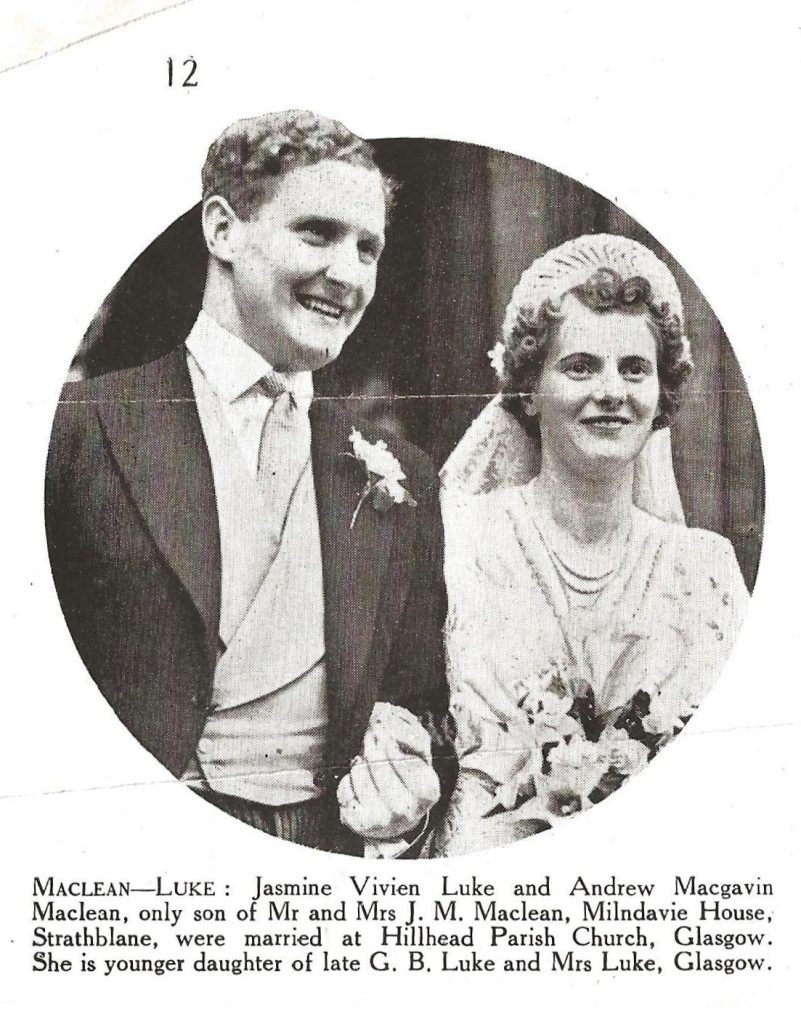
War was approaching and in October 1938 Andrew enrolled in the RNVR (Royal Naval Volunteer Reserve) in the Clyde Division. By now his family was living in Milndavie House in Strathblane. The following year he was promoted to Sub Lieutenant and before long to the rank of full Lieutenant. On 1st November 1939 he married Jasmine Vivien Luke at Hillhead Parish Church and set up home in Lilybank Gardens in the west end of Glasgow.
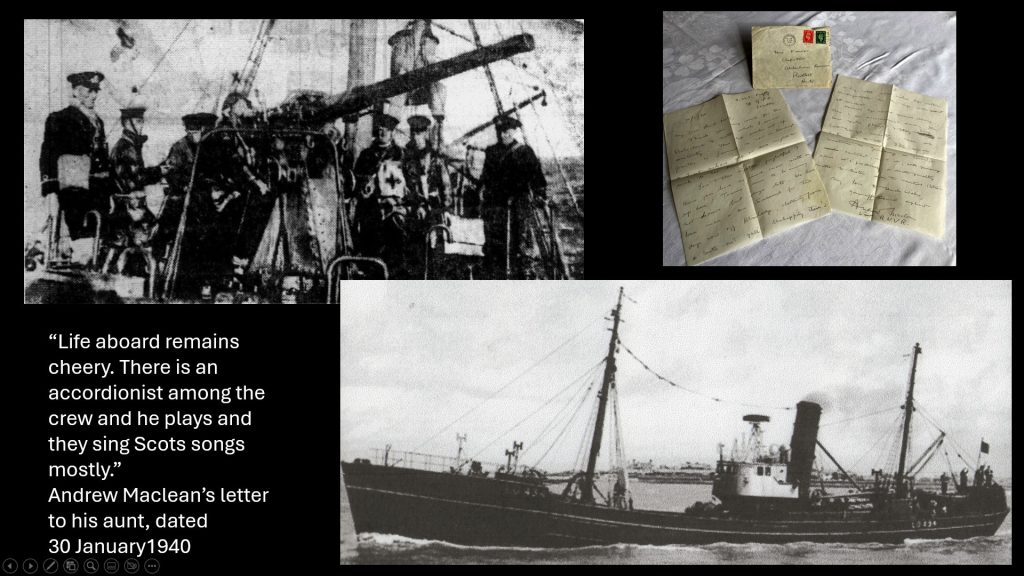
Andrew was to serve on HMS Firefly, a former fishing vessel converted to a Minesweeper. Seemingly, he told his family that this was a rather cushy appointment that would keep him out of the enemy’s firing line. He was able to visit his new wife two nights a week in Edinburgh. This letter was written to his Aunt from Firefly on 30 January 1940: “Life aboard remains cheery. There’s an accordionist among the crew and he plays and they sing Scots songs mostly.”
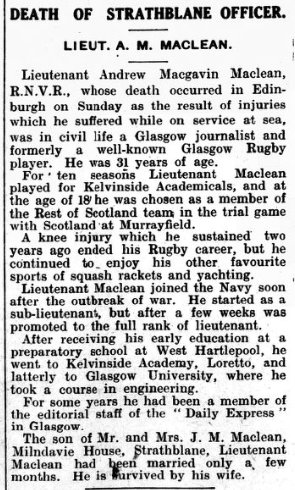
Four days later on 3 February 1940 his ship was deployed in the Firth of Forth to defuse a mine that had broken away from a British minefield. This was a routine but dangerous manoeuvre which would end in tragedy. An oar from the small boat lowered to move the mine was pushed against it by the bow wave from a British destroyer, which was passing at full speed. It exploded. Most of the crew were watching this from the side of Firefly and all were killed. Of 18 crew members, only four survived who were in the galley or wheelhouse, including Andrew. He was taken to Edinburgh Royal Infirmary where he sadly died of his wounds two weeks later on 18 February 1940, only three and a half months after his marriage to Jasmine. His death certificate records the causes of death as including injuries to his ribs, right eye and left thigh and septicaemia. Nowadays his death would be referred to as ‘friendly fire’.
We now know that Jasmine was able to visit him in hospital. But what was not reported or perhaps not even known at that time, was that Jasmine was just pregnant with their son, born eight months later on 22nd October 1940 and named after the father he would never know.
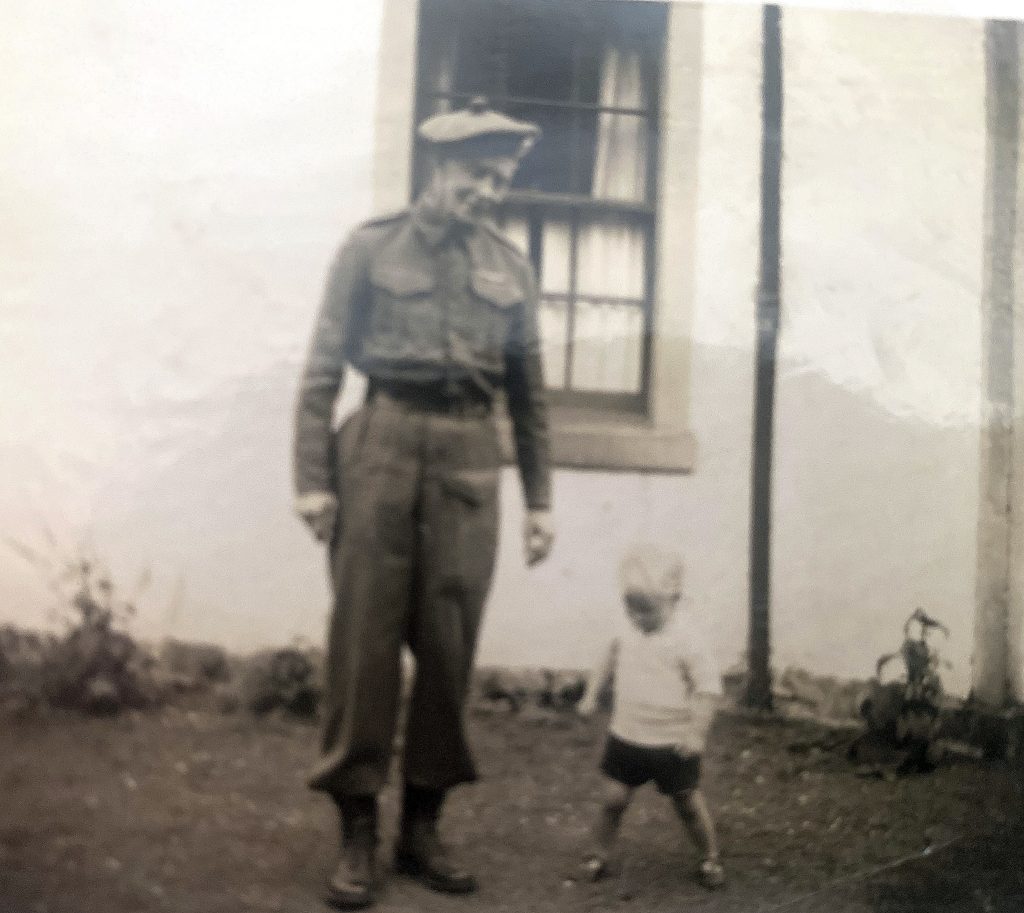
Andrew Ronald Macgavin Maclean, as he was known, had a good life, becoming a successful businessman, despite also losing his mother when he was only 8 years old. He was raised by Jasmine’s sister and only passed away in late 2024 at the age of 84. He had been aware of our work on this memorial project and gave it his blessing.
Anne Balfour and I met his son, (Andrew Snr’s grandson), Angus and family who retain strong links with Strathblane as they visit every year to lay flowers at the family grave. Let’s finish with a final quote from Andrew Maclean’s 1940 eulogy: “Now his valiant fight is over and we bring him to haven in the kindly native soil of this beautiful Scottish churchyard.”
Archibald MacNicol
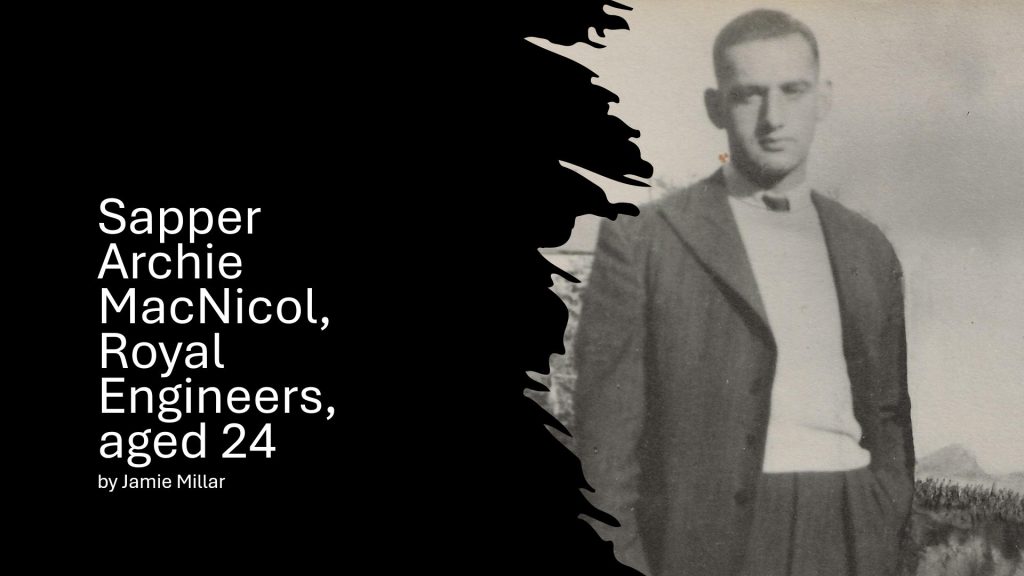
Archie MacNicol is commemorated on Strathblane war memorial as he was a resident of the parish and on Baldernock war memorial beside the church where his family worshipped. He also appears on the Brookwood 1939-1945 Memorial in Surrey, created for those with no known resting place. This is because Archie was lost at sea when the ship transporting his unit to North Africa was torpedoed and sunk in January 1943.
Archie was born on 17 September 1918, at Craigmaddie, between Strathblane and Milngavie. He was the first child of Alexander and Mary (née Watt) who had married on 6 June 1917. Alexander was living in Kames in Argyll and was serving at the time of his marriage and Archie’s birth in the Royal Naval Volunteer Reserve. A motor engineer by profession, he had enlisted in 1914 only days after the outbreak of the First World War.
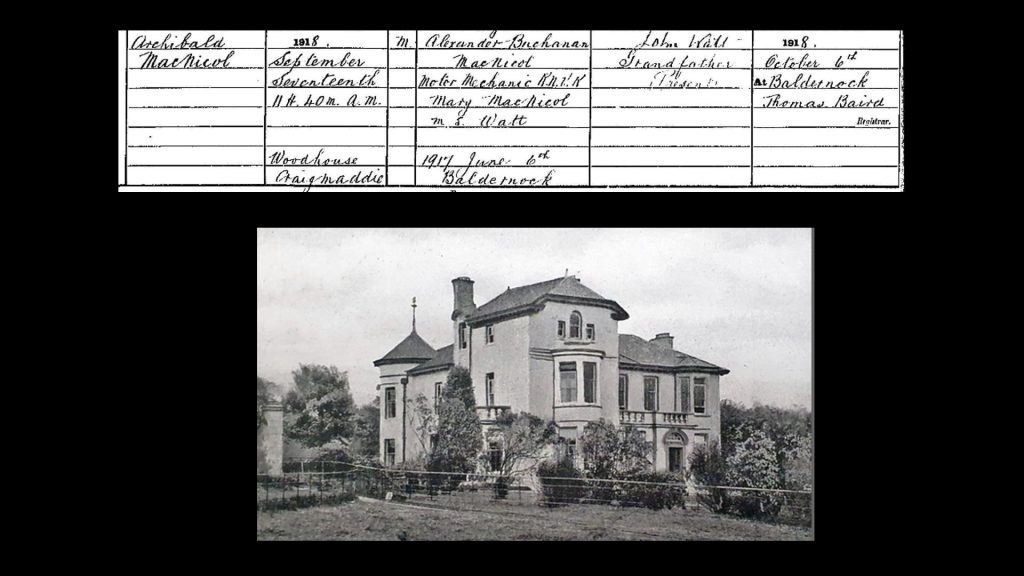
At the time of her marriage, Mary resided with her parents at Highwood, Easterton Estate, Craigmaddie. (She had seven brothers and was the only girl! Six of her brothers served in WW1 and all survived. They are commemorated on a brass plaque in Baldernock Church.) Mary’s father, John Watt, was a gamekeeper who worked for the Ker family, owners of Easteron Estate, Mugdock. All four of Archie’s grandparents were from Argyll and were Gaelic speakers. On his father’s side there was a strong connection, spanning several generations, with the gunpowder industry, which was carried on in Argyll throughout the nineteenth century.
Alexander and Mary went on to have five further children: Eoin (b 1920); Alexander (1922 and known as Alastair); Christopher (1925 and known as Christie); Janet (1927 and known as Jessie); Ronald 1929 (but who died aged one of peritonitis); and Alan (1938). All came into the world at Craigmaddie, apart from Christie and Jessie, born while the family were living in Balfron.
Alan is the only surviving sibling and has been the source of a great deal of information about his brother.
Mary appears to have returned to her parental home at Craigmaddie for the births of her first three children, as the valuation roll for 1920 shows Alexander, a seaman, as tenant of Rhumore Cottage, Kames and the 1921 census records Mary, Archie and Eoin at the same address, while Alexander is recorded as a Marine Mechanic on board MV Tarzan at Dunoon and employed by J. Kinnaird, Engineers.
By 1925 the family has moved to Balfron where the Valuation Roll for 1925-26 shows Alex Buchanan MacNicol, mechanic, as the tenant of a house in Buchanan Street, Balfron.
Details of Archie’s education are scarce but Alan is aware that his older siblings attended Balfron School even after the family moved from Balfron to Highwood Cottage at Craigmaddie on the death of Mary’s father in 1928. (Some of Mary’s brothers ran the local bus service.) Alexander also took over his father-in-law’s job as gamekeeper, as he is described as such and resident at Highwood on Ronald’s birth certificate in 1929.
The original cottage at Highwood has been demolished but Alan remembers it as a tiny three-roomed place which was extended after he was born to provide one additional bedroom.
Archie would have left school in 1933. Alan believes that he worked as a joiner until his enlistment in 1939, at which time we can find out more about Archie’s short life.
He enlisted in the British Army on 3 May 1939 and was sent to the School of Mechanical Engineers, Trade Training Wing at Kitchener Barracks, Kent.
On 13 September 1939, ten days after Britain’s declaration of war, Archie was posted to 240 Field Company Royal Engineers, based at Coatdyke Drill Hall, Coatbridge.
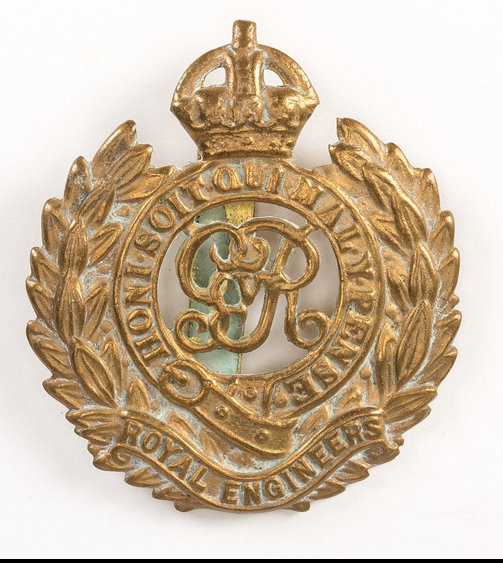
The Field Company was the standard unit of the Royal Engineers in an infantry division during WW2. 240 Field Company formed part of the famous 51st Highland Division. The principal functions of the Divisional Royal Engineers were bridging, demolitions, creation and clearance of obstacles and roadblocks, concrete and semi-permanent defences, development and maintenance of water supplies, and disposal of unexploded bombs and ordnance. A Field Company comprised normally seven officers, around 40 NCO’s and around 150 other ranks.
The War Diary of 240 Field Company records that between 20 and 25 August 1939 240 Field Company received a series of coded messages to prepare for mobilisation. On 31 August the Unit mobilise order was received and call up notices were issued.
The Unit left Coatdyke Drill Hall 05.00 on 17 September just four days after Archie had joined it and travelled to Preston arriving 17.45 where it was billeted overnight at barracks.
-Left Preston at 08.00 on 18 September. Arrived Swindon 18.05.
-Left Swindon 08.30 on 19 September. Arrived Southampton 13.30.
-Personnel embarked on SS Biarritz at 14.30 on 20 September and disembarked at Cherbourg at 12.05 on 21 September. Left Cherbourg at 18.25. Arrived at Lavogne and billeted.
-Left Lavogne at 08.00 on 2 September and arrived at Laval at 15.30. Billeted overnight at St Ouen Des Toits eventually arriving at Le Genest where the unit remained through October and November constructing gun emplacements and pill boxes.
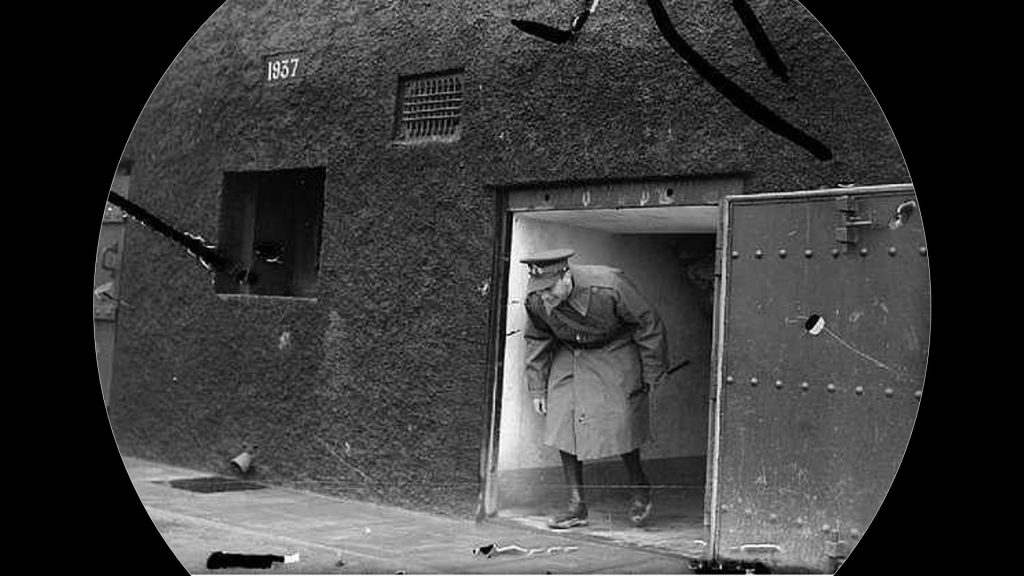
On 6 December the company was visited by King George VI at Libercourt in the Pas De Calais before departing for Annay Sous Lens on 20 December where it remained for the remainder of the “Phoney War” alternating between training on bridging, bren guns and rifle, watermanship and folding boat care and working on underground defences (sousterrains). An online researcher recently found Archie's name among graffiti in the tunnels.)
On 6 May information was received that Germany “may be about to invade Belgium”. This was upgraded on 7 May to Germany “certain to invade Belgium” On 10 May the unit is informed that Germany “has invaded Belgium”. At 22.30 the Company was given movement orders to proceed into Belgium.
On 11 May the company started movement into Belgium towards Berchem-St Agath where it was tasked with demolitions on Canal Charleroi, Brussels. On 14 May Brussels was declared an open town. The company carried out a reconnaissance of bridges on Canal Charleroi at 03.00 on 16 May and preparations for demolition begun at 10.00 on 17 May with the bridges demolished by explosives.
The company then began the retreat to Dunkirk. The War Diary records roads congested with military traffic and refugees, more demolition of bridges and roads and the laying of anti-tank mines and traps.
The company lost its only member, killed on 23 May, ironically from British shell fire.
The company was ordered to destroy all vehicles and equipment on 28 May and make its way to Dunkirk where it was evacuated on 29 May by the destroyer HMS Anthony at 13.30 arriving in Dover at 17.00.
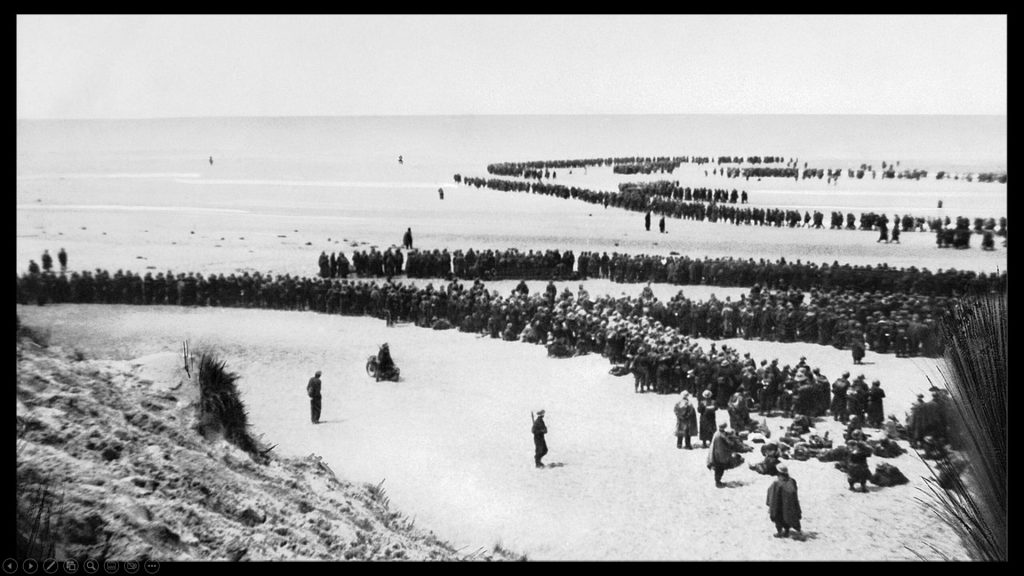
Archie was safely back in England but what was in store for him?
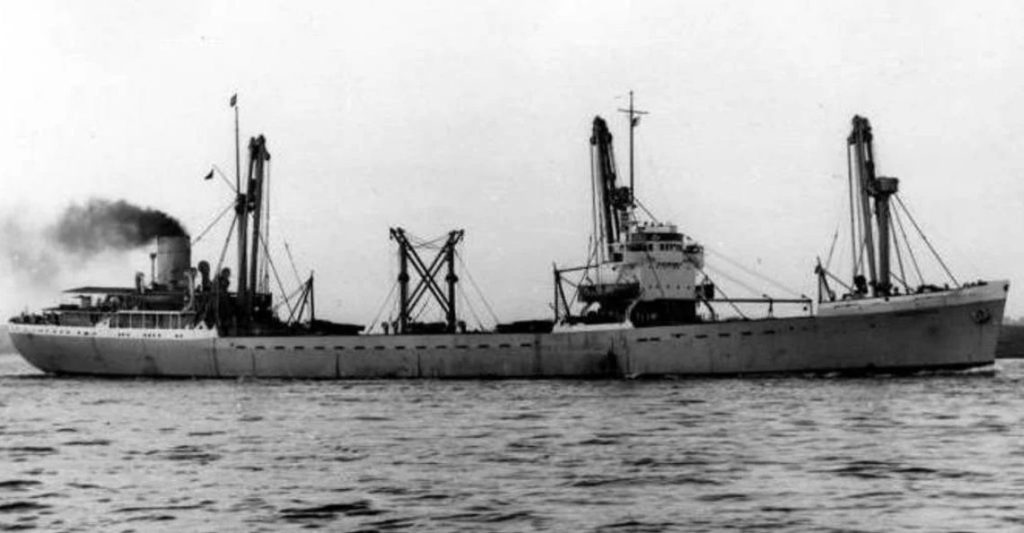
Meanwhile, back in Scotland in 1940 the shipbuilders, Charles Connell & Co, were completing a new ship on the Clyde for the Ben Line named the SS Benalbanach. Launched in June 1940, it was powered by a Steam Quadruple Expansion engine built by David Rowan & Co of Elliot Street, Glasgow. What’s the relevance? Well, the Connell family who owned the shipyard lived at Craigallion House barely a mile from Highwood. Also, Archie’s brother Eoin was an apprentice at David Rowan & Co before the war and SS Benalbanach was the ship that would transport Archie and his unit to North Africa.
1941 finds Archie back at Kitchener Barracks in Kent where he was admitted to a reception station on 27 January and discharged on 30 January. He was then admitted to the County Isolation Hospital, Bowthorpe Road, Norwich on 5 May with potentially fatal meningitis. However, he recovered and was discharged on 17 May.
More ill health occurred in 1942 when he was admitted to the RAF General Hospital at Littleport, Cambridgeshire on 30 April and discharged on 12 May but with no information about the reason for admission.
Despite his health issues, Archie felt that he had to do his bit. By this time both Alastair and Christie were in uniform and serving overseas.
Archie volunteered for active service and was transferred to 585 (Edin) Corps Field Park Company, Royal Engineers on 21 December.
In July 1942, 585 (Edin) Corps Field Park Company had been designated to form part of First Army, which was preparing to take part in the Operation Torch landings in North Africa later in the year. 585th Company was converted into an 'Army Field Park Company', which acted as a base for the field companies and held specialist equipment.
585 Field Company had spent most of 1942 in Scotland preparing for the landings in North Africa, first at Carlingnose Barracks, North Queensferry then at Drip Road, Stirling before arriving at Gourock for embarkation on 23 December.
Alan has a recollection of Archie arriving home on leave unexpectedly. From his description of events, it is probable that Archie had been granted embarkation leave prior to his departure for North Africa. He took a train to Westerton Station then walked from there to Highwood. Alan can remember waking up and seeing Archie’s battle dress jacket over the back of a kitchen chair. He went for a walk with Archie to Loch Ardinning and recollects a curling rink on Loch Ardinning which would fit in with the date of Archie’s departure from Gourock for North Africa. Alan, not yet five, must have had difficulty keeping up with his big brother, as he remembers Archie carrying him home on his shoulders. He would never see him again.
The Ben liner SS Benalbanach, under Capt. D. K. C. Macgregor, was taken over for service as an auxiliary transport late in 1941 and in November,1942, she had taken part in the Operation Torch landing at Oran in the North African campaign before returning to Scotland.
As part of convoy KMS6 (serial number was 7153 1940), she left the Clyde again on Christmas Eve, with a crew of 74 and 389 officers and men, including Archie MacNicol, as well as a cargo of 136 tanks and other motor vehicles, 800 tons of ammunition, 68 tons of petrol and 300 tons of general military stores.
At just after six o'clock on the evening of January 7th, 1943, the Benalbanach was attacked northeast of Algiers by a German aircraft with two torpedoes, which hit the ship in No. 3 and No. 5 holds. She sank almost immediately with 57 crew and 353 troops lost. Archie was one of them. Capt. Macgregor died from exhaustion after three hours in the water and just as he was about to be rescued by a destroyer.
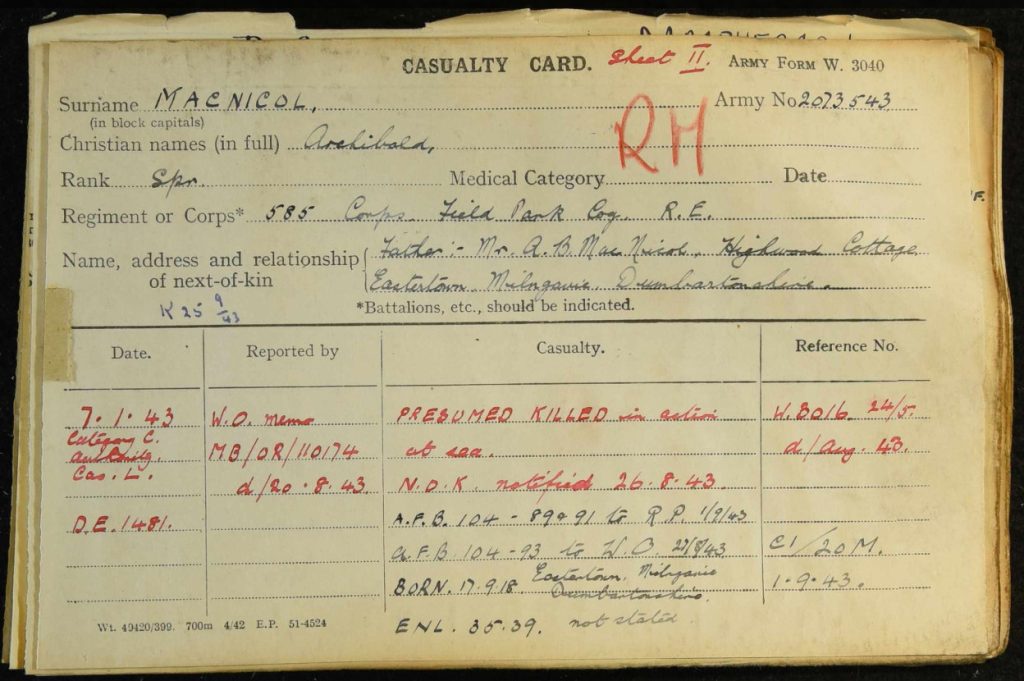
Archie’s next of kin were informed that he was missing on 4 February. He wasn’t “presumed killed” until 20 August and his next of kin informed on 26 August.
Would Archie have survived the war if he had not volunteered for active service in 1942? 240 Company went back to France in 1944 and was one of the first units on the beach on D-Day. Having lost only one man killed in the Battle of France in 1940, 240 Company lost six on D-Day alone. As one of its most experienced men, Archie would have undoubtedly been in the vanguard on D-Day with a high chance of being a casualty.
The tragedy of war was not over for the MacNicols. Archie’s sister Jessie had enlisted in the Women’s Land Army on 19 August 1944 and tragically died on 15 May 1945 from arsenic poisoning which was determined by the Procurator Fiscal to have been self-administered. The circumstances remain unclear.
Archie’s father died on 25 May 1962, and his mother passed away on 10 October 1975.
Archie is survived by his younger brother, Alan, born 20 years after him and in 2025 still a sprightly 87-year-old who has been of immense assistance in telling the tale of his ill-fated brother.
Gilbert MacKay
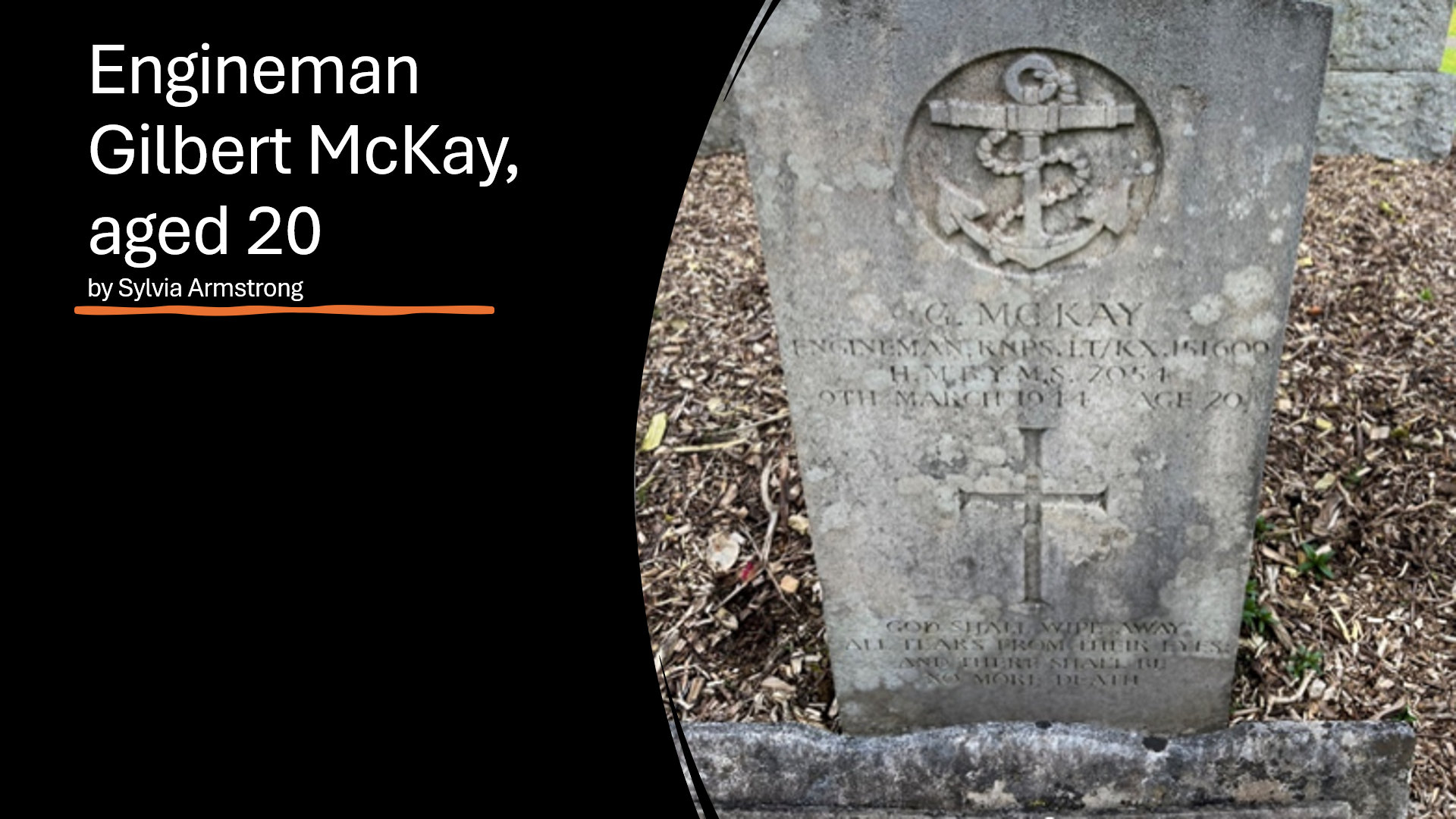
Gilbert McKay is the only World War Two serviceman for whom we do not have a photograph. He was born in Campbeltown in Argyll but came to live in Blanefield early in 1924, when he was just a baby of a few months old, with his parents Gilbert and Catherine.
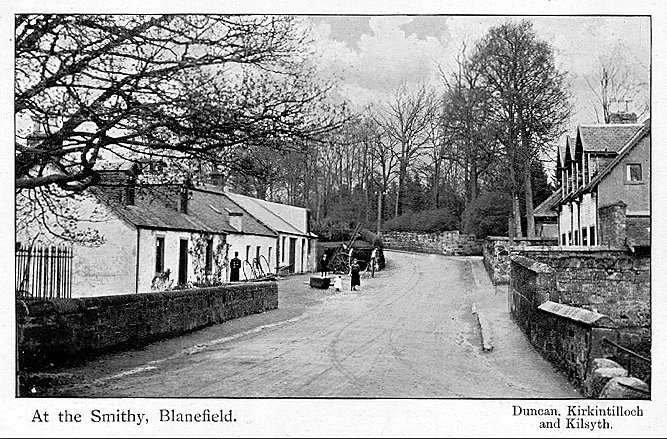
His father was a blacksmith by trade and took over the Smithy in Blanefield from the Brodie family who had run the business there since 1867. Gilbert senior was originally from Houston in Renfrewshire, the son of a ploughman, and that was where he learned his trade. The census of 1921 records him as living in Houston with his widowed father and working as a general blacksmith. However, his marriage certificate shows that by 1923 he was living in Campbeltown where he met and married Catherine MacPherson, a milliner. At that time he was still a journeyman blacksmith, and it seems likely that when the Smithy in Blanefield became vacant, Gilbert took the opportunity to set up a business of his own.
Two more sons were born to the family in Blanefield, Dugald in 1925 and Neil in 1927, and together with the premises at the Smithy, his father Gilbert rented the nearby Ballewan Cottage to house his growing family. The three boys attended the village school which was then next door to the forge. In the 1920s the forge was a thriving business with a constant demand for the services of a blacksmith and the ‘Smiddy’ was central to the life of the village community. The late Arthur Muir, in his memories of that time, says: "Everyone used to gather there as there was always a fire burning and the place was kept warm. Nothing could happen in the village without the blacksmith knowing about it."
But with the rapid development of modern methods of agriculture and transport in the early1930s tractors were replacing horses, and cars were replacing horse drawn carts and carriages. Inevitably this led to a steady decline in business for the forge. In 1934 Gilbert found he could no longer make a living to support his family and the business closed. It was the end of an era for the traditional blacksmith’s forge in Blanefield. After the smithy finally closed around 1936, Mr McKay became a postman and the family moved to Station Road.
Gilbert and Catherine were both members of the church in Blanefield. Gilbert was church officer there, and Catherine church cleaner. The Stirling Observer dated 16th January 1941 reports that Gilbert later became church officer in the church at Strathblane as well. Gilbert’s granddaughter Fiona remembers her grandmother telling her about the horse troughs at the door of the church in Blanefield and how the horses were tied up beside them while folks were inside at the service. Fiona now has care of the troughs and cups in her home on the island of Coll.
On the 19th of February 1942,18-year-old Gilbert McKay junior joined the Royal Naval Volunteer Reserve to serve on the minesweepers that patrolled the coast of Britain. Many of the minesweepers used in WW2 were YMS’s (Yard Minesweepers), made in the USA and loaned to the UK for the duration of the war. They were small vessels, 136 feet long with a beam of 24 feet 6 inches and a draft of only 8 feet below the waterline. Their hulls were made of wood so that they would not attract the mines to themselves.
The job of the minesweepers was to clear the shipping lanes of the magnetic mines laid by enemy submarines so that the ships of the Royal Navy with their steel hulls could have safe passage in and out of harbour.
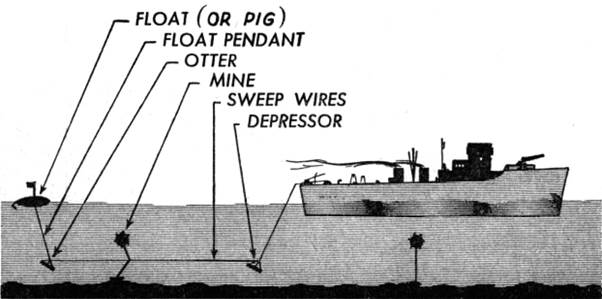
Magnetic mines were anchored to the ocean floor by cables that kept them floating just beneath the surface of the water so that they were invisible. The minesweeper was equipped with a mechanical device known as a ‘sweep’ which was designed to cut the anchoring cables of the mines so that they floated to the surface and could be detonated by rifle or gunfire.
Minesweepers dragged along behind them a nonferrous steel wire which would not attract the mines to itself. The wire ended with a torpedo shaped floater known as a Paravein Float. Not far below the floater was a steel frame with angled fins called the Otter which kept the steel wire under water at a safe depth as the minesweeper moved along. The wire was fitted at intervals with cutters. When a mine cable touched the wire, it slid along it until it hit a cutter which severed the cable which had been anchoring it to the ocean floor; the mine was freed and bobbed up to the surface and then was destroyed by firing at it with guns or rifles. This was known as the Oropesa technique.
YMSs had a vital and highly dangerous task, and sadly many of the minesweepers and their crews were lost. For the crew of 32 on such a small vessel, the quarters were extremely cramped, with a tiny kitchen to cater for them all, a few bunks and minimal toilet facilities. The deck area was small and crowded with equipment. With their shallow draft, the ships were notoriously unstable, tossing the crew about, even in the smallest disturbance of the water.
A crew member of one minesweeper testified that:
Men don’t live on YMS’s
Anon.
They just exist under strains and stresses,
Tossed around like a bundle of peas
Inside their ship on the calmest seas
Did you ever eat on a YMS?
It has been done a time I guess
But the simplest of meals can come to grief
When we hit the wake of a passing leaf
Then at ‘0 two hundred’ all’s secure
The anchor is deep and sure
And even when the sea’s like granite
She’s taking off for another planet.
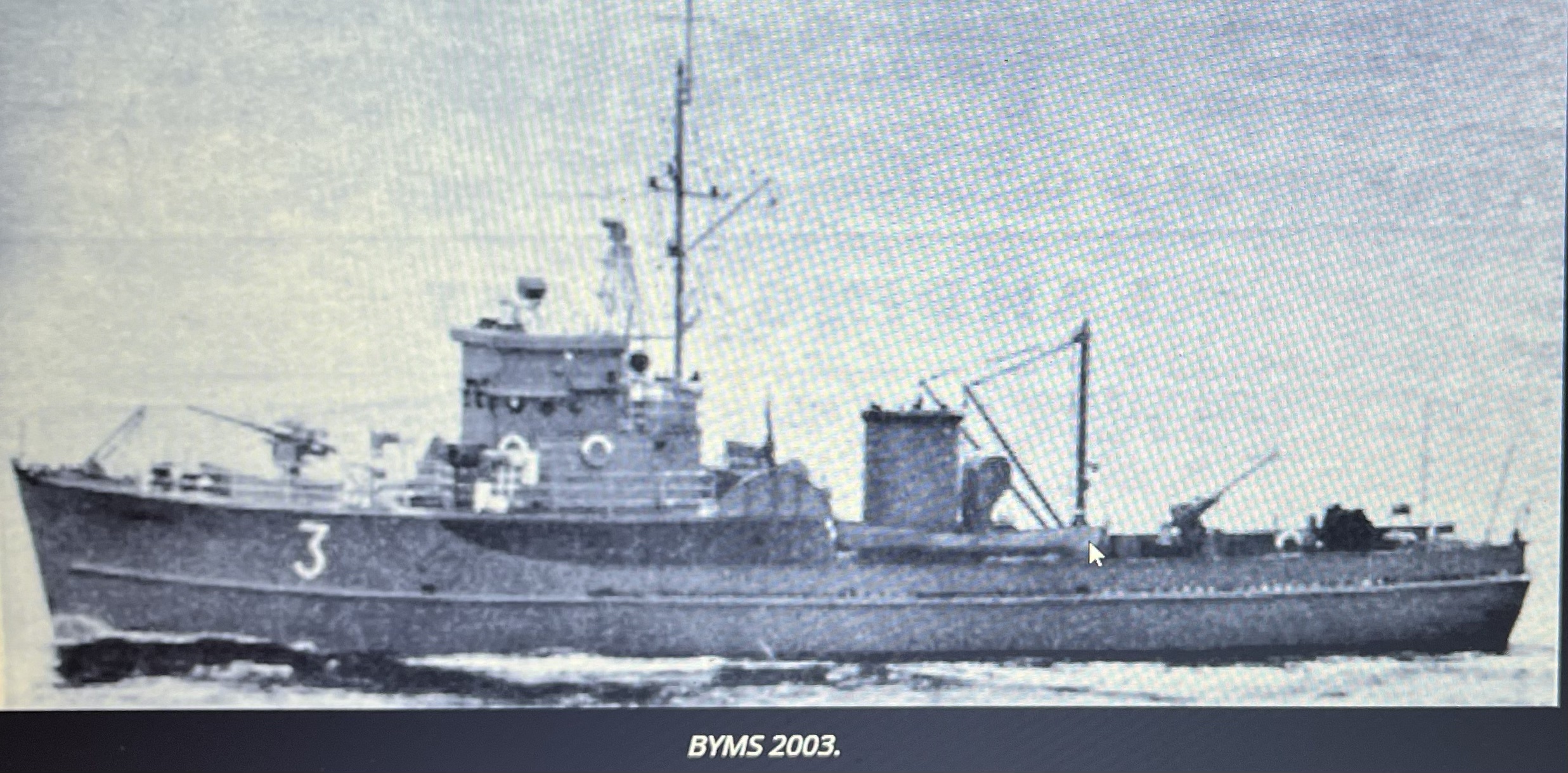
This is the ship on which Gilbert began his training on 19 February 1942 with a month’s introductory training a at Naval Base in Great Malvern in Worcester. He was then moved to a Naval Base at Lowestoft on the east coast of England. He began as a Stoker 2nd class, the lowest ranking. The work would be physically demanding and the confined space of the engine room unbearably hot. By 29 July 1942 he was promoted to Stoker 1st class and was serving on the minesweeper BYMS 3.
On 10 December 1943 he was given his final promotion of Wartime Engineman. He continued to serve for another three months at Lowestoft until in March 1944 he was posted to the Naval Harbour at Port Edgar in West Lothian. Gilbert’s final posting was to the minesweeper BYMS 2054, one of the minesweepers on loan from the USA.
After a few days leave, he boarded BYMS 2054 on 8 March 1944 where, tragically, his first spell of duty would prove to be his last. As the ship returned to harbour on 9 March, it appears that Gilbert lost his footing on the unstable and cluttered deck and fell overboard. Exactly where and how the accident happened will never be known since it was not witnessed by any of his shipmates. When his absence was reported to the naval authorities, they appeared to take no account of the instability of the ship and concluded that Gilbert was guilty of desertion. A letter was sent to his parents to that effect. Gilbert and Catherine were devastated. They knew their son better than anyone and would not believe that he was capable of such a thing. Their faith in him was justified when, one month later, in early April, Gilbert’s body was washed up on the shore at Port Edgar.
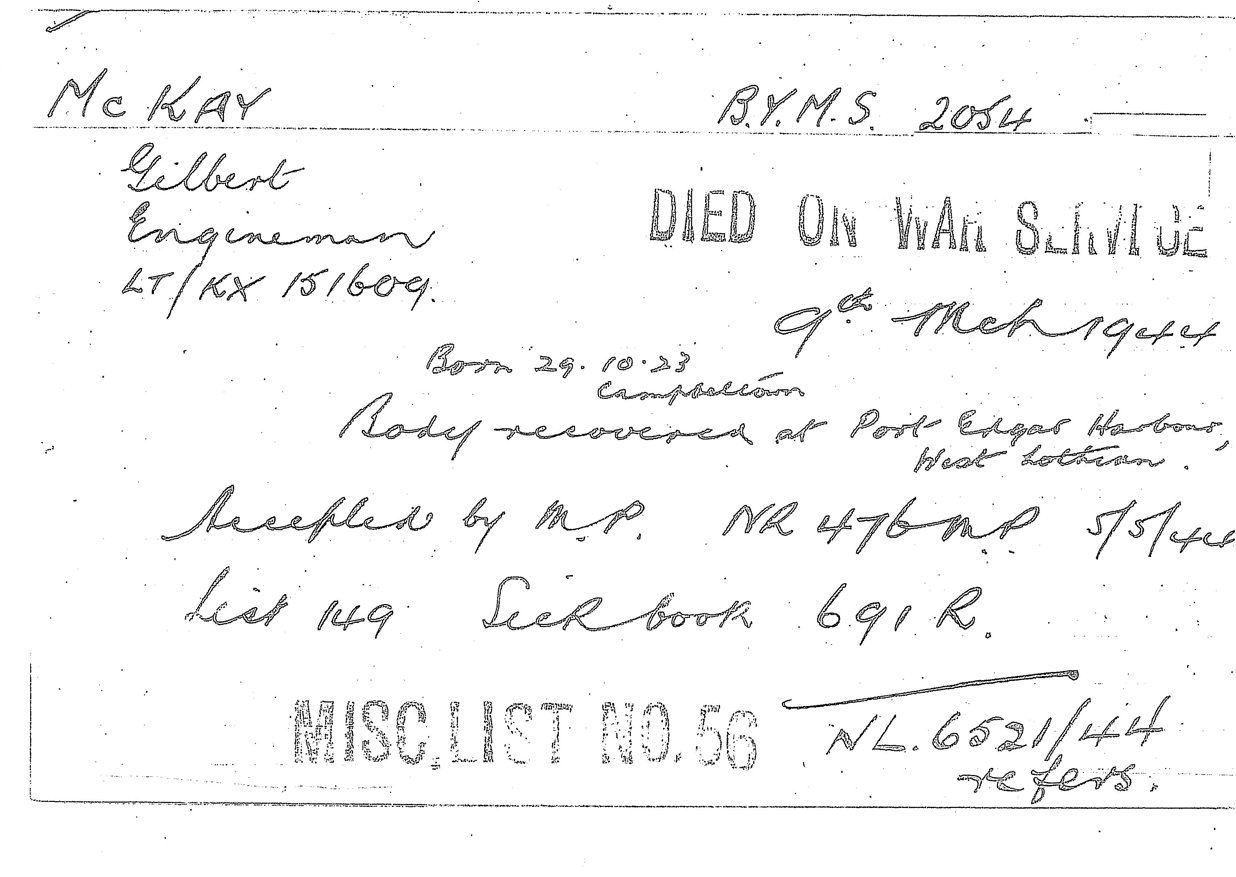
A board of enquiry was held and the cruel injustice done to Gilbert was acknowledged on 5 May 1944. The record of his death was changed to read ‘Died on War Service’.
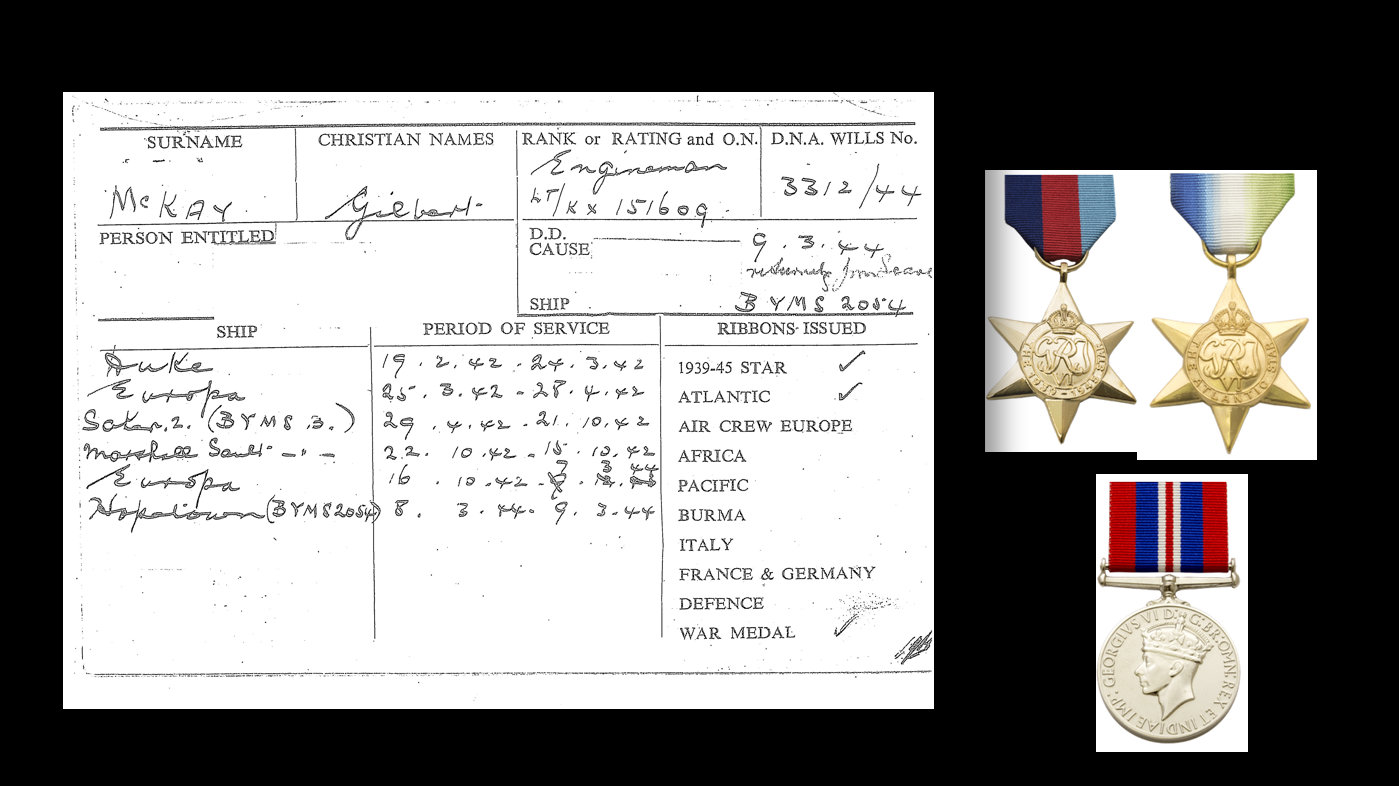
His service record was corrected, and he was posthumously awarded his well-deserved medals: the War Medal, 1939 – 45 Star and Atlantic Star.
Gilbert’s body was brought home, and he was buried in a Commonwealth War Grave in the peaceful cemetery next to the church in Strathblane, where his father was church officer. The inscription at the base of his stone reads: "God shall wipe away all tears from their eyes, and there shall be no more death."
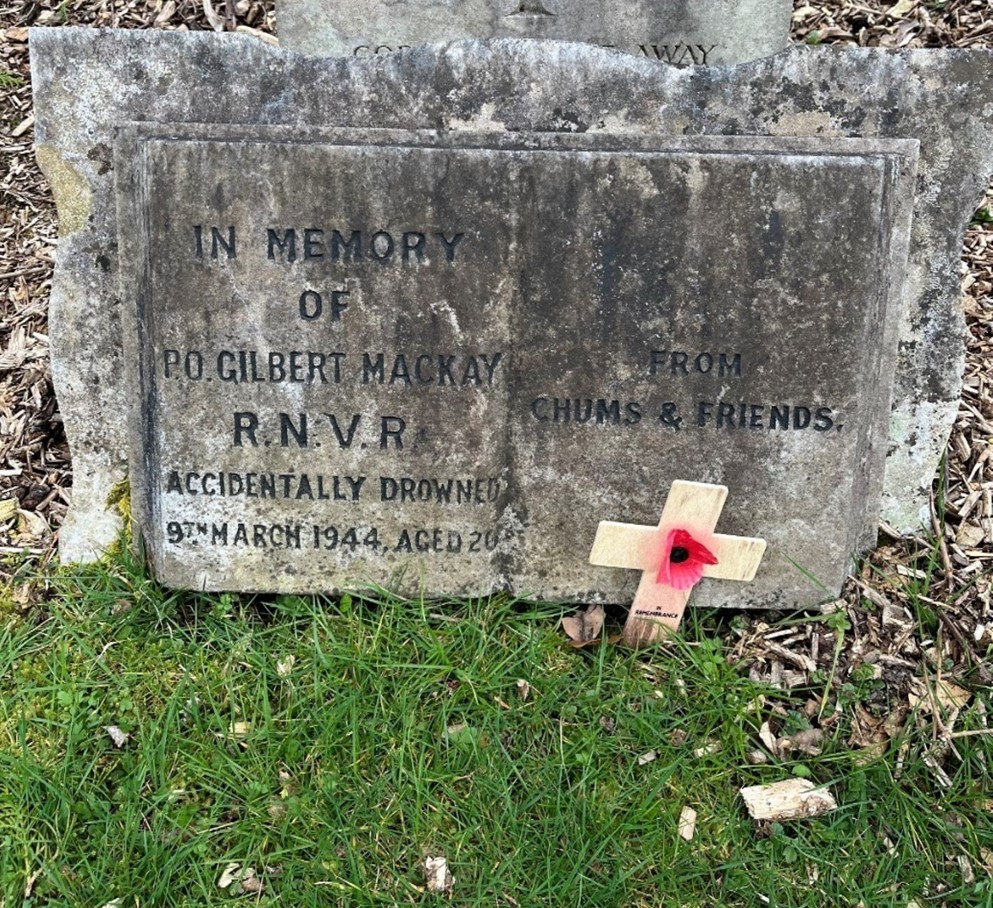
At the foot of Gilbert’s Commonwealth gravestone there stands another, smaller one, not erected by any official naval authority, but simply by the mates he grew up with and the village community who mourned his death and honoured his life. The inscription reads: "In memory of P.O. Gilbert MacKay RNVR, accidentally drowned 9th March 1944, aged 20. From Chums & Friends."
Richard Pedder
Childhood & Training
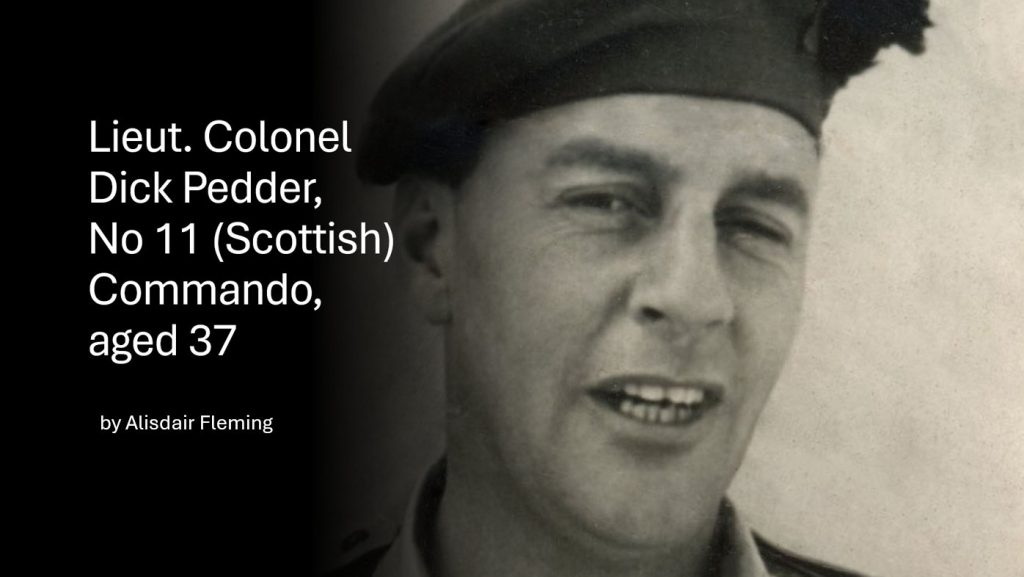
Richard Robert Newsham Pedder was born on 20 July 1904 in Hampshire. His father, Ernest William Newsham Pedder was a Brigadier General and his grandfather had also been a career soldier.
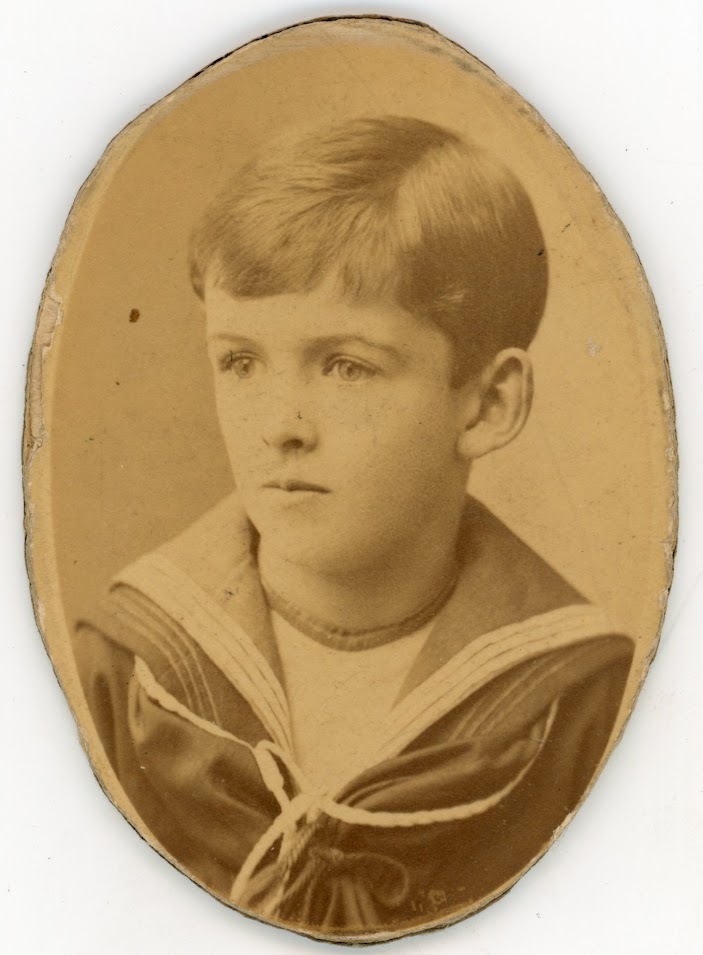
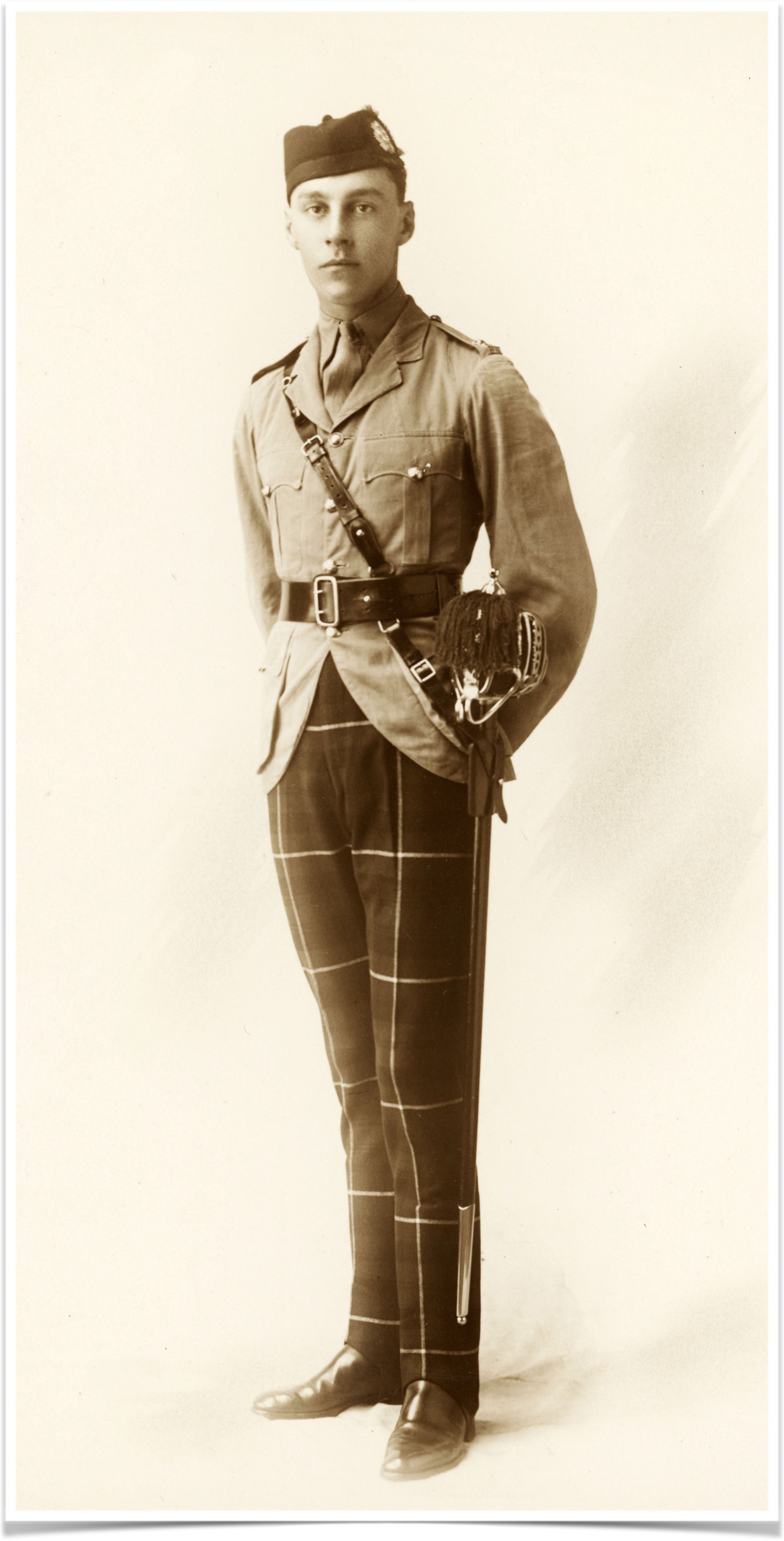
As a youngster, Richard, who was an only child, attended Wellington College in Berkshire and, as expected, he too chose a military career. He gained a place at the Royal Military Academy Sandhurst in 1922 and in August 1924 he was commissioned as a 2nd Lieutenant in the Highland Light Infantry and sent to report to their barracks at Fort George near Inverness. (Despite the “Highland” in the name, the HLI were, at that time, based in Hamilton and mainly recruited from the Glasgow area. Because of this, they were not in fact deemed a “Highland” unit, meaning their uniform did not include the kilt. Instead they wore tartan trews.) In 1921, the regiment transferred its HQ to Maryhill Barracks in Glasgow. Today, the Barracks form the area now known as the Wyndford Estate and the towering surrounding barracks walls are still very noticeable on Maryhill Road. The regiment was keen to establish a relationship with its new home and in 1923 the title “City of Glasgow Regiment” was added to the HLI name. Thus began a long close association with the city.
Egypt & India
In November 1924, young Pedder sailed to Egypt to join his new unit, the 2nd Battalion HLI, and in February 1925, he accompanied them to India. In August 1926, he was promoted to Lieutenant and from April until the December of that year, he was back in the UK on leave. After this, he was based back in Maryhill Barracks. In March 1929, Pedder was posted back to India, this time to Jullunder (now Jalandhar) in the Punjab. There he was a junior officer in command of the 10th Battalion of the 17th Dogra Regiment. This Battalion was a training unit for the main Battalion. At the time, this regiment was part of the Indian Army, which came under the overall command of the British Army.
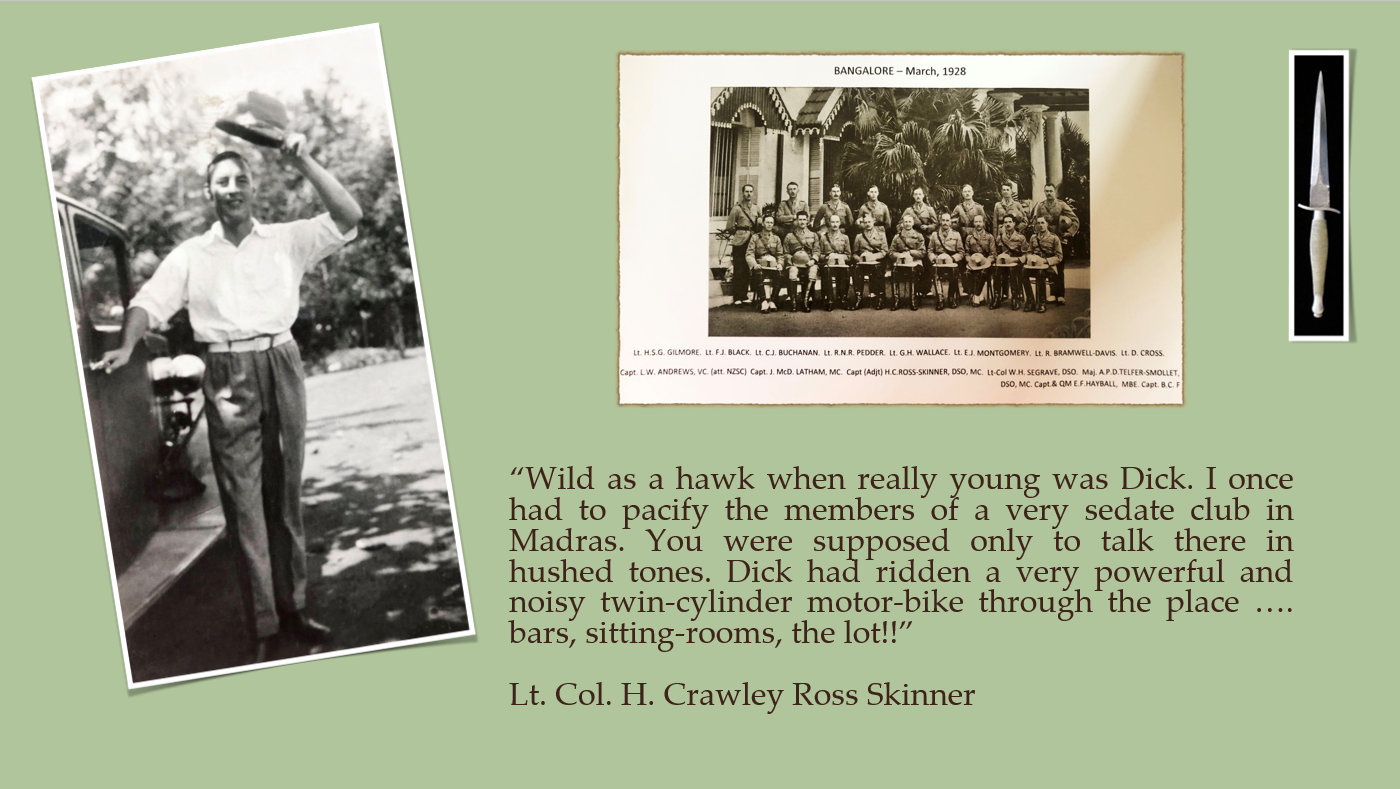
Pedder was a strict task master but it would appear that beneath the young subaltern’s no-nonsense and conformist image, there lurked a bit of a wayward soul. One of his commanding officers relates an incident where Pedder drove an extremely powerful and noisy motorcycle through the corridors and lounges of the “sedate” Garrison Officers Club in Madras. As one would expect, this caused uproar amongst the fusty “Old Guard”. Another story relates of an incident in Cairo when Pedder headed out on a Saturday night despite an order that no service personnel should go into town unaccompanied. On the Sunday morning, he arrived back in an open taxi in a “dazed and dishevelled” state. He might have got away with this but for his misfortune in arriving at the barracks just as his unit was marching out for Sunday morning Church Parade. When he was later ordered to report to “the Boss” to account for his transgression, he escaped punishment due to his CO being enthralled by young Pedder’s tales of his previous night’s exploits. The record shows that Pedder was a man who “knew how to celebrate”.
Marriage, West Africa & the Move to Strathblane
In December 1933, Pedder married a Miss Pamela Watt at a swanky ceremony in Kensington at which a fellow officer guest recorded :“It was an absolute miracle that the highly intoxicated groom didn’t collapse!”.
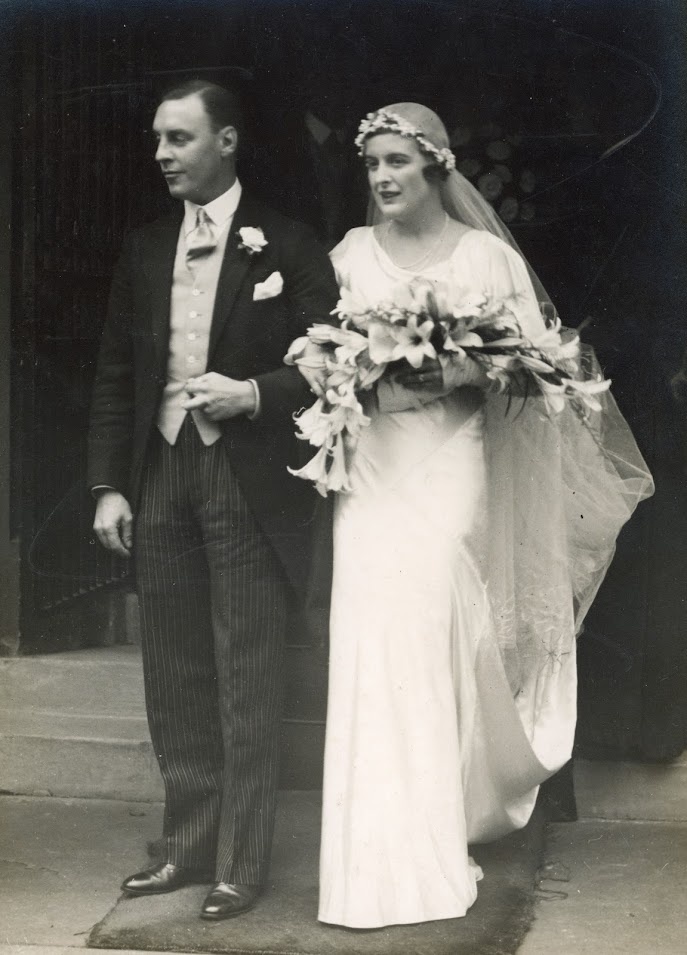
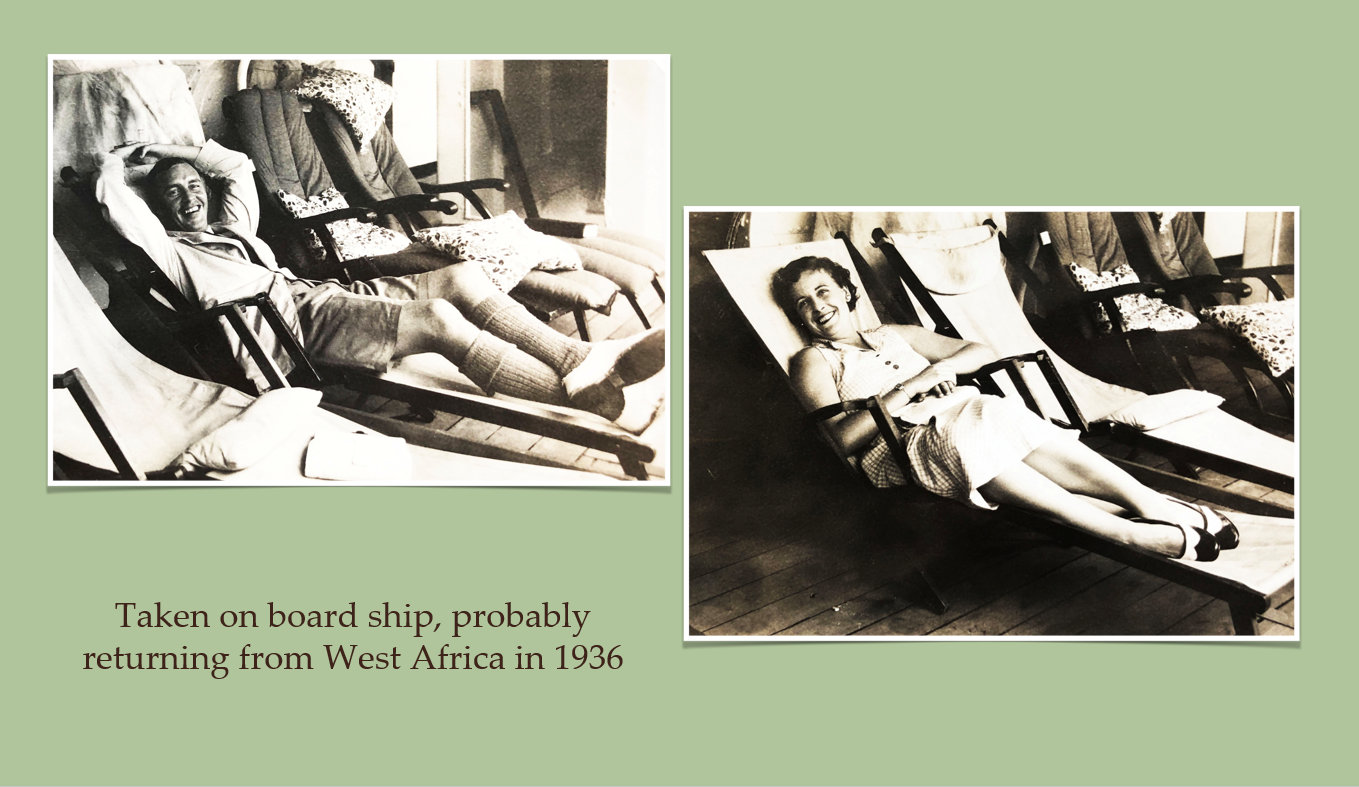
As an officer, Pedder was seen as a good leader and trainer of soldiers. In the early 30’s, he served in this role at home and abroad including a spell with the Colonial Office in West Africa and for the next five years this was Pedder’s home until, in November 1936 he returned to UK where he was posted to the 1st Battalion of the HLI and the following month saw him promoted to Captain. He appears to have had a low profile until he was posted to the HLI Infantry Training Centre three days after the outbreak of the Second World War.
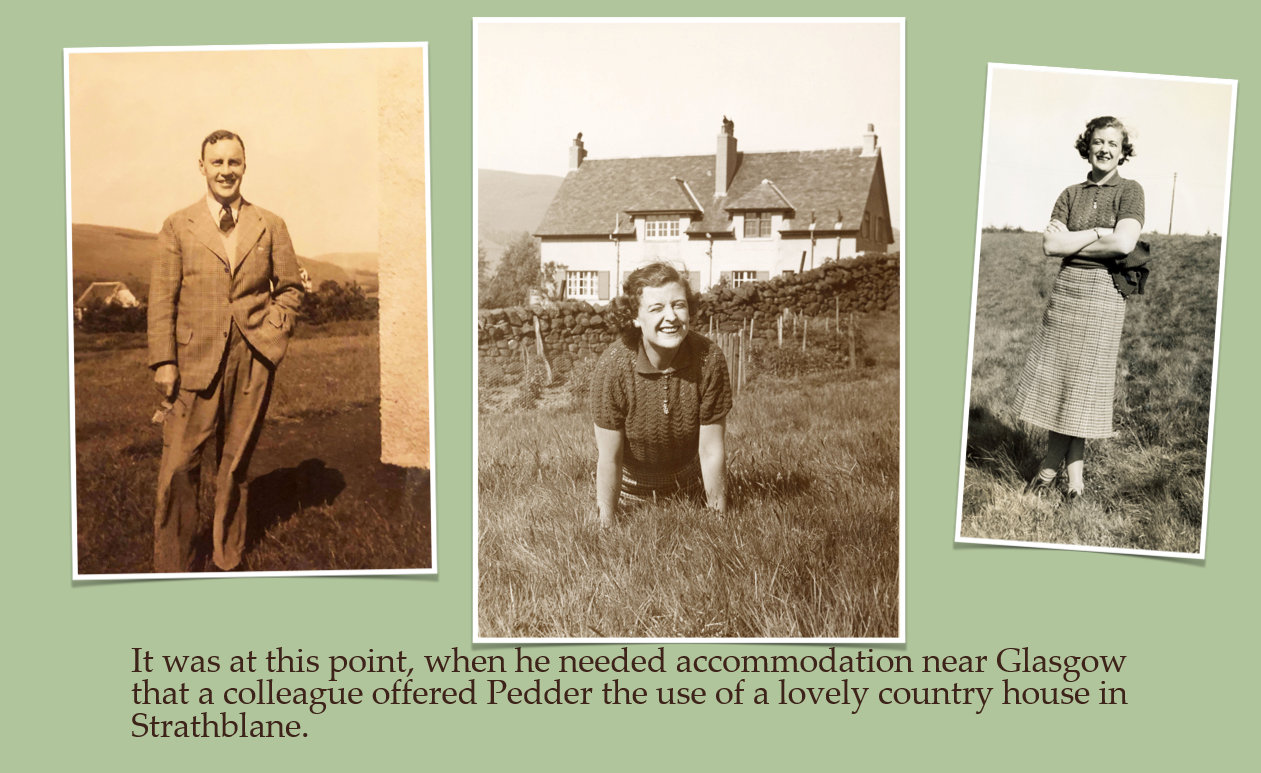
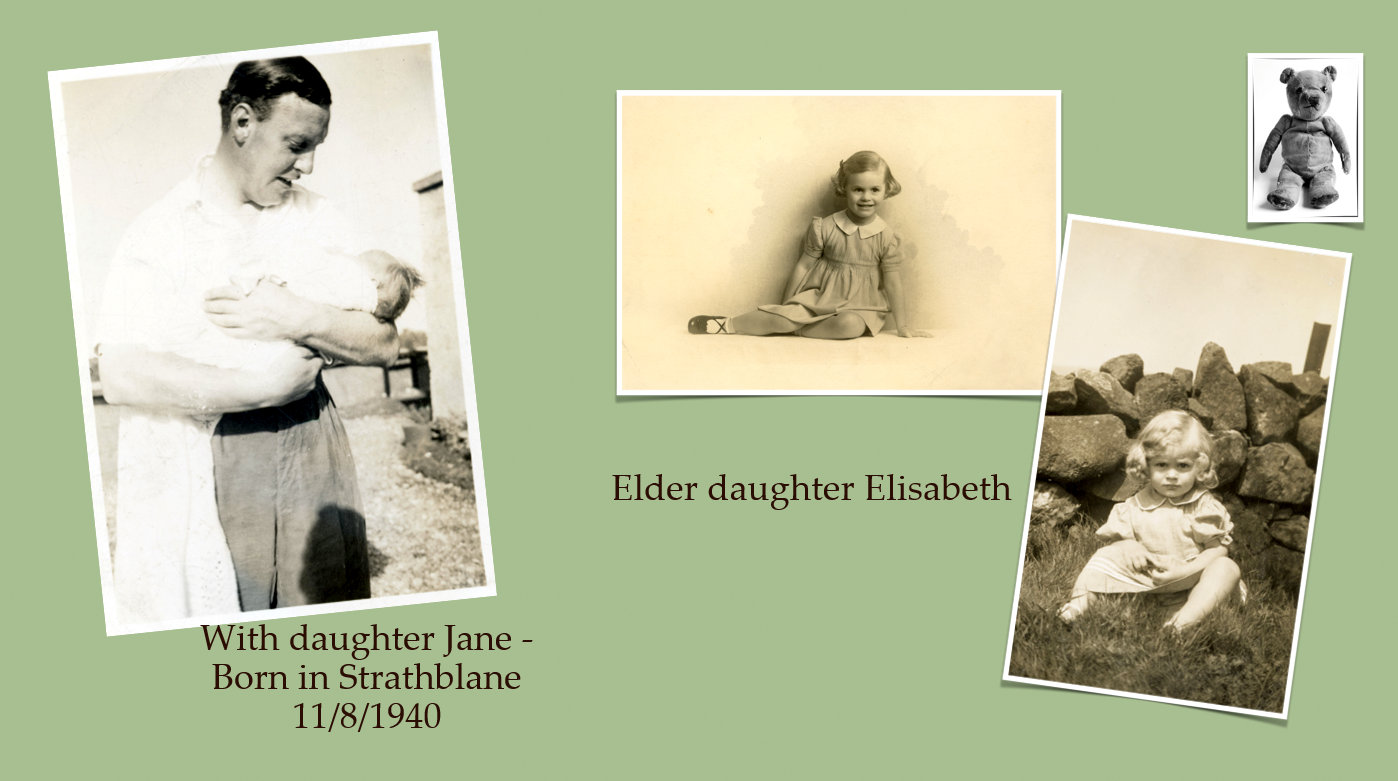
By now he had rented a spacious villa in Strathblane's Old Mugdock Road called Dumbrock House and installed Pamela and infant daughter Elisabeth. A second daughter, Jane, was born in Strathblane in August 1940. Her father would be dead before her first birthday.
Meanwhile in May 1940, the British Expeditionary Force was forced to retreat when the German forces advanced through the Ardennes and the Low Countries. This resulted in the major setback of the Dunkirk evacuation. To boost the morale of the country, Churchill was determined that Britain should not simply be defensive and insisted that British forces take the fight directly to the Germans. This required the formation a highly skilled and aggressive seaborne raiding force and so, the Commandos were born.
Number 11 Scottish Commando
The name Commandos had originally been coined by the Boers during the early C20th Boer War and referred to a Guerrilla force formed to fight the British. Understandably, the Military Establishment was loathe to use this title and preferred Special Services Brigade. However, after early British Army communications shortened the unit name to "SS", Churchill, not surprisingly put his foot down and so, the name Commandos stuck.
In July 1940 Pedder was posted to Scottish Command HQ and within two days, he was appointed leader of the soon-to-be Number 11 Scottish Commando. This was the first Special Forces unit raised from Scottish Command and within three months of Pedder forming this unit, he was promoted to Major.
He wasted no time in advertising for volunteers from Scottish units. Pedder stipulated that these volunteers required to be fully trained soldiers, fit, able to swim and not suffer from sea or air sickness. They were also required to demonstrate other attributes, stressing courage, physical endurance, initiative and importantly, an aggressive spirit towards the enemy. Appreciably more than the required 500 applied and they were told to report in the first instance to Netherdale Mill in Galashiels on 23 June 1940. Within days, the weeding out of unsuitable candidates began. It was to be a gruelling time for these hopefuls with one of the new recruits recounting their first day’s activity: “A 15-mile march with only a 20-minute break at the 11-mile mark. Following this, it was a bath in the chill waters of the River Tweed”.
After several weeks of this kind of pressure, the successful candidates were marched across country 100 miles to Ayr. No accommodation was provided and each night, the men slept in the hedgerows and woods at the side of the road.
Arran
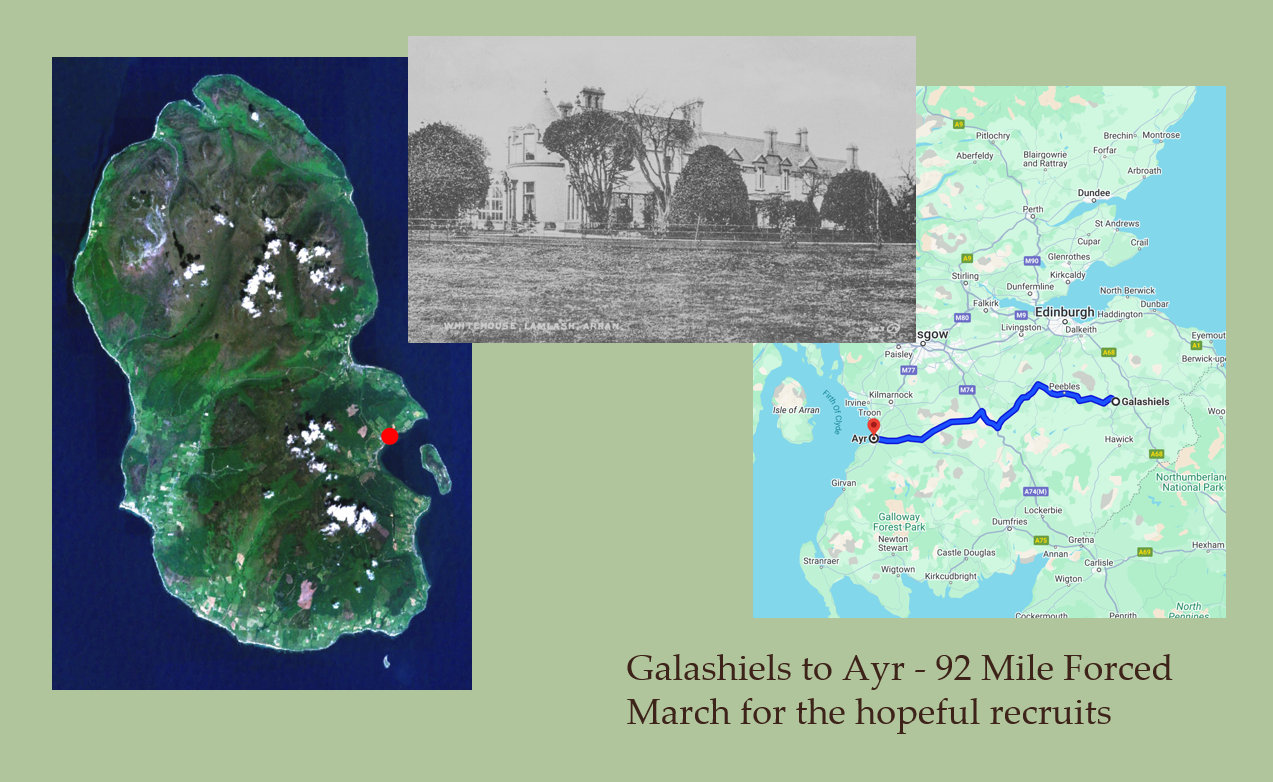
They then embarked for the island of Arran where they were based and billeted in and around the village of Lamlash. The trainees were not accommodated in Barracks but were expected to find lodgings with local families. Officers had a daily allowance of 13/4d and other ranks, 6/8d. A mansion called the White House was rented from the Duchess of Montrose as an officers' mess. There was one day off per week. At Lamlash, they spent six months enduring intensive testing and challenges. Training included all aspects of warfare as well as physical training and endurance. Orienteering, mountaineering, canoeing, as well as judo and unarmed combat were the order of the day. Cross-country forced marches with full packs were a regular activity, often culminating in high-speed ascents of Goat Fell. There is the story of an officer marching a unit of fully equipped men across country all day before marching them off the end of the pier at Lamlash! Pedder would not hesitate to send a volunteer back to their home unit if they failed to perform to his expectations. “RTU” (Returned To Unit) was what every volunteer dreaded to have written in his Army record.
After around six months training on Arran, 11 Commando was deemed ready for action and they became C Battalion of a formation of 4 Battalions, each of 500 Commandos. They were under the overall command of Colonel Robert Laycock and this contingent was christened Layforce in his honour. Layforce was posted to Egypt and, because of the danger from enemy forces in the Mediterranean Sea, they had to take the long way round via South Africa, up the Red Sea and through the Suez Canal. Around this time, Pedder was promoted again … now Lieutenant-Colonel Richard Pedder.
Action & Inaction
Layforce C Battalion’s time in Egypt was frustrating with potential raids being planned but often cancelled due to bad weather or the force having to withdraw for different reasons. Along with A and D Battalions, a detachment of C Battalion was sent to Cyprus to deter a possible German invasion there. During this time, they were involved in a couple of abortive attempts to land and hold positions on Crete where they were mainly involved in holding off the Germans and covering the retreat and evacuation of the Allied forces. On 31May, Laycock and some of his HQ staff including the writer Evelyn Waugh, managed to make good their escape. This whole action was a debacle with 600 of the 800 Commandos listed as killed, missing or wounded.
Litani River
Shortly after this, in early June, C Battalion was called into its first major action. Swathes of the eastern Mediterranean coastline were held by the Vichy French and manned by fearsome French Colonial troops. There was concern that the German and Axis forces might use the Vichy French presence to advance down the Eastern Mediterranean coast and threaten British-held Egypt. There was also the very real danger that the French would give the Luftwaffe access to airbases in Syria. This would be an extremely dangerous situation for the Allies in the Mediterranean. The Australian Army was tasked with advancing up the coastline to engage the French and so prevent a German advance. The Litani River was at that time in Syria and a major obstacle to the Aussies’ progress. The only north-south road crossed the Litani at the Kafr Badda bridge and 11th Scottish Commando was tasked with landing to the north of the river and seizing this bridge. This was to allow the northward advancing Australians to cross and continue up the coast. Like previous Layforce operations, this was to be dogged by misfortune.
The attack was on. Pedder and his unit sailed from Alexandria in the troop ship Glengyle and arrived off the coast at dawn on 8 June. Unfortunately, the sea was deemed to be too rough for the safe launch of the attack boats and so, after some frustrating discussion, the operation was called off and the ship returned to Alexandria. The French troops saw the attacking force and, realising that an attack may be imminent, reinforced their defensive positions.
At dawn the following morning, 11th Commando returned to attempt the landing again. This time the sea state was good and they successfully made it to shore. A fierce battle ensued with the defenders, who were already on high alert after seeing the previous morning’s attempted landing. Three units of Commandos were landed but only two made it to the chosen landing site whilst the third unit mistakenly landed to the South of the Litani River mouth. This meant that the attacking force, against the well-defended north shore, was depleted by one third. To make matters worse, the French troops, realising what the attack was all about, had blown the bridge the previous night. Attacking and holding this bridge had been a key aim of the whole operation but the blown bridge now prevented the third unit from rapidly joining the battle in support of the main force. In fact, this unit met up with the Australians and together they forced a successful boat-borne crossing of the river.
Pedder was in Command of the party fighting north of the Litani and this became a fierce gun battle with the well-prepared French troops. During this firefight, Pedder accompanied by senior officers, was mortally wounded by a sniper. It is recorded that he only had time to say :“I’m hit … go on” before collapsing. The attack stalled with the remaining Commandos holding on until nightfall when they retired south to meet the advancing Australians.
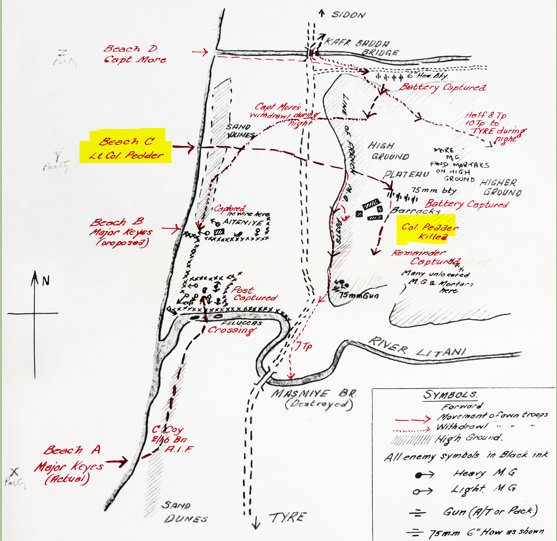
The whole operation was deemed a success as it distracted the French, allowing the Aussies to advance, cross the Litani and force the Vichy French troops to retreat. However, it came at a dreadful cost, mauling the Commandos, who were never to see action as a unit again. Out of the 400 Commandos, 123 were killed or wounded. Despite this dubious “success”, Winston Churchill, in his memoirs, was to mention the importance of this action on the security of the Allies in the Middle East.
Praise from Churchill
“Their [the Australians’] advance was aided by a daring raid by Number 11 Commando, which was landed from the sea behind the enemy lines. In this devoted strike the Commando lost its leader, Colonel Pedder, and all its other officers were either killed or wounded, together with nearly 120 other ranks, or a quarter of its total strength.”
The Second World War by Winston Churchill, Vol 3, PAGE 296
Lt/Col Dick Pedder was buried in Sidon Military Cemetery where he lies to this day, along with many of his officers and men.
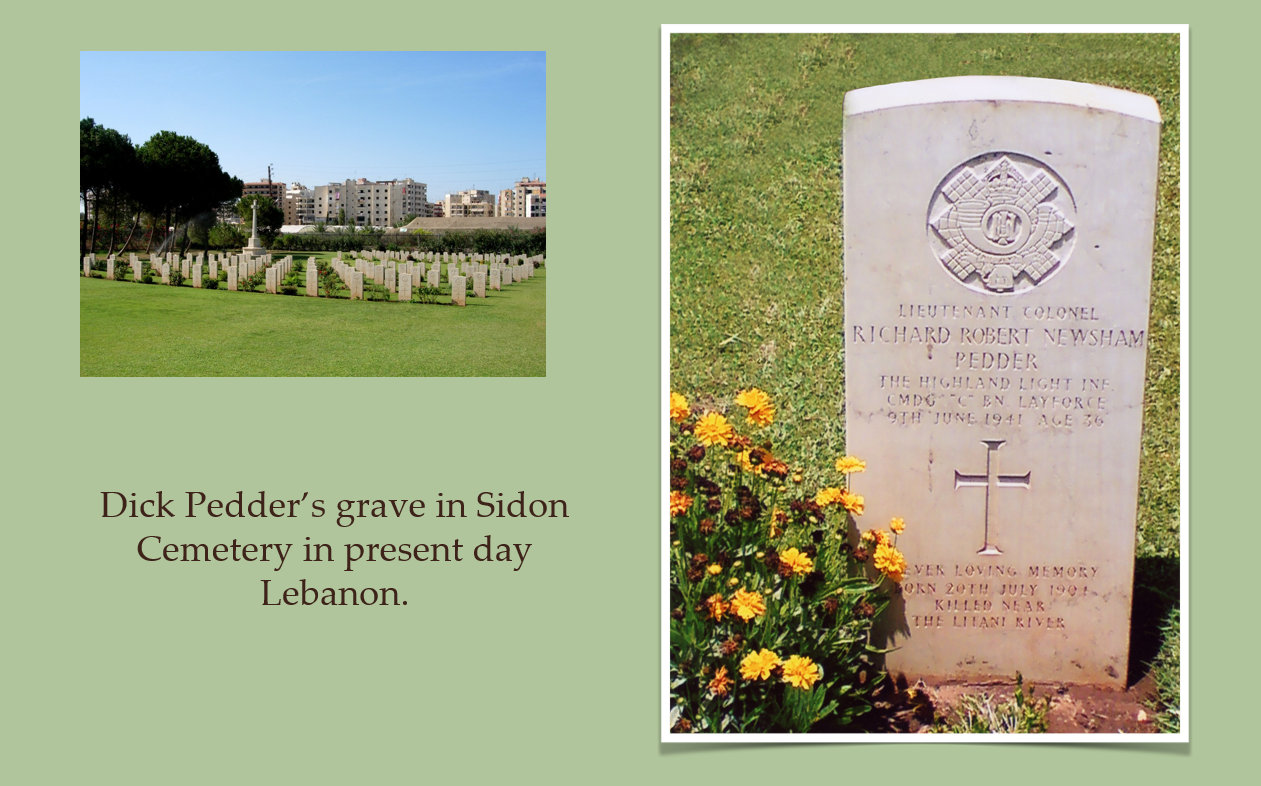
After this action, the Commando concept lost favour and they would not go into action again. However, many of the surviving personnel went on to become leading lights in what was to become the SAS. A flavour of their spirit is captured in the television drama SAS Rogue Heroes.
The Family
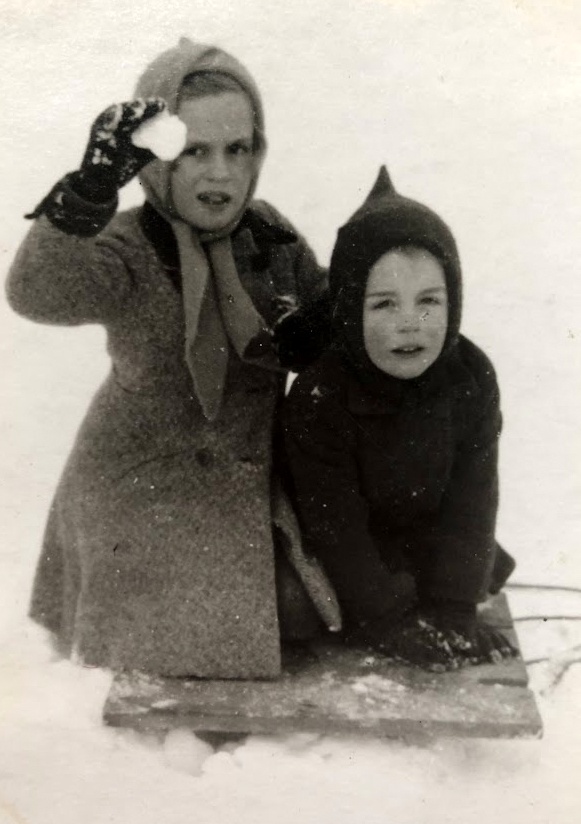
Dick’s wife and children never recovered. Family albums show two rather sombre little girls playing in the snow above Strathblane a year or two after their father’s death. Soon afterwards the family moved back to England. Dick’s widow Pamela never remarried and died an alcoholic. The daughters married and had children but their father’s cruel fate blighted their lives. Jane died only last year.
A chance online reference enabled us to contact Pedder’s eldest granddaughter, Caroline Hope, who had spent much of the Covid lockdown gathering Pedder memorabilia and correspondence and was keen to share it. She said: “The family was so upset after my grandfather’s death that I think everything got put into a box and no one dared open it for 80 years.”
Arran Memories
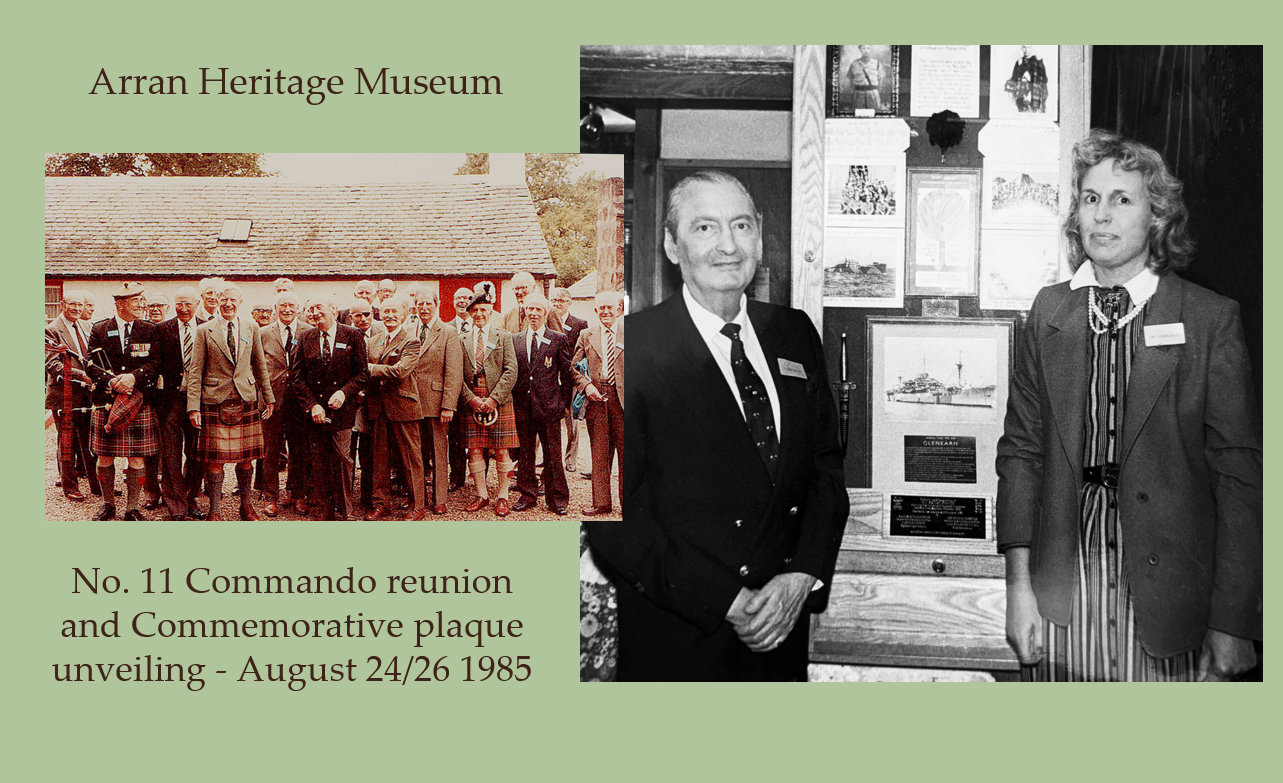
The camaraderie of 11th Commando survived and many had strong and happy memories of their spell in training on Arran. Long after the end of the War, ex-Commando members kept in touch and in August 1985 they organised a celebratory two-day reunion at Lamlash. A surprisingly large number attended and guest of honour was Pedder’s daughter Elisabeth. The culmination of the reunion was the unveiling of a plaque and an exhibition of other mementos of 11th Commando’s time on the Island. This material is still on permanent display at the Arran Heritage Museum outside Brodick.
Pedder Marches On
Among the contents of the box containing Colonel Pedder’s material was a tune for the bagpipes entitled Pedder’s March. On Remembrance Sunday 2024, a lone piper played it in Strathblane as wreaths were laid at the war memorial. And Caroline Hope, who has always been haunted by her grandfather’s untimely death, was able to visit the memorial in March 2025 and join members of Strathblane Heritage to hear a presentation about this remarkable man.
Alexander Turnbull
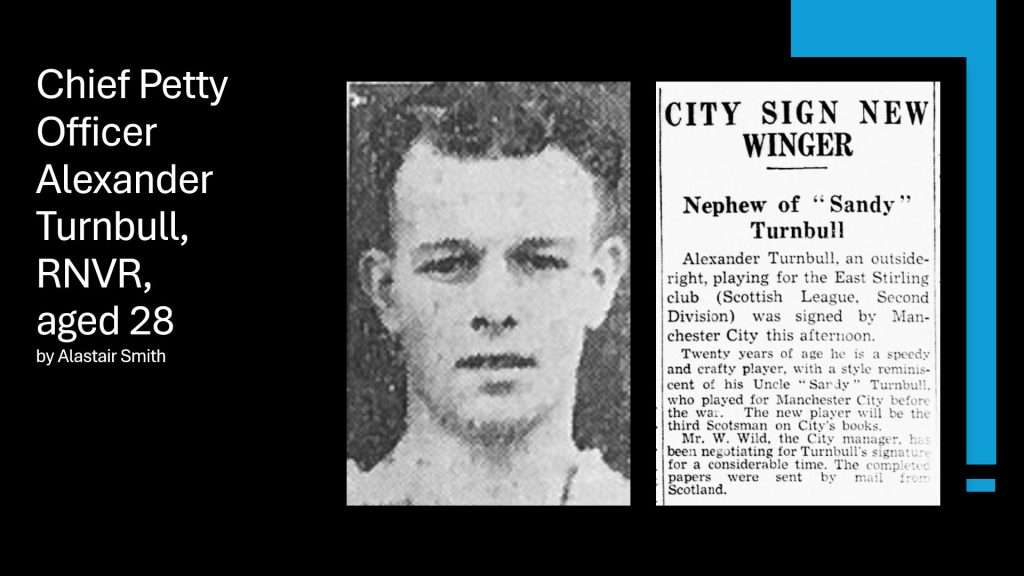
This is the only photograph found to date of Alexander Turnbull. He was born on the 7 September 1916, the son of David and Elizabeth Turnbull, in the village of Craigie near Kilmarnock in Ayrshire. Though his family had a mining background, his father was a fire clay worker who made sanitary ware for J & R Howie in Hurlford. His mother was a cook.
She died when he was only four. His father remarried on 1 January 1927 and Alexander acquired a half-brother, John, the following year. By 1935 the family had moved to Mugdock. Alexander went to school in Milngavie and he was Milngavie Higher Grade School Dux in the summer of 1932, having excelled in Mathematics, Science, Art and Technical.
After school he planned to take up an apprenticeship to become an engineer. However, there was a history of football in the family. Alexander’s uncle and namesake was the famous Sandy Turnbull, who had played for both Manchester City and Manchester United where he scored the first ever goal in their Old Trafford ground.
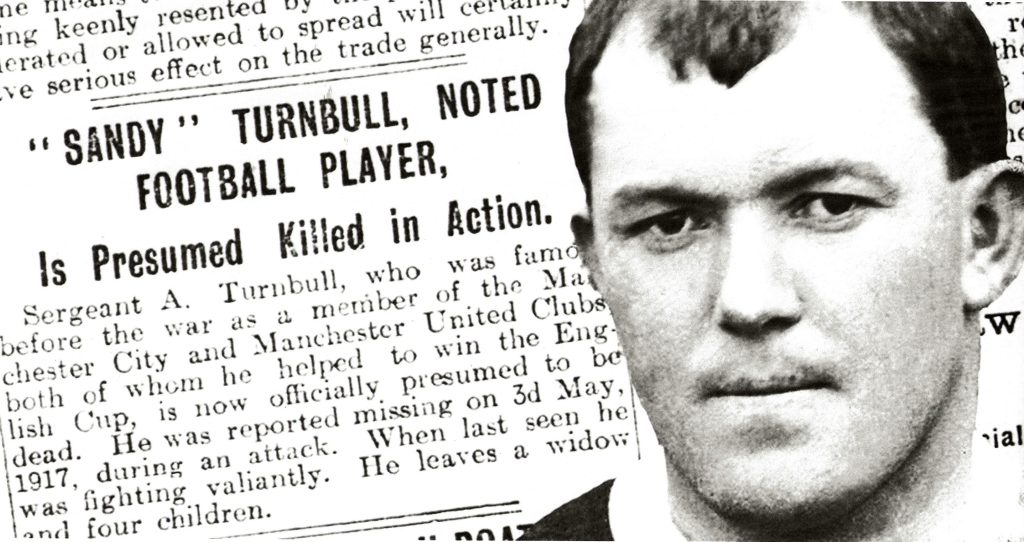
Alexander never knew his famous Uncle Sandy, as he was killed at the Battle of Arras in 1917.
But keeping to the family tradition, Alexander became a professional football player, joining Manchester City in 1937. The Manchester Evening News of 12 July that year described him as a “speedy and crafty” outside right.
Perhaps he failed to live up to his billing as he joined the less distinguished Exeter City the following season. His football career came to an end in 1939 when the football leagues were suspended at the onset of war and Alexander returned to Mugdock and to the idea of becoming an engineer.
He married nurse Janet MacFadyen Cameron, known as Nettie, on 23 February 1940, in her home town of Blantyre. A daughter, Mary Cameron Forrest Turnbull, was born later the same year. Though Mary was born also in Blantyre, the family residence was registered as Mugdock.
In June 1941 Alexander joined the Royal Naval Volunteer Reserve. Between October 1941 and May the following year, he was based mainly at the "stone frigate" (naval shore base) HMS Vernon, which was responsible for mine disposal and measures to counter the threat from German mines. To escape the intensive bombing of Portsmouth, most of its operations had been moved to Roedean, the famous girl's boarding school, based in Brighton. After initial training, he served on HMS Cyclops, a submarine maintenance vessel operating in the Clyde area, It was also used as a target vessel for training submarine commanders. This must have enabled him to see more of his wife and young daughter in Mugdock. But in September 1943 he was transferred to the destroyer depot ship HMS Blenheim in Greenock, which sailed for the Mediterranean as part of a slow convoy, arriving in Alexandria, Egypt on 30 November.
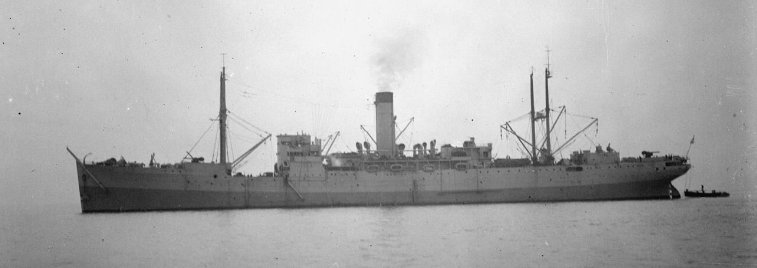
In early 1944 HMS Blenheim was based in Malta, though in June, according to Turnbull's service record, he spent a week at Timsah Camp on Lake Timsah, half way along the Suez Canal. This was probably a rest week, as the camp was at the time part of HMS Stag, a shore establishment for British naval personnel in Egypt.
The Blenheim was supporting Hunt-class destroyers in the Eastern Mediterranean and in July 1944 Alexander was transferred to one of them, HMS Lauderdale. By this time the Italians had surrendered and the Germans had left mainland Greece. However, some smaller Greek islands still had Germans fighting on them and while clearing them out the Allied ships were at danger from mines, shore batteries, torpedoes and fast-moving boats full of explosives.
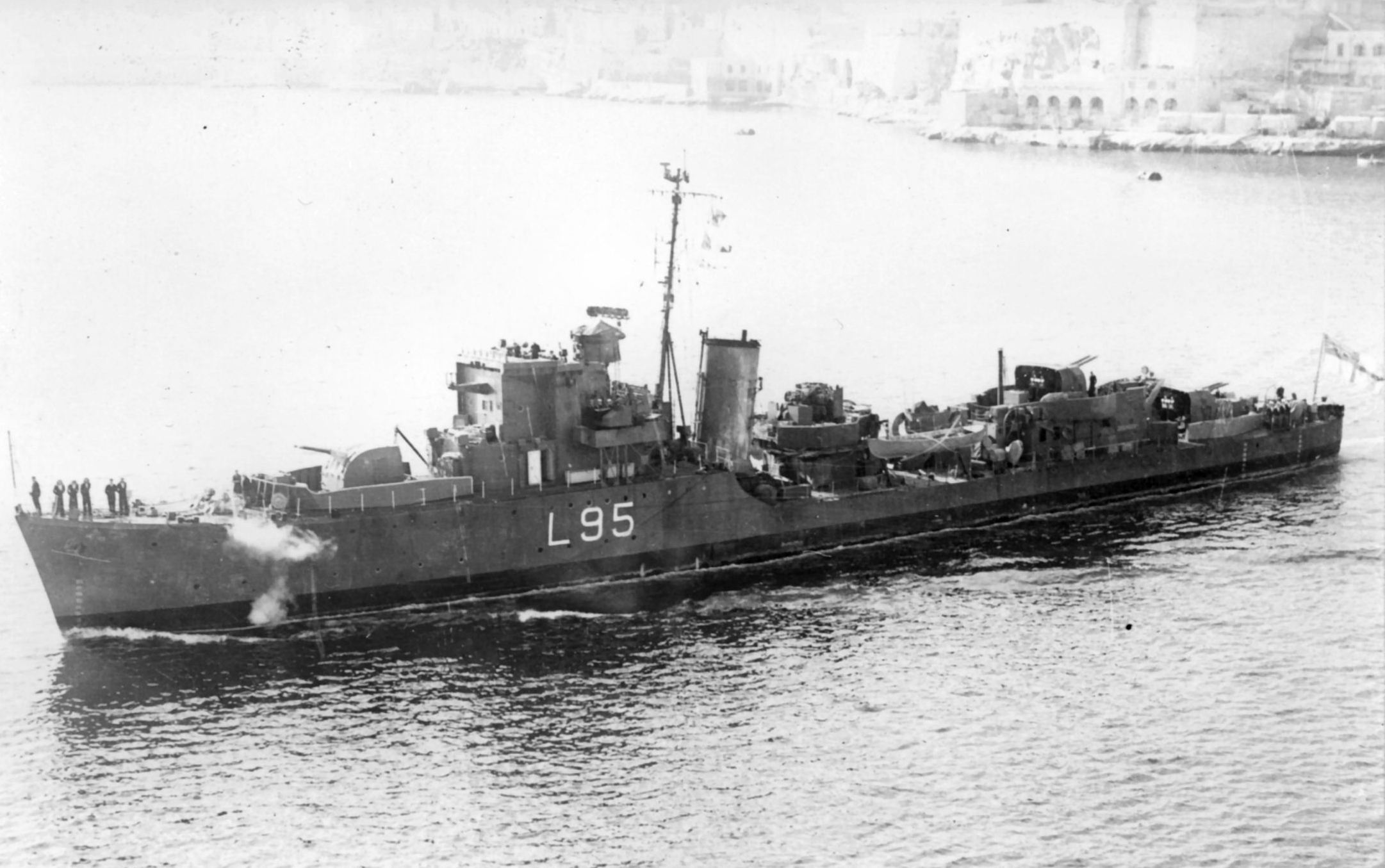
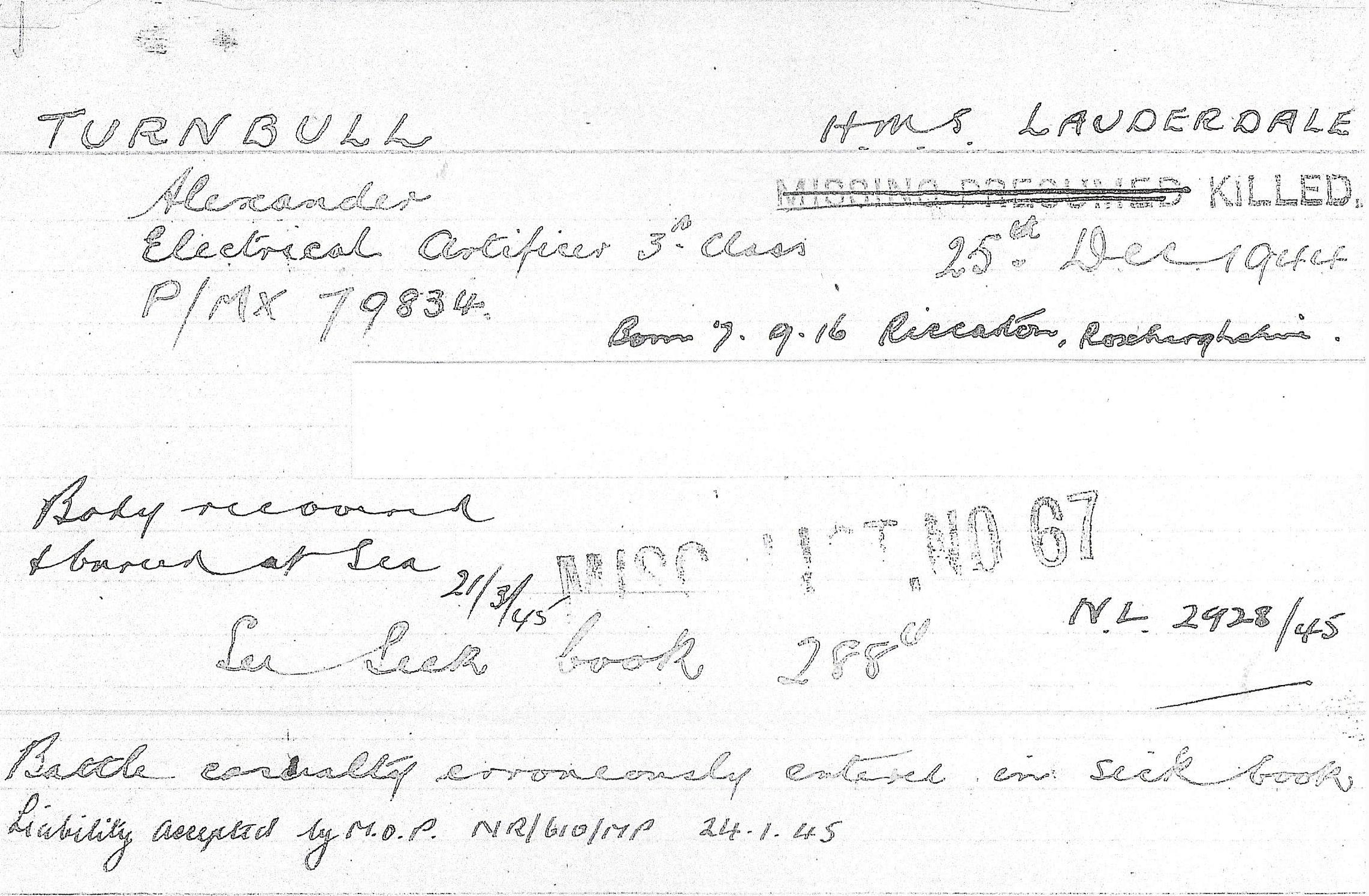
It is likely that one of these that struck the Lauderdale and caused his death on Christmas Day 1944. Perhaps another possibility is that he simply fell overboard. In the fog of war, he was initially reported as sick and only later as “missing presumed dead”. For Nettie, at home in Mugdock with their little daughter, it must have been an agonising wait. His death was not confirmed until his body was found three months later. He was buried at sea. Though his casualty card describes him as Electrical Artificer 3rd Class, it may not have been updated, as he is recorded on Strathblane War Memorial at a Chief Petty Officer. The card also has the wrong birthplace, confusing Riccarton Ayrshire (near his birthplace of Craigie), with the place of the same name in Roxburghshire.
Members of his family continued to live in this community, latterly in Ballewan Cresent, and whenever asked about the Turnbulls, neighbours would say simply that they were passionate about football. Alexander’s half-brother John died in 1980 and is buried in Strathblane.
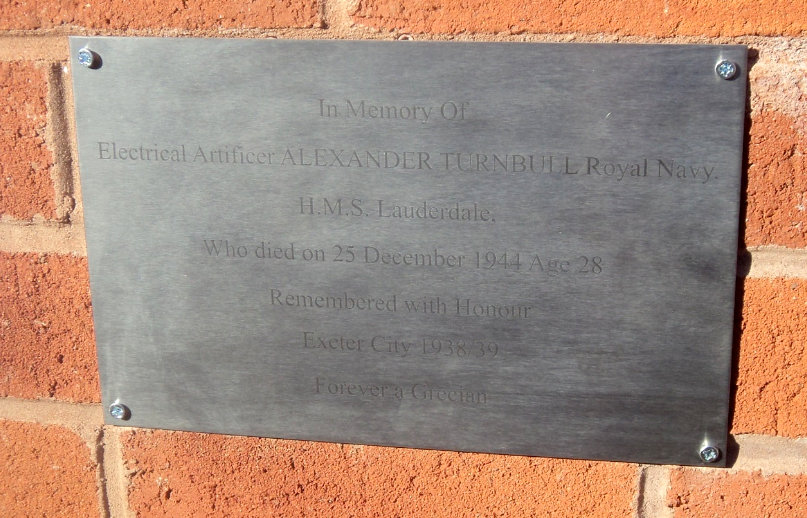
Alexander is remembered on both the Strathblane and Milngavie war memorials and the Portsmouth Naval Memorial. There is also a plaque in his memory at Exeter City’s ground, bearing the words “Forever a Grecian” (a reference to the club’s nickname). In view of the manner and location of his death, this seems sadly ironic. Nettie never re-married and died in Troon, Ayrshire, aged 56, in 1973. It is not currently known what happened to their daughter.