DISPLAY BOARD ① KIRK AND KIRKHOUSE
(This is a copy of the information on the Heritage Trail display board.)
STRATHBLANE PARISH CHURCH
The current church was designed by John Brash and built in 1803 of stone from the nearby Kirkland Quarry. But as long ago as 1216 Strathblane was already a parish. The first church was on or near this one. Mary, sister to King James I of Scotland and wife of local laird, Sir William Edmonstone of Duntreath, is buried beneath the church. She died around 1458. A mausoleum in the churchyard houses a number of other Edmonstone tombs.
After the Reformation the first Protestant service in Strathblane was held in 1560. Several of Strathblane’s Protestant ministers have burials in the south-east area of the churchyard. They include the imposing sandstone monument in memory of the Reverend Dr William Hamilton, who served from 1809 until 1835, an anti-slavery campaigner and passionate advocate for a congregation’s right to choose its own minister.
It is reported that as late as 1830, female worshippers often walked to church barefoot, carrying their shoes and stockings as far as the Kirk Burn and only putting them on to enter the building.
The church acquired its elegant pitched roof and much-admired stained glass windows in the 1870s. The current organ was installed in 1910. The cemetery was added in 1932. In 2024 Strathblane and Killearn became a linked parish, sharing a minister.

TRANSGRESSORS
Ministers took their role in maintaining law and order very seriously. Around 1650 the Reverend John Cochran spent 12 shillings “for hinging of the joggs at the Kirk doore”. This consisted of an iron collar chained to the wall. The neck of a transgressor would be inserted as a punishment and deterrent to others. He also invested in “ane harne gowne” [sackcloth robe] to be worn by adulterers.
In 1659 the Stirling Quarter Session ordered a writ to be pinned to the kirk door banning the payment of blackmail to Captain Macgregor [an ancestor of Rob Roy] , whose clan had been extracting money from Blane Valley landowners in exchange for defending their livestock against raiders.

KIRKHOUSE INN
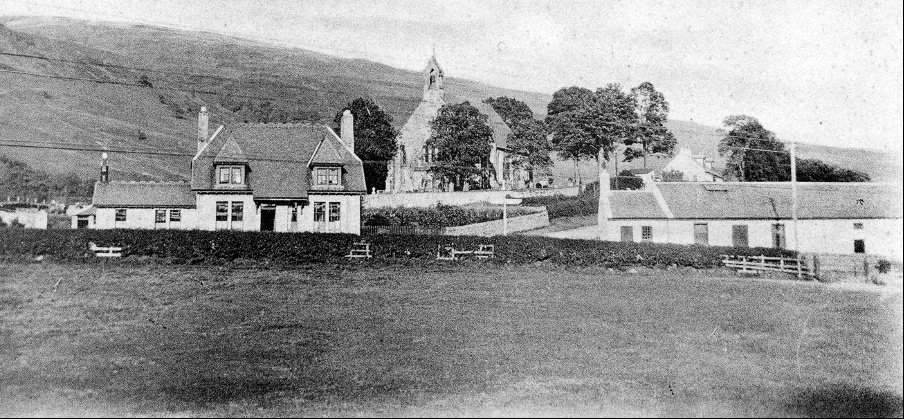
Kirk v Kirkhouse The Kirkhouse Inn is said to date from 1601 when permission was granted for a “tavern with tables”. However, until the second half of the 19th century, it was sited in a low cottage immediately outside the church gate, much to the extreme annoyance of various parish ministers. Feelings boiled over in 1774 when, following some unruly scenes at the inn, the Reverend Archibald Smith summoned the landlord to appear before the kirk session. The case ended up before the presbytery, where the publican was put under a sentence of “lesser excommunication”.
Animosity flared again with the rise of the Victorian temperance movement. By now the Buchanan family was running both the inn and Kirkhouse Farm on the opposite side of Campsie Road [now Station Lofts]
Comfortable Co-Existence Relations improved after the Kirkhouse Inn moved from the church gate to its current position on Glasgow Road, the site of a former toll house.
Dinners were served and the inn became the base for the organisation of horticultural shows and ploughing matches.
By 1900 Kirk and Kirkhouse had settled into a comfortable co-existence. For many years the inn was run by Peter Buchanan, a popular figure known as “the Three Ps”, on account of his three jobs: postman, pig man and publican!
In 1941 during the Clydebank Blitz, The Kirkhouse became a place of refuge for those fleeing from Blanefield to Strathblane after a German landmine fell on New City Row. In the 1960s a major extension on the site of the former single-storey toll house transformed the Kirkhouse into the building we know today.
James Stirling, who had been born in Strathblane and worked as a herd boy at Kirkhouse, took the pledge in 1832 and became the first agent of the Scottish Temperance League He later described spending his childhood witnessing local men “staggering, swearing and tumbling” into the road after a day’s drinking at the Kirkhouse, then a low-ceilinged room with a beaten earth floor.
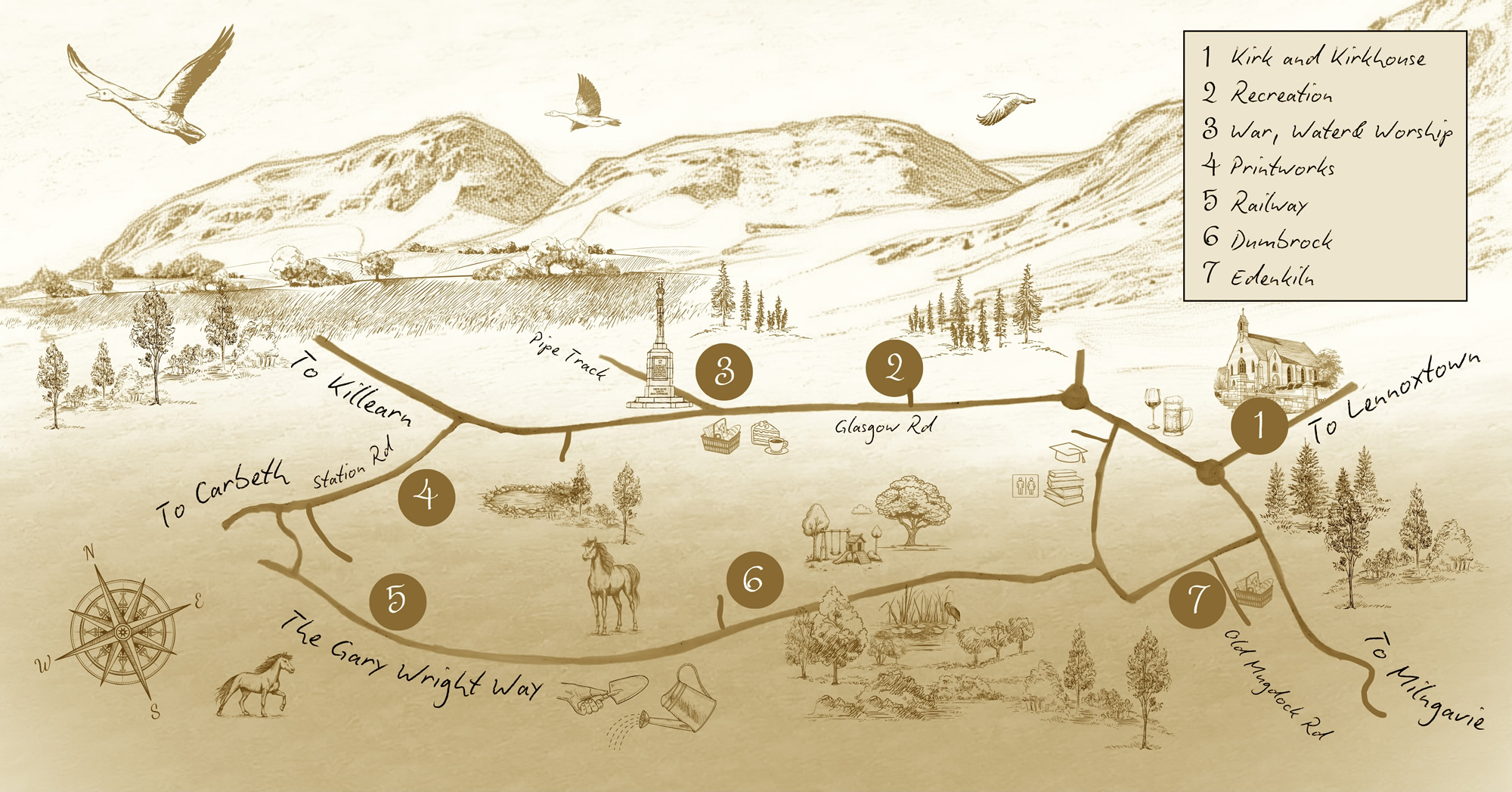
HERITAGE TRAIL MAP
FURTHER INFORMATION
The Kirkhouse Inn: The Kirkhouse Inn was established in 1601 although until Victorian times it stood immediately beside the gates of the parish church. On occasion this was a source of friction. In 1774 the landlord was in open rebellion against the minister and the kirk session. According to session records, one of his offences was that he appeared at a session meeting and threatened “to kick the kirk officer’s heels and trample him like dirt under his feet if he would but presume to go to his house and call his wife”. (His wife was being pursued over some alleged irregularity.) The session tried to “bring him to repentance” and bound him over to the presbytery. After a presbytery inquiry he was laid under the sentence of lesser excommunication “till he should repent and humble himself”. Seemingly, he never did.

The Kirkhouse has long been an important meeting place in the parish, especially after it was rebuilt on the main road in mid-Victorian times. Standing at the junction of two major roads, it was both a toll house and a staging post for horse-drawn carriages.

During the second night of the Clydebank Blitz in March 1941, it became a place of refuge for villagers, young patients from the Children’s Home Hospital and those fleeing from the German bombing in Clydebank. The bombing of Sunnyside in Blanefield resulted in villagers fleeing from Blanefield to Strathblane.
At a time when buying a drink on a Sunday was a major hurdle to be overcome, the Kirkhouse had the advantage of a seven-day licence. Anyone ordering a drink on the Sabbath needed to be a “bona fide traveller”, which involved travelling at least four miles and signing a book to say where they had come from. Some tall tales were told in its columns and the buses from Glasgow were extremely busy.
The Buchanan family were involved in running the Kirkhouse for at least 150 years until the 1960s. They also ran Kirkhouse Farm, which stood on the opposite corner of Campsie Road. Peter Buchanan was known as “the Three Ps” on account of his three jobs: postman, pig man and publican.

The Kirkhouse Inn has been considerably enlarged and has changed hands several times in recent years. It is the only remaining public licenced premises in the parish.