DISPLAY BOARD ③ WAR, WATER AND WORSHIP
(This is a copy of the information on the Heritage Trail display board.)
WAR
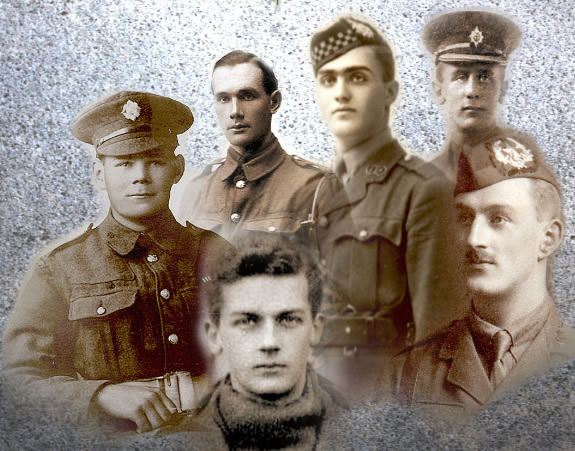
On 21 August 1921, in torrential rain, Strathblane War Memorialwas unveiled by the Duke of Montrose. After a service at the parishchurch, a large crowd led by a pipe band marched to the memorial.The chosen design was by Robert Lorimer and made of Doddington stone. The square base has panels on each side bearing the namesof 27 men with local connections who were killed in the First WorldWar and the inscription “SACRED TO THE MEMORY OF THOSE FROM THE PARISH OF STRATHBLANE WHO FELL IN THE GREATWAR”. A slender shaft rises from the base, topped by four shieldsand a cross. The cost of more than £800 was met entirely by public subscription.
Unlike on some other memorials, the dead, regardless of rank, are listed simply in alphabetical order The only exceptions are Lieutenant Philip Binnie and Private John Dillon, whose names appear to have been added later. So Lieutenant Willie Edmonstone, heir to the Duntreath Estate, appears between a coal merchant and the son of an accountant. First to fall was professional soldier Sergeant Donald McNeil, son of the local tailor, killed in the First Battle of Ypres in November 1914. The youngest was Private James Macintyre, the 19-year-old son of a tartan manufacturer, who died at the Somme. The sons of both the parish minister and the former village doctor also feature, along with clerks and gardeners.
In 1949 the names of six local men killed in the Second World War were inscribed on the base of the memorial. They include Dick Pedder, the Lieutenant Colonel who created and commanded Number 11 Scottish Commando. His daring raid behind enemy lines in Syria cost him his life and earned him a namecheck in Sir Winston Churchill’s account of the war.
The war memorial was completely dismantled and moved in the 1970s so that Central Regional Council could widen the junction at the bottom of Campsie Dene Road. On the wall beside the memorial there is now a plaque commemorating another local man, Gary Wright, the 22-year-old Royal Marines Commando, killed in action in Afghanistan in October 2006.
In 2014 local volunteers marked the centenary of the First World War by researching and writing the life and war stories of all 27 men on the memorial who perished in that conflict. The results formed the basis for the book, A Village Remembers. In 2025, to mark the 80th anniversary of the end of World War Two, the lives and war stories of the men who fell in that conflict were recorded in an exhibition and booklet. Both projects are available to read on www.strathblaneheritage.org.
WATER
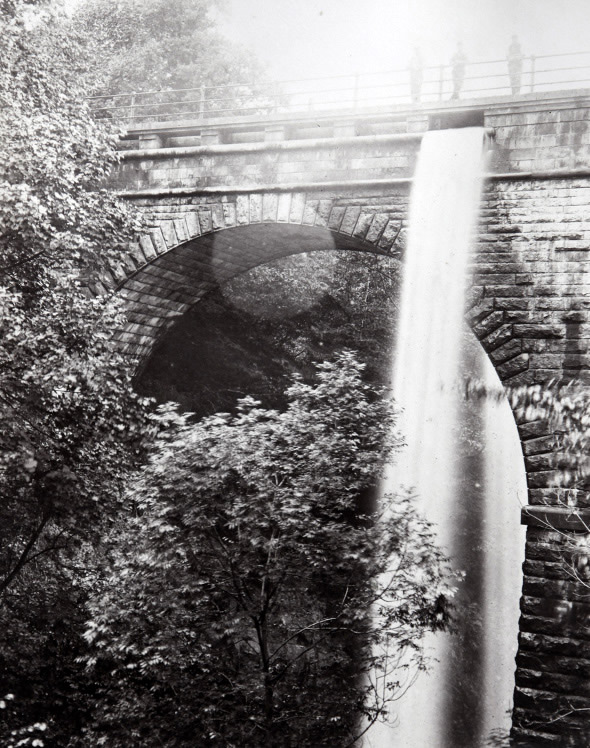
Until the mid-19th century this part of the parish was known as Netherton. Life was transformed in the 1850s by the arrival of squads of labourers to build the tunnels and aqueducts that carry the water supply from Loch Katrine to Glasgow. It passes under the main road near this point. The process was repeated in the 1890s when a second pipeline was deemed necessary, though Strathblane had to wait until the early 20th century before it too enjoyed the benefits of a reliable clean water supply. Of course, for the people of Glasgow this remarkable feat of engineering transformed public health.
WORSHIP
Accommodating the Loch Katrine pipeline’s workforce was a challenge and there were reports of drunken disorder. However, some of the navvies, many of whom were Irish, preferred to spend their free time building St Kessog’s Roman Catholic Church, which opened for worship on 28 May 1893. The cost was around £1,200.
The stained-glass window in the porch was donated in memory of the chapel’s first priest, Father John Foley, who came from Kerry. It depicts St Kessog , who is thought to originate from the royal family of Munster before coming to Scotland. He was widely venerated in medieval times and the troops under Robert the Bruce used “Blessed Kessog” as a battle cry. He was considered the patron saint of Scotland until St Andrew was adopted in the 14th century.

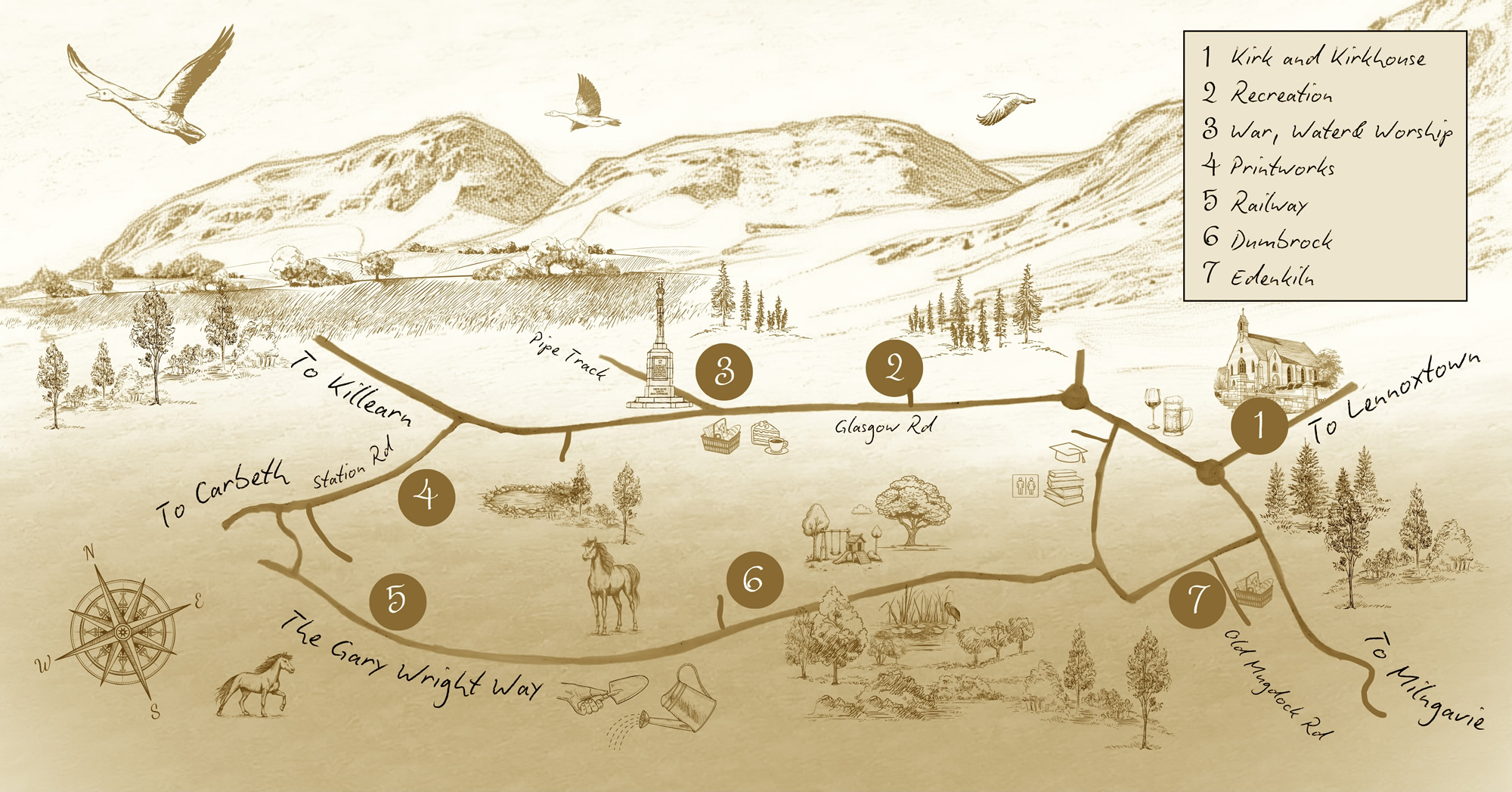
HERITAGE TRAIL MAP
FURTHER INFORMATION
War:
NOTE THAT BETWEEN BOARDS 3 & 4 ARE SEVERAL BUILDINGS OF INTEREST (all on the same side of the road as the war memorial):
- The Former United Free Church (now a private house)
- The Smithy
- The Old School