DISPLAY BOARD ④ THE PRINTWORKS
(This is a copy of the information on the Heritage Trail display board.)

INDUSTRIAL REVOLUTION
By 1800 throughout Britain new technologies were sparking a revolution that reached deep into the countryside. Pre-industrial Strathblane was a predominantly agricultural community with a small population scattered throughout the parish.
That began to change after 1797 when Walter Weir established a block printing business on this site, which had previously held a small “inkle” (linen tape) factory.
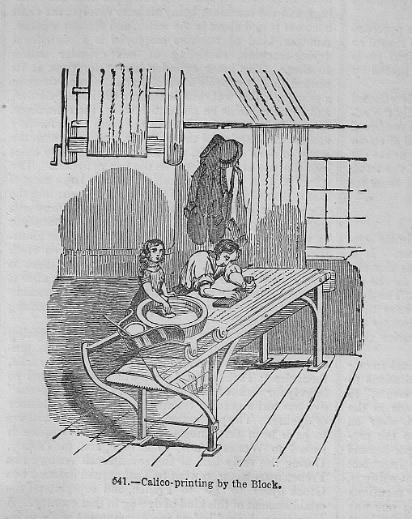
Children as young as eight were central to the operation of the printworks. They worked mainly as “tearers”, who applied colour to the pad on which the printer’s block was pressed.
The technique of printing patterns on fabric using carved wooden blocks had arrived in Scotland in the late 17th century but was largely a cottage industry. The Blanefield printworks went through several owners and cylinders gradually replaced blocks. Despite fears that this would lead to unemployment, the workforce here continued to grow.
By 1851 Anthony Park Coubrough and his family were the sole proprietors of the Blanefield Printworks. They were employing around 500 men, women and children by 1856. At its height, the works were producing 500,000 pieces of cloth per year.
GRAND DESIGNS
The Blanefield Printworks registered dozens of their own designs with the Board of Trade. Here are some examples. Do you recognise number 3149? It is the motif chosen by Strathblane Heritage for its logo!

KEY DATES:
- 1864 The printworks boiler exploded and seven people were killed including three children aged 16, 15 and 12.
- 1867 The opening of the Blane Valley Railway meant coal and goods no longer had to be carted in and out. A siding was constructed directly into the works.
- 1869 Mr Coubrough told a government inquiry into employment in printworks that he now employed between 250 and 300 people, including 50 children. The working day was 6am to 6pm with two meal breaks, plus overtime when the works were busy. He objected to the idea of sending children to school more than twice a week for four hours because this would delay production.
- 1875 Fire broke out in the finishing house and the entire works were destroyed. The damage was estimated at between £40,000 and £60,000. The works were rebuilt.
- 1876 The reopening of the works was delayed by a pollution case brought by local landowners, including Sir William Edmonstone of Duntreath, who claimed that the dyes and other chemicals discharged by the Blanefield Printing Company were seriously polluting the Blane Burn. Settling ponds built downstream of the works were an attempt to tackle this.
- 1898 A syndicate of calico printers bought the printworks but in the face of a famine in India and the consolidation of the industry around Manchester, the Blanefield works were finally closed in November 1898. As a result the population of the parish fell dramatically. By 1901 it had sunk to 880. It had been 1,671 a decade earlier.
HOMES SWEET HOMES?
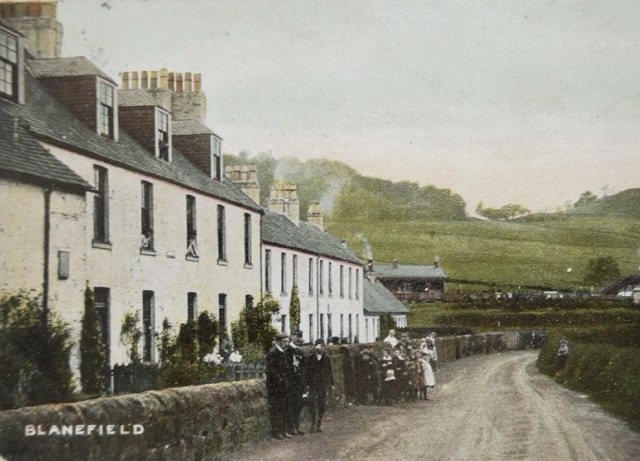
The vintage postcard below shows Burnside Row on Station Road with Blanefield Station in the background. These tenements were known locally (ironically perhaps) as The Palace. Many of the printworkers were housed here in unimaginably cramped conditions. For instance in the 1891 Census, the McQuade family shared a room and kitchen with not only four children, aged one to 12, but also three boarders. Meanwhile, the Coubroughs owned Blanefield House. In the 1901 Census it had 25 rooms!
Many other printworkers were crammed into the whitewashed terraces around Wood Place on the main road, which still stand. Burnside Row was replaced by modern housing in the 1960s, while Blanefield House was demolished to make way for the Netherblane flats. Blane Avenue and Blane Crescent now occupy the land once covered by the printworks. The former drying room (now a private house) is the only part of the printworks to have survived.
LANGUID & LIFELESS
The Reverend William Hamilton was minister of Strathblane from 1809 until his death in 1835. He was a passionate opponent of child labour. In his memoir, he complains: “Boys and girls are employed at the bleachfield and printfield at the age of eight and nine years. Their wages are two shillings a week… When sleepy and worn out with the labours of the day, the little creatures are sometimes sent to an evening class. But they often fall fast asleep, and even if they can be kept awake, are so languid and lifeless that they can learn nothing.”
WERE THE COUBROUGHS GOOD EMPLOYERS?

The Coubroughs regarded themselves as good employers. Once a year staff were treated to an excursion. In 1880 the Coubroughs donated the first bowling green in the parish. And, despite Anthony Coubrough’s objections in 1869 to his child workers attending school, his family members were later involved in the school board, as well as the parish council and administering the Poor Law.
The printworks had its own store and employees were expected to shop there. Anyone late for work three days in a row was fined a farthing.
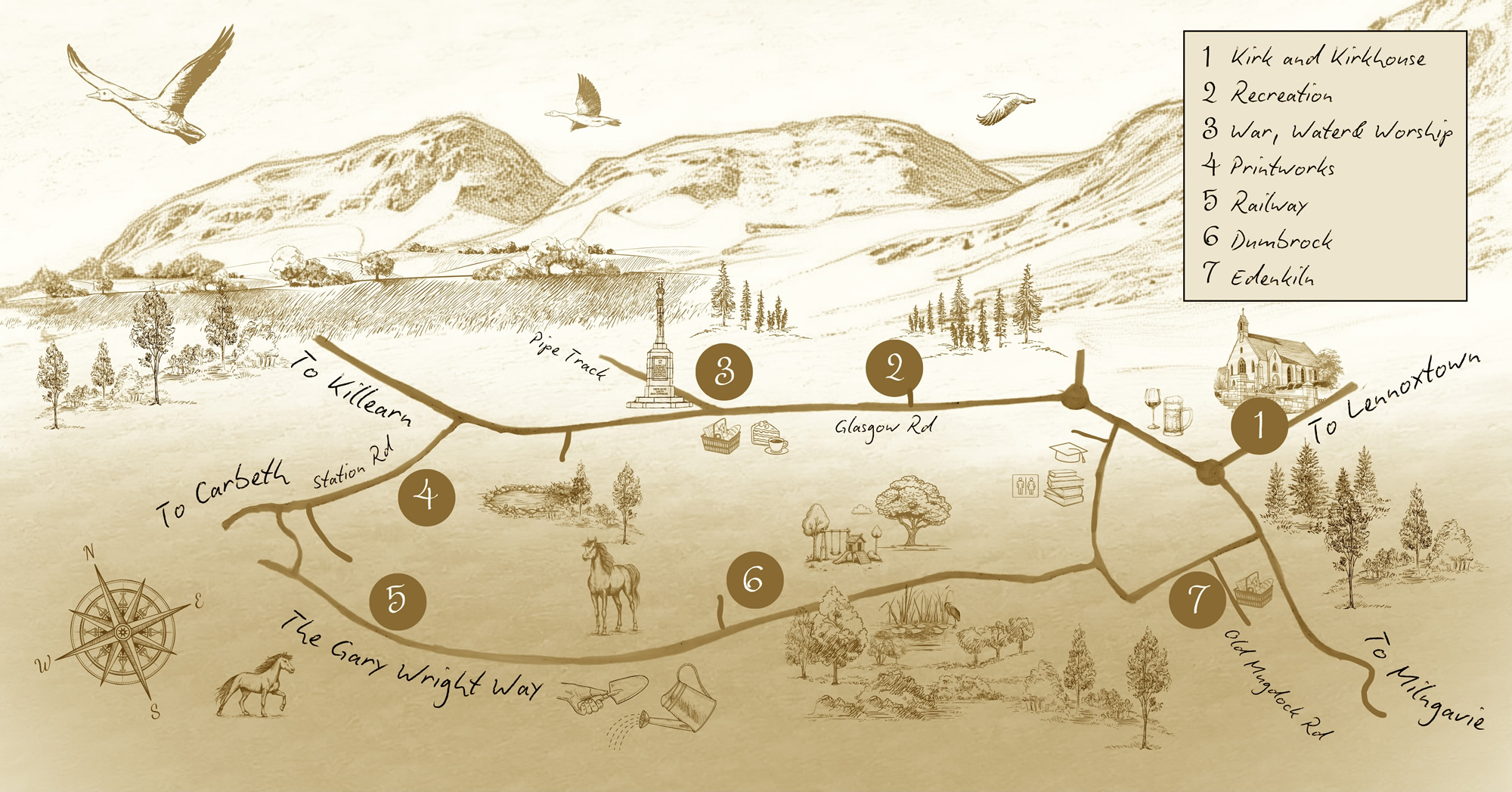
HERITAGE TRAIL MAP